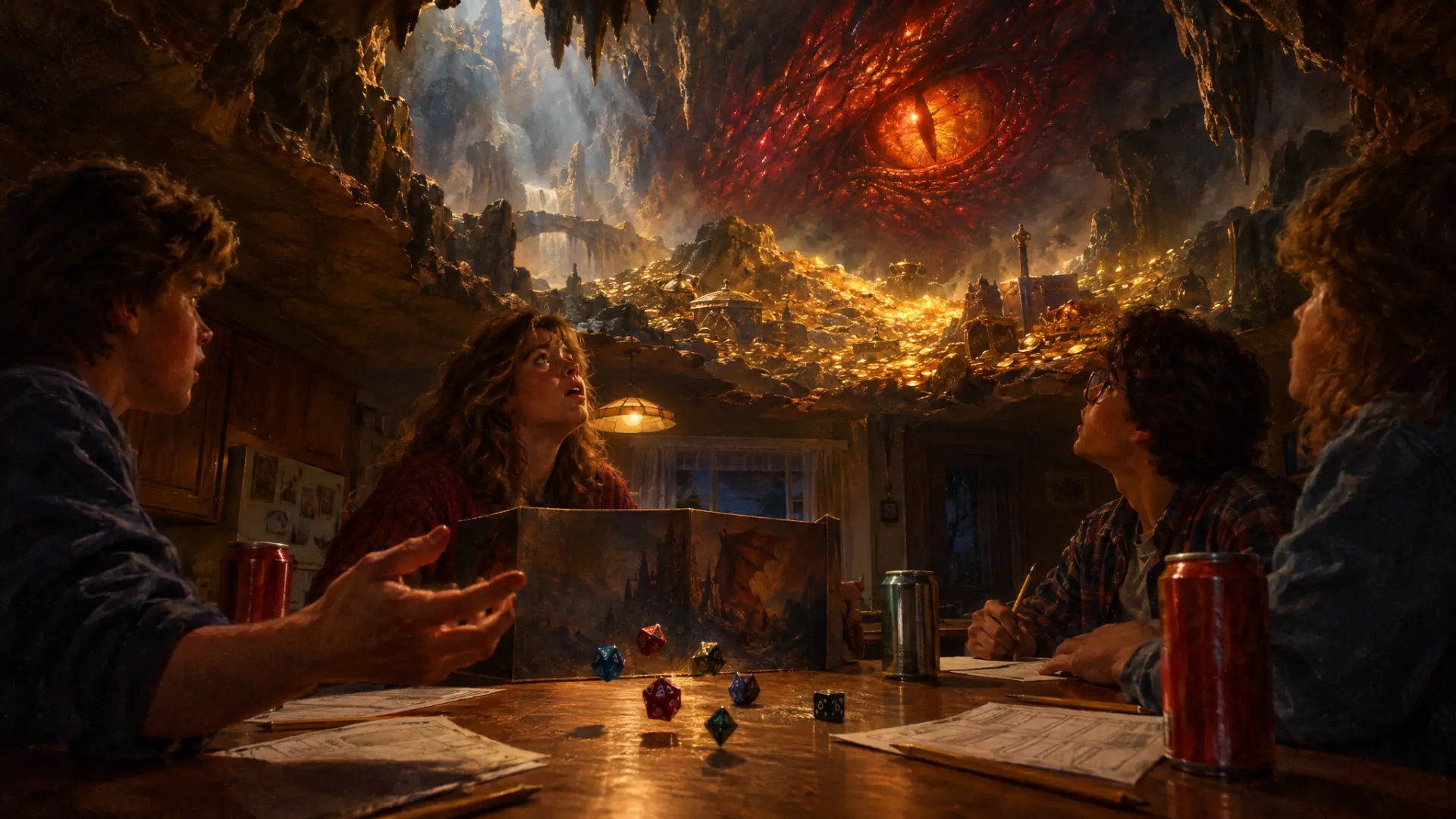
Hickman pioneered story-driven adventure design at TSR. Ravenloft gave D&D its first great villain with a personality, and Dragonlance joined game modules and novels into a single epic, a model for shared-world tie-in fiction and for narrative campaigns ever since.
Life
Tracy Hickman was born on November 26, 1955, in Salt Lake City, Utah. A devout member of the Church of Jesus Christ of Latter-day Saints, he served a mission in Indonesia from 1975 to 1977, and in 1977 he married Laura Curtis. The couple have four children and have collaborated on games for more than three decades.
In the early 1980s the young family was struggling financially. The Hickmans had written and self-published two D&D adventures, and selling them to TSR, Inc. led to a job there. He moved to Lake Geneva, Wisconsin, in 1982 and spent the next several years as one of TSR's most influential designers. He has since written or co-written more than 60 books.
Work
Hickman arrived with a distinctive idea of what an adventure could be: not just a map of rooms and monsters, but a story with a beginning, middle and end, carried by characters with motives. His and Laura's early self-published modules, Rahasia and Pharaoh, already showed this, and TSR later republished them.
The clearest early expression was Ravenloft (1983), designed by Tracy and Laura Hickman, which grew out of a Halloween game they had run for friends. Its villain, Count Strahd von Zarovich, was a Vampire with a tragic backstory and his own agenda, who stalked the players through his castle rather than waiting in a room to be killed. A fortune-telling reading at the start randomized the locations of key items and Strahd's goals, so that no two sessions played alike. Its three-dimensional isometric maps of Castle Ravenloft were admired too. The module later grew into an entire gothic-horror campaign setting.
His most ambitious project was Dragonlance. Conceived by Hickman and developed by a team at TSR that included artist Larry Elmore, editor Harold Johnson and Margaret Weis, it was planned from the start as a multimedia saga: a series of linked adventure modules for AD&D, beginning with Dragons of Despair (1984), telling one continuous story on the world of Krynn, together with a trilogy of novels retelling that story. Weis and Hickman ended up writing the novels themselves. Dragons of Autumn Twilight (1984), Dragons of Winter Night and Dragons of Spring Dawning (both 1985) became bestsellers, followed by the Legends trilogy (1986). By 1987 the line had reportedly sold two million books and half a million modules.
Weis and Hickman became one of fantasy's most productive partnerships. After leaving TSR they wrote the Darksword trilogy for Bantam, the seven-volume Death Gate Cycle, the Rose of the Prophet series and many more, over 30 novels together, and returned repeatedly to Dragonlance. In October 2020 they sued Wizards of the Coast for breach of contract over a new Dragonlance trilogy; they withdrew the suit that December, and the Dragonlance Destinies novels, beginning with Dragons of Deceit, appeared in 2022.
Legacy
Hickman's influence runs in two directions. In game design he was a leading advocate of narrative adventures, in which a module tells a planned story: a model admired for its drama and debated for how much it steers players, and a precursor both of the story-driven campaigns of later D&D and of the plotted quests of computer RPGs. Strahd remains one of D&D's defining villains, revisited in Curse of Strahd for the fifth edition.
In publishing, Dragonlance proved that game worlds could sustain bestselling fiction. It helped open the way for TSR's other novel lines, including the Forgotten Realms books and R. A. Salvatore's Drizzt novels, and for the whole genre of shared-world and tie-in fantasy that followed. He was inducted into the Origins Hall of Fame in 2002.
Marginalia
- Hickman was born on November 26, 1955, in Salt Lake City, and served a church mission in Indonesia before marrying Laura Curtis in 1977.
- Before joining TSR, Inc. he and Laura self-published the adventures Rahasia and Pharaoh.
- He and Laura designed I6 Ravenloft (1983), featuring the Vampire Count Strahd von Zarovich, originally as a Halloween game for friends.
- By 1987 Dragonlance had reportedly sold two million books and half a million adventure modules.
- With Margaret Weis he has co-written more than 30 novels, including the Darksword trilogy and the Death Gate Cycle.
- In October 2020 he and Weis sued Wizards of the Coast over a new Dragonlance trilogy, dropping the suit that December; the books appeared in 2022.
Quick answers
- Who is Tracy Hickman?
- The Utah designer who co-wrote the gothic D&D module Ravenloft with his wife Laura and, with Margaret Weis, turned Dragonlance into a bestselling saga of novels and adventures.
- When was Tracy Hickman born?
- Tracy Hickman was born in 1955 in Salt Lake City, Utah.
- What is Tracy Hickman known for?
- Tracy Hickman is best known for Ravenloft, Dragonlance and Dragonlance Chronicles.
- Why does Tracy Hickman matter to fantasy and games?
- Hickman pioneered story-driven adventure design at TSR. Ravenloft gave D&D its first great villain with a personality, and Dragonlance joined game modules and novels into a single epic, a model for shared-world tie-in fiction and for narrative campaigns ever since.