Elmore's paintings defined the visual identity of D&D during its mass-market peak, and his concept art for Dragonlance helped sell a new kind of story-driven product line to TSR itself.
Life
Larry Elmore was born on August 5, 1948, in Louisville, Kentucky, and grew up in rural Grayson County. His school had no art program, so he drew in class and got in trouble for it; he later joked that he wished he had a quarter for every drawing a teacher destroyed. He majored in art at Western Kentucky University, married his wife Betty in 1971, and a month after graduating was drafted into the U.S. Army and stationed in Germany. Back home, he spent about three years as an illustrator for the federal government in the Training Aids Department at Fort Knox before going freelance, selling work to National Lampoon and Heavy Metal.
A fellow government illustrator introduced him to Dungeons & Dragons. That chance encounter led him to Lake Geneva, Wisconsin, where in November 1981 he joined TSR, Inc., by some accounts as its first professional illustrator, at the moment the company was turning from a hobby publisher into a mass-market phenomenon. He lives in Leitchfield, Kentucky, and remains a regular guest at fantasy and gaming conventions in the United States and Europe.
Work
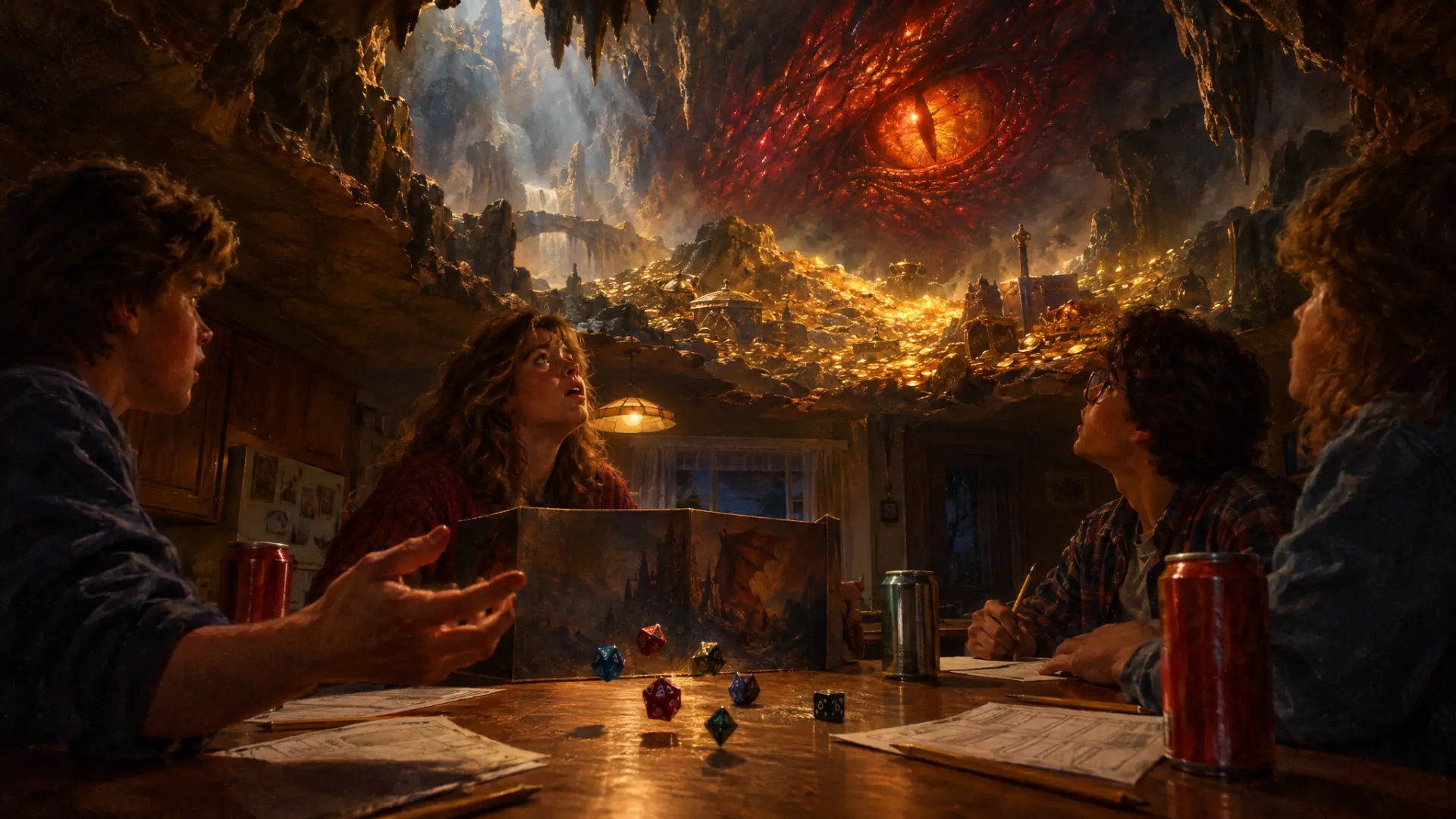
At TSR, Elmore painted covers and interiors for adventure modules, rulebooks, calendars, posters, and novels. Among his best-known images is the cover of the 1983 D&D Basic Set edited by Frank Mentzer, the famous "Red Box": a lone warrior squaring off against a vast red Dragon over a hoard of treasure. For a generation of new players, that painting was the first picture of what the game promised. He also created SnarfQuest, a comic strip that ran in Dragon and became one of the magazine's most beloved features.
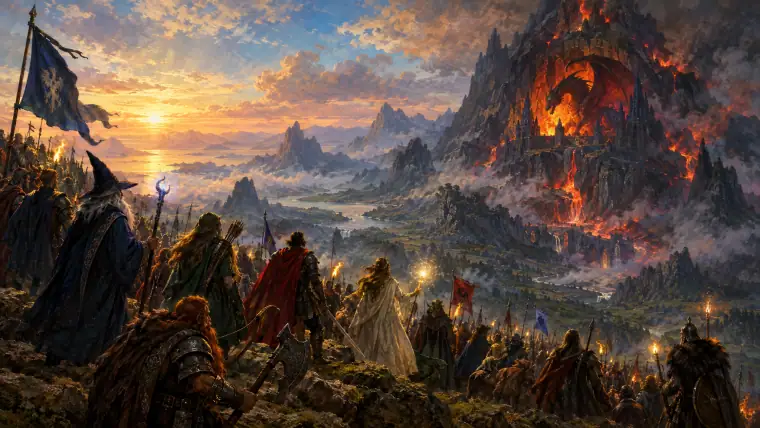
His most consequential work was on Dragonlance. During the development phase known internally as "Project Overlord," Elmore painted the concept art that Tracy Hickman, Margaret Weis, and their colleagues used to sell the idea of a linked series of modules and novels to TSR's upper management. He was charged with creating the look of the whole saga and drew many of the early character sketches, and his first cover for the line was Dragons of Autumn Twilight (1984), the opening novel of the Dragonlance Chronicles. His images of the saga's heroes, and his many dragons, fixed how readers pictured the setting. The British designer Graeme Davis remarked that Elmore should get an award "for drawing so many dragons and making them all different."
Elmore left TSR in 1987 but kept painting for the games industry. His cover for FASA's Shadowrun (1989) proved so popular that it was reused for the second edition and for a video game adaptation. He painted cards for Magic: The Gathering, box art for the MMORPG EverQuest, and black-and-white interiors for a 1996 edition of the science-fiction RPG Traveller. In 1996 he wrote the novel Runes of Autumn, reportedly with his cousin Robert. In the late 1990s Weis and Hickman built their Sovereign Stone trilogy on Elmore's own world of Loerem, and he supplied the art for the Sovereign Stone game system in 1999. In the early 2000s he revived SnarfQuest for the magazine Games Unplugged.
He scaled back in 2006, taking only contract work, after the death of his friend and former studio-mate Keith Parkinson, another TSR painter; the two had talked for years about doing their own work at fifty, and Parkinson did not live to do so. Elmore published the retrospective 20 Years of Elmore in 2005, and in 2013 funded a 336-page hardcover collection of his forty-year career on Kickstarter.
Legacy
If Frazetta gave fantasy its barbarian and the Hildebrandts its storybook Middle-earth, Elmore gave the roleplaying game its heroes. His paintings are clean, bright, and legible, with armored adventurers who look like people you might play: a style suited to box covers seen from across a toy store. Together with TSR colleagues such as Jeff Easley, Clyde Caldwell, and Parkinson, he defined the look of D&D and its novels through the Tabletop Golden Age & the Satanic Panic, and in the decade when TSR's worlds also reached computer screens through licensed games such as Pool of Radiance, that house style was the public face of the brand.
His career also illustrates how fantasy art began to cross media. An artist hired to paint module covers ended up concept-designing a multimedia franchise, painting the face of an MMORPG, and seeing his creations fill game books, novels, cards, and screens. In 2014 Black Gate ranked him first among the RPG artists of the preceding four decades, crediting him with helping to "define a good portion of 1980s TSR." For many players, his Red Box dragon is still the image that means "Dungeons & Dragons."
Marginalia
- Elmore joined TSR in November 1981, often described as its first professional illustrator, after years as a U.S. government illustrator at Fort Knox.
- His concept paintings for 'Project Overlord' were used to pitch Dragonlance to TSR's management.
- He painted the cover of the first Dragonlance novel, Dragons of Autumn Twilight (1984).
- His comic SnarfQuest ran in Dragon magazine.
- Designer Graeme Davis joked that Elmore deserved an award for drawing so many dragons and making them all different.
- His cover for FASA's Shadowrun was so popular it was reused for the second edition and a video game.
- In 2014 Black Gate named him No. 1 among the top RPG artists of the previous 40 years.
Quick answers
- Who is Larry Elmore?
- The Kentucky painter who joined TSR in 1981 and gave 1980s Dungeons & Dragons its heroic face: the Red Box dragon, the Dragonlance companions, and a thousand distinct wyrms.
- When was Larry Elmore born?
- Larry Elmore was born in 1948 in Louisville, Kentucky.
- What is Larry Elmore known for?
- Larry Elmore is best known for Dungeons & Dragons Basic Set, Dragonlance, Dragonlance Chronicles and Shadowrun.
- Why does Larry Elmore matter to fantasy and games?
- Elmore's paintings defined the visual identity of D&D during its mass-market peak, and his concept art for Dragonlance helped sell a new kind of story-driven product line to TSR itself.