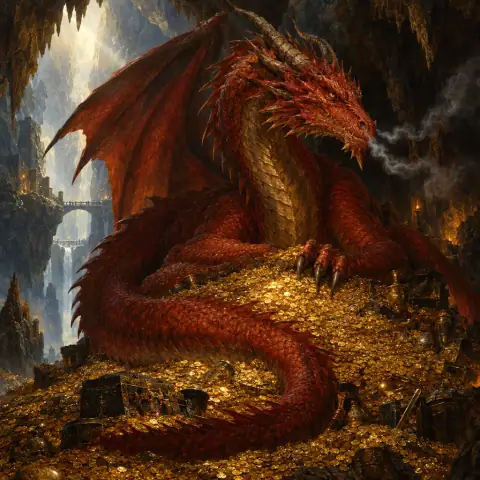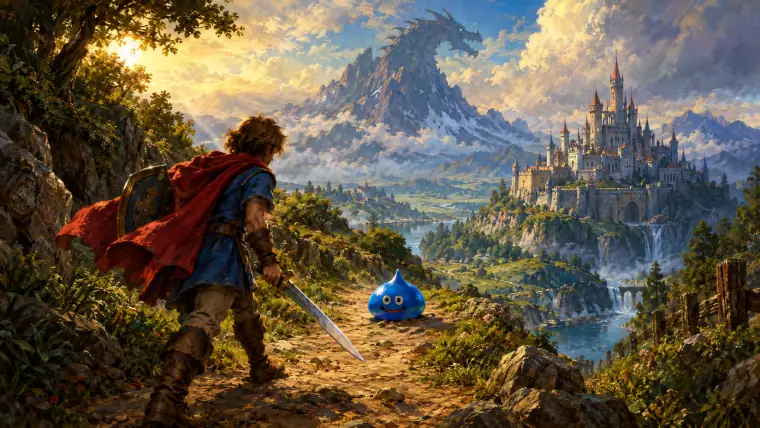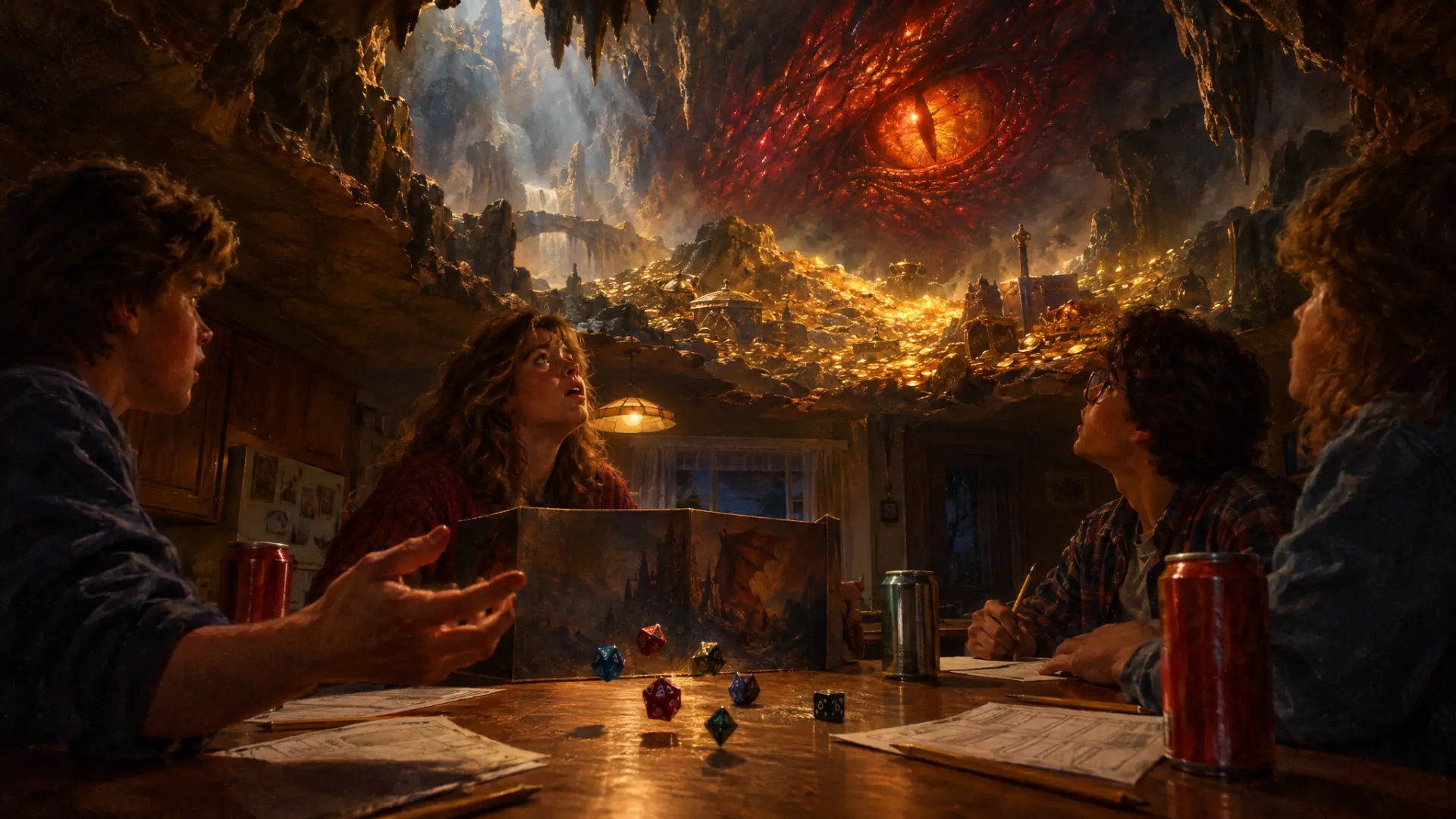
Dragonlance Chronicles is the founding text of game tie-in fiction: a story written alongside a series of AD&D modules that outsold expectations so thoroughly that TSR built a book division around it.
Overview
Before Dragonlance, novels based on games barely existed as a category. After it, they filled whole aisles. Dragons of Autumn Twilight (November 1984), Dragons of Winter Night (July 1985) and Dragons of Spring Dawning (September 1985) — the Dragonlance Chronicles by Margaret Weis and Tracy Hickman — told the story of a group of adventurers that readers could also play, module by module, at their own tables. It is the moment the traffic between fantasy books and roleplaying games became a two-lane highway.
Origins
The idea came from Tracy Hickman and his wife Laura, who, while driving to Wisconsin in 1982 for Tracy's job interview at TSR, sketched out two ambitions: an entire world built to support a single storyline, and a world dominated by dragons, which Dungeons & Dragons had so far used mostly as monsters in a list. At TSR, Hickman developed the concept into a twelve-part saga of adventure modules for AD&D, starting with DL1 Dragons of Despair in March 1984. A team including Harold Johnson, Jeff Grubb and the painter Larry Elmore gave the setting of Krynn its look and history.
The novels were meant to publicize the modules. TSR hired Margaret Weis as a book editor and assigned her to the project; when the outside writer's pages disappointed, Weis and Hickman wrote the book themselves. For the first novel they followed the modules closely, which made the story feel episodic, so for the later books they reportedly reversed the order, finishing the novels before the related modules. TSR, skeptical that a game company could sell fiction, reportedly ordered only a minimum first printing of 50,000 copies of Dragons of Autumn Twilight. It needed more printings.
The story
Krynn's gods have been absent for three centuries since the Cataclysm, and the true dragons are thought to be legends. Old friends reunite at the Inn of the Last Home in the treetop town of Solace: the half-elf Tanis, the knight Sturm Brightblade, the dwarf Flint Fireforge, the kender Tasslehoff Burrfoot, the twin brothers Caramon and Raistlin Majere, and the barbarian lovers Goldmoon and Riverwind, who carry a blue crystal staff of true healing. The staff is evidence that the gods have returned — including the Queen of Darkness, Takhisis, whose Dragonarmies are sweeping across the continent.
Readers could feel the dice underneath. The companions are a balanced adventuring The party of classes: fighter, cleric, thief, mage, ranger. But the novels outgrew their source. The frail, sardonic wizard Raistlin, with his hourglass eyes and ruinous ambition, became one of the most popular characters in fantasy, and his story continued in the Legends trilogy (1986).
Reception & impact
The Chronicles became bestsellers and established TSR as a major fiction publisher. Their success created the template for Shared-World & Tie-In Fiction tied to game settings: TSR soon did the same for the Forgotten Realms, giving R. A. Salvatore the assignment that became The Icewind Dale Trilogy.
Games came back from the books. Strategic Simulations' Heroes of the Lance (1988) was based on both the first module and the first novel. SSI then set three of its Gold Box computer RPGs on Krynn — Champions of Krynn (1990), Death Knights of Krynn (1991) and The Dark Queen of Krynn (1992) — using the engine introduced by Pool of Radiance. An animated film of Dragons of Autumn Twilight, with Kiefer Sutherland and Michelle Trachtenberg, followed in 2008.
Legacy
Weis and Hickman returned to Krynn many times, not always smoothly: in 2020 they sued Wizards of the Coast over a cancelled trilogy, then dropped the case. The Dragonlance Destinies trilogy followed — Dragons of Deceit (2022), Dragons of Fate (2023) and Dragons of Eternity (August 2024) — alongside the fifth-edition adventure Shadow of the Dragon Queen (2022). A new novel, Dragonlance: War Wizard, about the wizard Magius and the knight Huma, appeared on August 4, 2026.
The larger legacy is structural. Every novel line built on a game — Forgotten Realms, Warhammer, Warcraft, Magic: The Gathering — descends from the decision to let a party of adventurers step off the game table and into a bestseller.
Marginalia
- Tracy and Laura Hickman conceived Dragonlance while driving to Wisconsin for Tracy's TSR job interview.
- TSR reportedly ordered only a minimum first printing of 50,000 copies of Dragons of Autumn Twilight, doubting a game company's novel would sell; it required more printings.
- Margaret Weis was hired at TSR as a book editor and was assigned to the project before becoming Hickman's co-author.
- After the first book, Weis and Hickman reportedly reversed the process, finishing the novels before the related modules were written.
- SSI's Heroes of the Lance (1988) adapted the first module and the first novel; the Gold Box Champions of Krynn followed in 1990.
- Weis and Hickman were still writing Krynn in 2026: Dragonlance: War Wizard, about Magius and Huma, appeared in August 2026.
Quick answers
- When was Dragonlance Chronicles first published?
- Dragonlance Chronicles was first published in 1984–85.
- Who created Dragonlance Chronicles?
- Dragonlance Chronicles was made by Margaret Weis (co-author), Tracy Hickman (co-author; creator of the Dragonlance storyline) and Larry Elmore (cover and setting art).
- Who published or developed Dragonlance Chronicles?
- TSR, Inc..
- What kind of work is Dragonlance Chronicles?
- Dragonlance Chronicles is a book series in the Shared-World & Tie-In Fiction and High / Epic Fantasy tradition.
- Why is Dragonlance Chronicles important?
- Dragonlance Chronicles is the founding text of game tie-in fiction: a story written alongside a series of AD&D modules that outsold expectations so thoroughly that TSR built a book division around it.