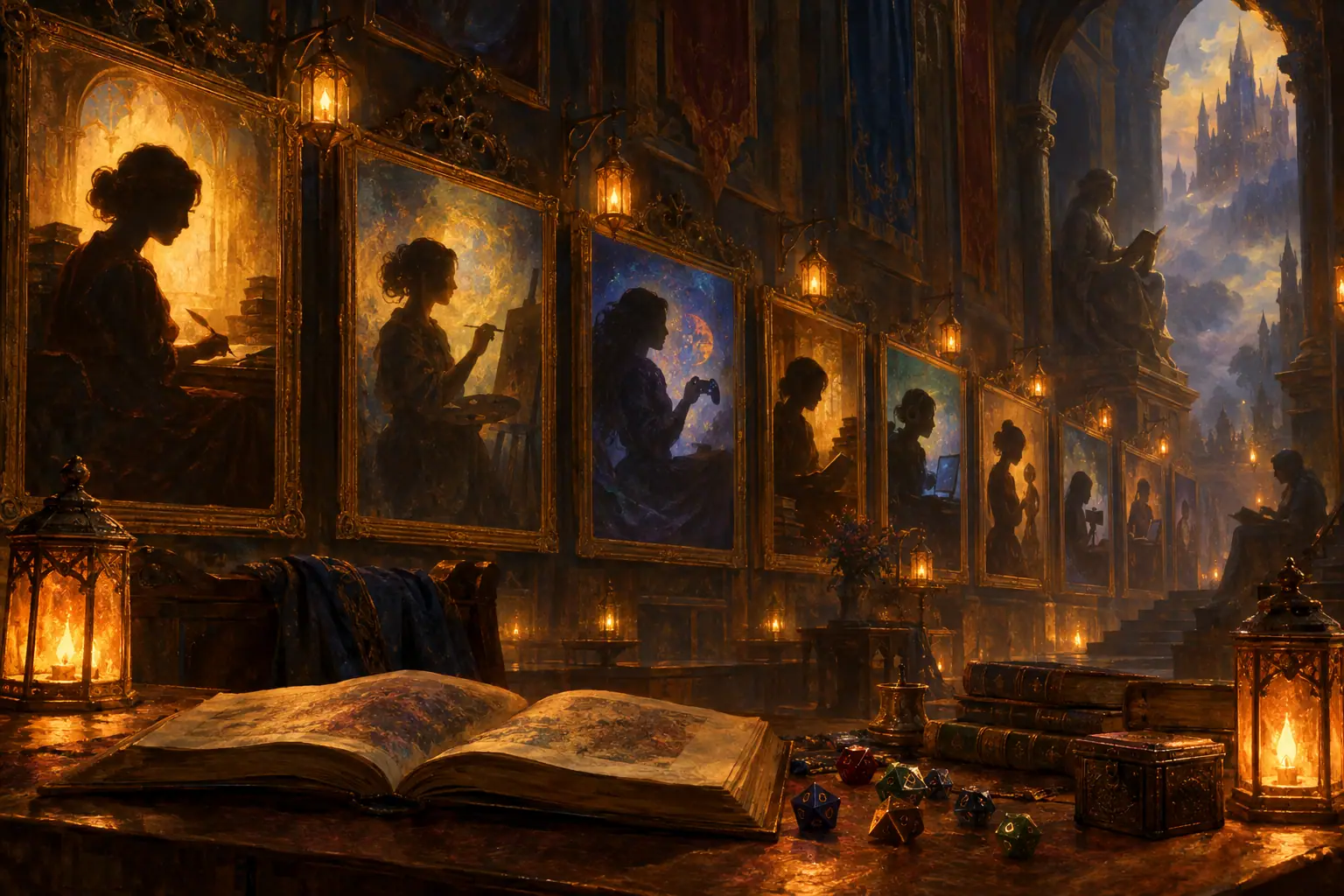
The Women Who Built Fantasy & RPGs
Writers, designers, programmers and publishers the histories often skip
Fantasy has always had women at its center, even when its histories did not. Their names were sometimes hidden behind initials and pen names, their games shipped under company names, and their work too often went uncredited. This tour brings some of them together.
The first stops are writers. C. L. Moore published sword and sorcery in Weird Tales in the 1930s. In the 1960s, Susan Cooper, Anne McCaffrey and Ursula K. Le Guin wrote The Dark Is Rising, Dragonriders of Pern and Earthsea, books that shaped how later fantasy handled myth, dragons and magic.
The next stops belong to games. The tabletop hobby of the 1970s was mostly male, but Jennell Jaquays and Jean Wells designed, edited and wrote some of its most important early material. Margaret Weis co-created Dragonlance's novels, and Lorraine Williams ran TSR, Inc. for more than a decade. In computers, Roberta Williams helped found Sierra On-Line and designed King's Quest, Rieko Kodama shaped Phantasy Star at Sega, and Rebecca Heineman co-founded Interplay Productions and designed the third Bard's Tale.
The last stops return to books. Robin Hobb, J. K. Rowling, Susanna Clarke, Sarah J. Maas and Rebecca Yarros have written some of the most widely read and admired fantasy of the past three decades, and the rise of Romantasy shows the genre's readership, and much of its authorship, shifting decisively.
Taken together, the stops also show how often women worked across media. Jaquays moved from fanzines to tabletop modules to video games, Weis from editing to novels to publishing her own games, and Heineman from competitive play to programming, design and company-building.
The tour is necessarily incomplete. Many more women worked as editors, artists, playtesters, producers and players, often with little credit. Let these fourteen stops stand for them, and follow the links at each exhibit to find others.
- 1C. L. MooreAuthor · 1911–1987
Begin in the pulps. In 1934 a bank secretary in Indianapolis, writing as C. L. Moore, created Jirel of Joiry, sword and sorcery's first great woman warrior, only two years after Conan. Moore used her initials partly so her employers would not learn she wrote for the pulps.
- 2Susan CooperAuthor · b. 1935
Susan Cooper, who heard Tolkien and Lewis lecture at Oxford, began The Dark Is Rising sequence in 1965. The Grey King won the 1976 Newbery Medal, and the series brought Arthurian and Welsh legend into modern Britain.
- 3Anne McCaffreyAuthor · 1926–2011
With 'Weyr Search' (1967), Anne McCaffrey became the first woman to win a Hugo Award for fiction. Her telepathic dragons of Pern reshaped how fantasy imagined dragons, as partners rather than monsters.
- 4Ursula K. Le GuinNovelist · 1929–2018
A Wizard of Earthsea (1968) sent a dark-skinned boy to a school for wizards and made true names and balance into the deepest magic in fantasy. Le Guin's influence on how fantasy thinks about magic is hard to overstate.
- 5Jennell JaquaysGame designer · 1956–2024
A student fanzine editor in 1976, Jennell Jaquays went on to design some of the most admired early adventures, among them Caverns of Thracia (1979). Her looping, many-pathed dungeons gave designers the term 'Jaquaying,' and she later worked in video games.
- 6Jean WellsGame designer · 1955–2012
Jean Wells joined TSR in 1979 as its first woman designer, edited The Keep on the Borderlands and started the 'Sage Advice' column. Her module Palace of the Silver Princess was pulped on release over its artwork, one of TSR's most notorious episodes.
- 7Roberta WilliamsGame designer · b. 1953
With her husband Ken, Roberta Williams founded the company that became Sierra On-Line. Her Mystery House (1980) is described as the first graphic adventure, and King's Quest (1984) let players steer an animated knight through a storybook kingdom, a landmark of the adventure game.
- 8Margaret WeisNovelist · b. 1948
Hired by TSR as a book editor in 1983, Margaret Weis wrote the Dragonlance Chronicles with Tracy Hickman. The novels turned a game campaign into a best-selling trilogy and made game fiction a genre of its own.
- 9Lorraine WilliamsBusiness executive
Lorraine Williams took control of TSR from Gary Gygax in 1985 and ran it through the second edition of AD&D and a boom in campaign settings, before selling the struggling company to Wizards of the Coast in 1997. Her record is debated, but she ran D&D for a dozen years.
- 10Rieko KodamaArtist · 1963–2022
Credited in her early games as 'Phoenix Rie' because Sega did not then allow real names, Rieko Kodama was the main artist of Phantasy Star (1987), directed Phantasy Star IV and produced Skies of Arcadia. She received a Game Developers Choice Pioneer Award.
- 11Rebecca HeinemanProgrammer · 1963–2025
A national video game champion in 1980, Rebecca Heineman co-founded Interplay in 1983, designed The Bard's Tale III: Thief of Fate and Dragon Wars, and ported many games. She married fellow stop Jennell Jaquays.
- 12Robin HobbNovelist · b. 1952
After years as Megan Lindholm, Robin Hobb published Assassin's Apprentice in 1995. Her Farseer books traded battlefield spectacle for intimate first-person character study and grew into the sixteen-book Realm of the Elderlings.
- 13J. K. RowlingNovelist · b. 1965
Harry Potter (1997–2007) became the best-selling book series in history and brought a generation of young readers into fantasy. Her publisher suggested initials so boys would not be put off by a female author, the same choice C. L. Moore had made for different reasons.
- 14Fourth WingBook series · 2023
End with the present. Sarah J. Maas's A Court of Thorns and Roses (2015) and Rebecca Yarros's Fourth Wing (2023) made romantasy the biggest phenomenon in 2020s publishing, written for and largely by women.