The wizard-school story before Hogwarts and the most influential 'true names' magic in fantasy — a high fantasy whose hero is brown-skinned, whose climax is self-knowledge, and whose later books questioned the genre itself.
Overview
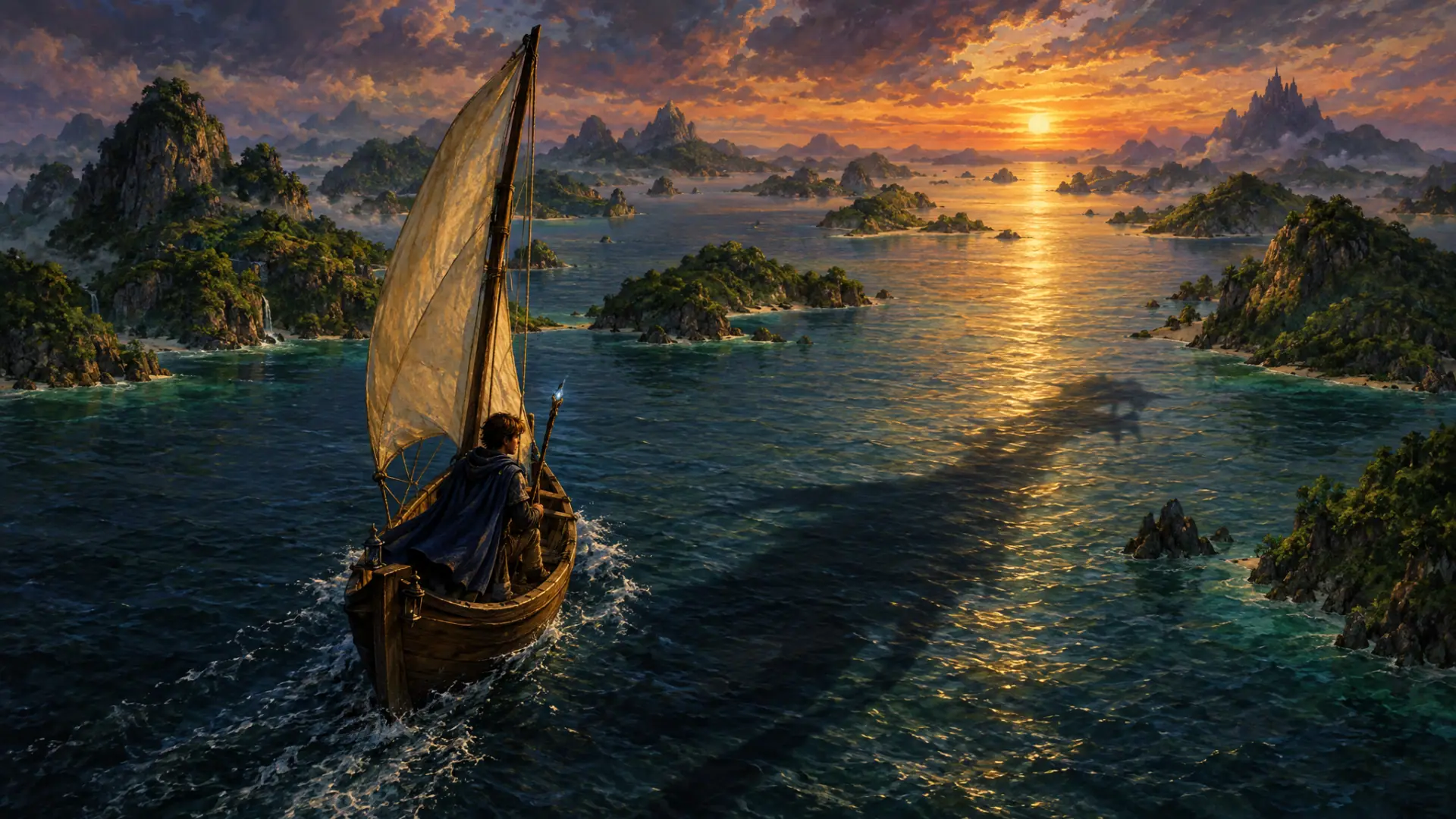
Earthsea is a world of islands — hundreds of them, scattered across an open ocean, from the rich Inner Lands to the wild Reaches and the dragon-haunted West. In the six books Ursula K. Le Guin set there between 1968 and 2001, magic works through knowledge of the true names of things, and the highest wisdom is to know when not to use it. The first book, A Wizard of Earthsea, is one of the essential fantasy novels of the twentieth century: a coming-of-age story in which a gifted, arrogant boy becomes a mage by learning to face his own shadow.
Origins
Le Guin had been writing science fiction and fantasy for magazines when, in 1967, Herman Schein, publisher of the small Parnassus Press in Berkeley, asked her to write a book for older children and gave her complete freedom. She returned to a world she had sketched in two short stories published in Fantastic in 1964, "The Word of Unbinding" and "The Rule of Names." A Wizard of Earthsea was published in 1968, with a cover and woodcut-like chapter illustrations by Ruth Robbins.
Le Guin intended a single book, but unresolved threads drew her back. The Tombs of Atuan (1971) and The Farthest Shore (1972) followed from Atheneum. Nearly two decades later she returned with Tehanu (1990), and in 2001 with Tales from Earthsea and The Other Wind, each revisiting the world from new angles.
The story
Duny, a bronzesmith's son who herds goats on the island of Gont, shows a raw talent for magic and is given his true name, Ged, by the mage Ogion; the world knows him as Sparrowhawk. Impatient with Ogion's quiet teaching, he goes to the school for wizards on the island of Roke. There, in a proud duel with a rival, he casts a forbidden spell to summon the dead and tears open the world, releasing a shadow creature that scars him and pursues him across the archipelago. Only when Ged turns and hunts it to the edge of the world, and names it with his own name, is he whole.
The Tombs of Atuan shifts to Tenar, a girl raised as priestess of the nameless dark powers of a desert temple, whom Ged helps to escape. The Farthest Shore follows the aging Archmage Ged and the young prince Arren to the land of the dead to heal a wound in the world's magic. Tehanu turns the series on its head: Ged has lost his power, and the story centers on Tenar, now a widowed farm-woman, and a burned, abused child. The Other Wind reconciles humans, dragons and the dead.
Reception & impact
The books won honor after honor: the Boston Globe–Horn Book Award for A Wizard of Earthsea, a Newbery Honor for The Tombs of Atuan, the National Book Award for Children's Books for The Farthest Shore in 1973, the Nebula Award for Best Novel for Tehanu, and the World Fantasy Award for The Other Wind in 2002.
Le Guin's quiet subversions became as famous as her prose. Ged is brown-skinned, and most of Earthsea's people are brown or black; the pale-skinned Kargs are the raiders from the east. Le Guin later wrote with frustration about book covers that showed a white hero, and she publicly condemned the 2004 Sci Fi Channel miniseries Legend of Earthsea for "whitewashing Earthsea." Studio Ghibli's animated Tales from Earthsea (2006), directed by Gorō Miyazaki and loosely combining elements of the first four books with Hayao Miyazaki's Shuna's Journey, also disappointed her. A BBC radio adaptation in 1996 was narrated by Judi Dench. In 2018 the complete cycle was gathered as The Books of Earthsea, illustrated by Charles Vess.
Legacy
Earthsea's school for wizards on Roke is the great precursor of every magical academy in later fantasy, and readers have long noted how much ground it covered before J. K. Rowling's Hogwarts. Its magic of true names — precise, costly and bound by a principle of Equilibrium — is one of the most influential "soft" magic systems in the genre, and its echo can be heard in Patrick Rothfuss's Kingkiller Chronicle, where the study of names is the highest art at a university of magic. Its dragons, ancient and ambiguous rather than simply monstrous, shaped a more mysterious image of the Dragon.
For game designers, Earthsea offered a counter-model to Vancian spell-slinging: magic as understanding, with consequences for the balance of the world. And for fantasy as a whole, Tehanu showed that a great series could turn back on its own assumptions about power, gender and heroism and become richer for it.
Marginalia
- Parnassus Press publisher Herman Schein asked Le Guin in 1967 for a book for older children, giving her complete freedom.
- Earthsea first appeared in two 1964 stories in Fantastic, 'The Word of Unbinding' and 'The Rule of Names.'
- Ged and most people of the archipelago are brown- or dark-skinned — a deliberate choice that cover artists and adapters repeatedly ignored.
- The Farthest Shore won the 1973 National Book Award for children's books; Tehanu won the Nebula Award for Best Novel.
- Le Guin publicly criticized the 2004 Sci Fi Channel miniseries Legend of Earthsea for 'whitewashing' her characters.
- Studio Ghibli's Tales from Earthsea (2006) was directed by Gorō Miyazaki, son of Hayao Miyazaki.
Quick answers
- When was Earthsea first published?
- Earthsea was first published in 1968–2001.
- Who created Earthsea?
- Earthsea was made by Ursula K. Le Guin (author).
- What kind of work is Earthsea?
- Earthsea is a book series in the High / Epic Fantasy and Children's & YA Fantasy tradition.
- Why is Earthsea important?
- The wizard-school story before Hogwarts and the most influential 'true names' magic in fantasy — a high fantasy whose hero is brown-skinned, whose climax is self-knowledge, and whose later books questioned the genre itself.