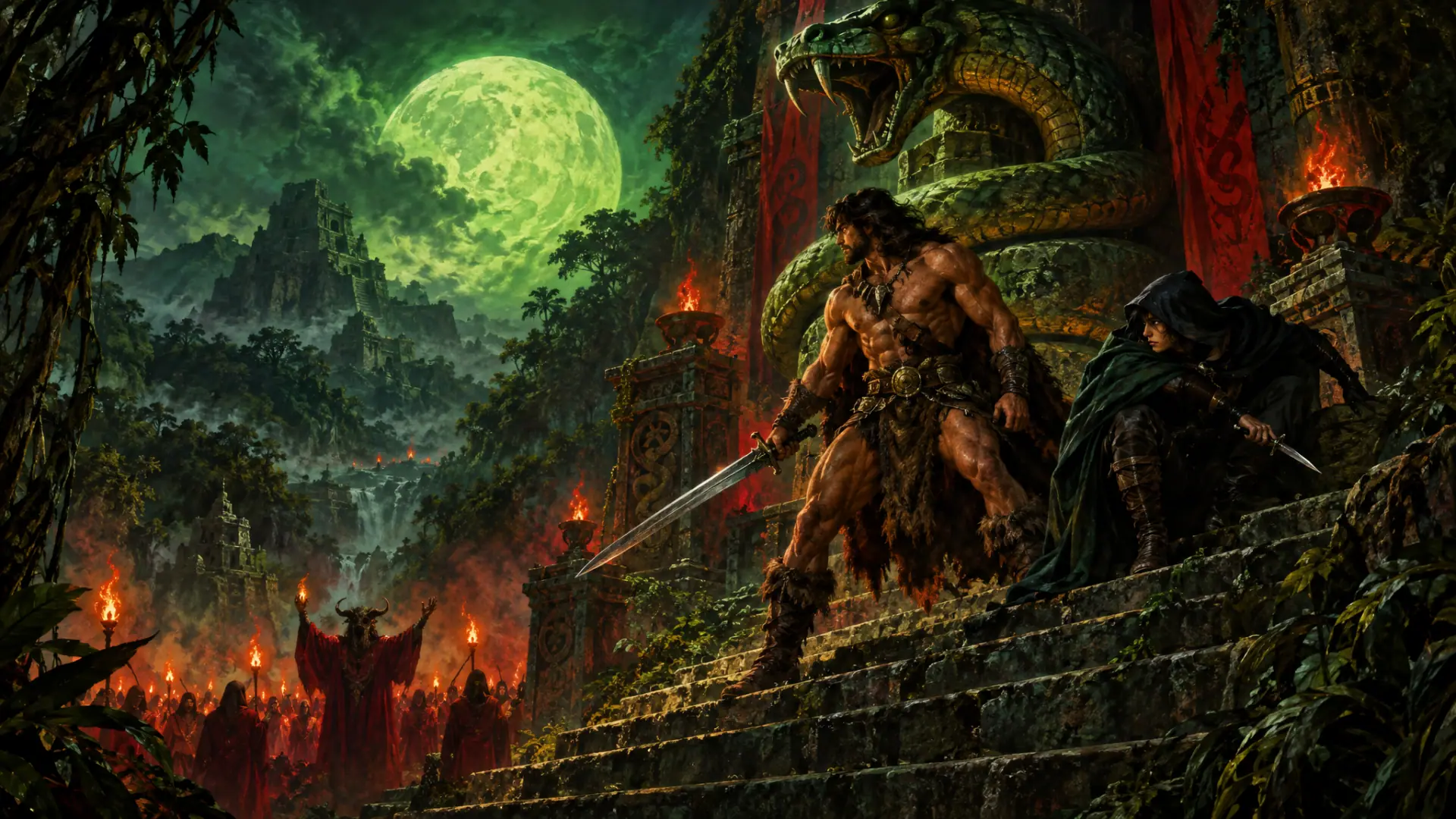
The source of D&D's memorized, fire-and-forget spells — 'Vancian magic' — and the founding text of the dying-earth subgenre, admired for some of the most elegant prose in fantasy.
Overview
The Dying Earth is a slim book of six linked stories by Jack Vance, published in 1950, set in an unimaginably distant future when the sun has grown red and dim and humanity lingers among the ruins of countless forgotten civilizations. Science has decayed into sorcery, and the few surviving magicians guard fragments of the old lore in libraries of crumbling tomes. The mood is autumnal and ironic; the prose is ornate, witty and precise, full of invented words and formal, bargaining dialogue.
It is the founding text of the Dying Earth subgenre and a classic of Science Fantasy. For game history it matters for one very specific reason: its rules of magic became, almost unchanged, the spellcasting system of Dungeons & Dragons — the system players still call Vancian magic.
Origins
Vance wrote several of the stories while serving in the merchant marine during the Second World War. They were collected and published as a paperback original by Hillman Periodicals in 1950. The edition was small and poorly distributed, and the book became a rarity cherished by collectors before later reprints brought it to a wide audience.
Vance returned to the setting sixteen years later. The Eyes of the Overworld (Ace, 1966), assembled from stories in The Magazine of Fantasy & Science Fiction, follows Cugel the Clever, a shameless rogue sent on an impossible errand. Cugel's Saga (1983) continued his adventures, and Rhialto the Marvellous (1984) turned to a squabbling association of the last great wizards.
The story
The six stories are loosely connected. In "Turjan of Miir," a magician seeks the secret of creating life and travels to the strange realm of Embelyon to study under the wizard Pandelume. "Mazirian the Magician" follows a cold sorcerer who hunts a mysterious woman through his enchanted garden. "T'sais" concerns a woman created with a flaw that makes her see all beauty as ugliness; "Liane the Wayfarer" pits a vain adventurer against the terrible Chun the Unavoidable; "Ulan Dhor" seeks lost knowledge in Ampridatvir, a city split between two hostile factions; and "Guyal of Sfere" ends the book with a young man's quest for the Museum of Man.
The magic is what games remember. In Vance's world, spells are complex formulae that must be impressed upon the mind by study. Turjan, one of the most powerful magicians of his age, can hold only four of the most potent spells at once; Mazirian carries five, including Phandaal's Gyrator and the Excellent Prismatic Spray. When a spell is spoken it is gone, erased from memory, and a magician who has spent his spells is helpless until he can study again.
Reception & impact
The collection's reputation grew slowly, then steadily; in 1987 Locus readers ranked it among the best fantasy novels of all time. Its real power was as a writer's book. Its descendants include Gene Wolfe's The Book of the New Sun and a long line of other dying-earth stories. In 2009 George R. R. Martin and Gardner Dozois edited Songs of the Dying Earth, a tribute anthology in which major authors wrote new stories set in Vance's world.
Its most famous heir, though, is a game. When Gary Gygax shaped the magic-user rules for the 1974 game he created with Dave Arneson, he adopted Vance's system: a magic-user prepares a limited number of spells from a spellbook, and each is forgotten when cast. Gygax credited Vance directly, listed The Dying Earth and The Eyes of the Overworld in Appendix N of the 1979 Dungeon Master's Guide, and named Vance among his most immediate influences.
Legacy
Vancian magic shaped five decades of game design. It survived through Advanced Dungeons & Dragons and into computer games built on its rules, such as Pool of Radiance and Baldur's Gate, where wizards must rest to re-memorize their spells. Later editions softened it into "spell slots," and many designers rebelled against it with Mana pools and cooldowns, but the idea of spells as prepared resources remains the default grammar of fantasy magic in games. Specific spells came across too: D&D's prismatic spray is a direct descendant of Mazirian's Excellent Prismatic Spray.
Cugel, meanwhile, is a model for the amoral rogue-protagonist, and Pelgrane Press's Dying Earth Roleplaying Game (2001) tried to capture Vance's wit, rewarding players for eloquent persuasion and baroque insults. Few books of 1950 have so thoroughly shaped how millions of people imagine a wizard at work.
Marginalia
- Vance wrote several of the stories while serving in the merchant marine during the Second World War.
- The first edition was a paperback from Hillman Periodicals in 1950, a small print run that quickly became scarce.
- In 'Turjan of Miir' the sorcerer's brain can hold only four of the most potent spells at once; Mazirian manages five.
- Once cast, a Dying Earth spell is gone from the magician's mind until he studies it again — the core of D&D's spell memorization.
- D&D's prismatic spray descends from Vance's 'Excellent Prismatic Spray,' one of Mazirian's five spells.
- Gary Gygax listed The Dying Earth and The Eyes of the Overworld in Appendix N and named Vance among his most immediate influences.
Quick answers
- When was The Dying Earth first published?
- The Dying Earth was first published in 1950 (series to 1984).
- Who created The Dying Earth?
- The Dying Earth was made by Jack Vance (author).
- What kind of work is The Dying Earth?
- The Dying Earth is a story collection in the Dying Earth and Science Fantasy tradition.
- Why is The Dying Earth important?
- The source of D&D's memorized, fire-and-forget spells — 'Vancian magic' — and the founding text of the dying-earth subgenre, admired for some of the most elegant prose in fantasy.