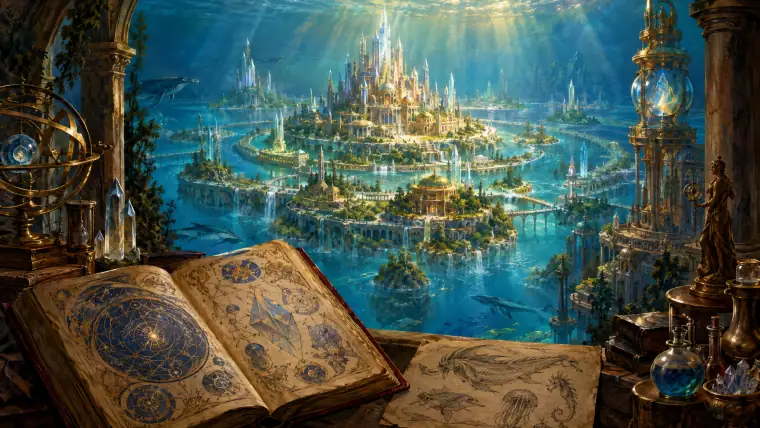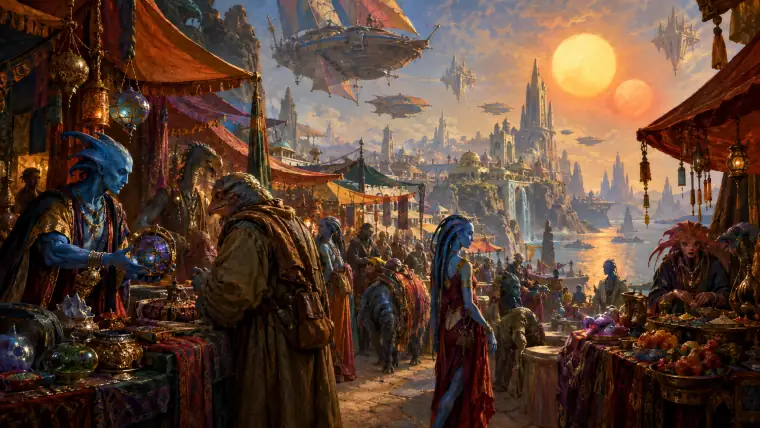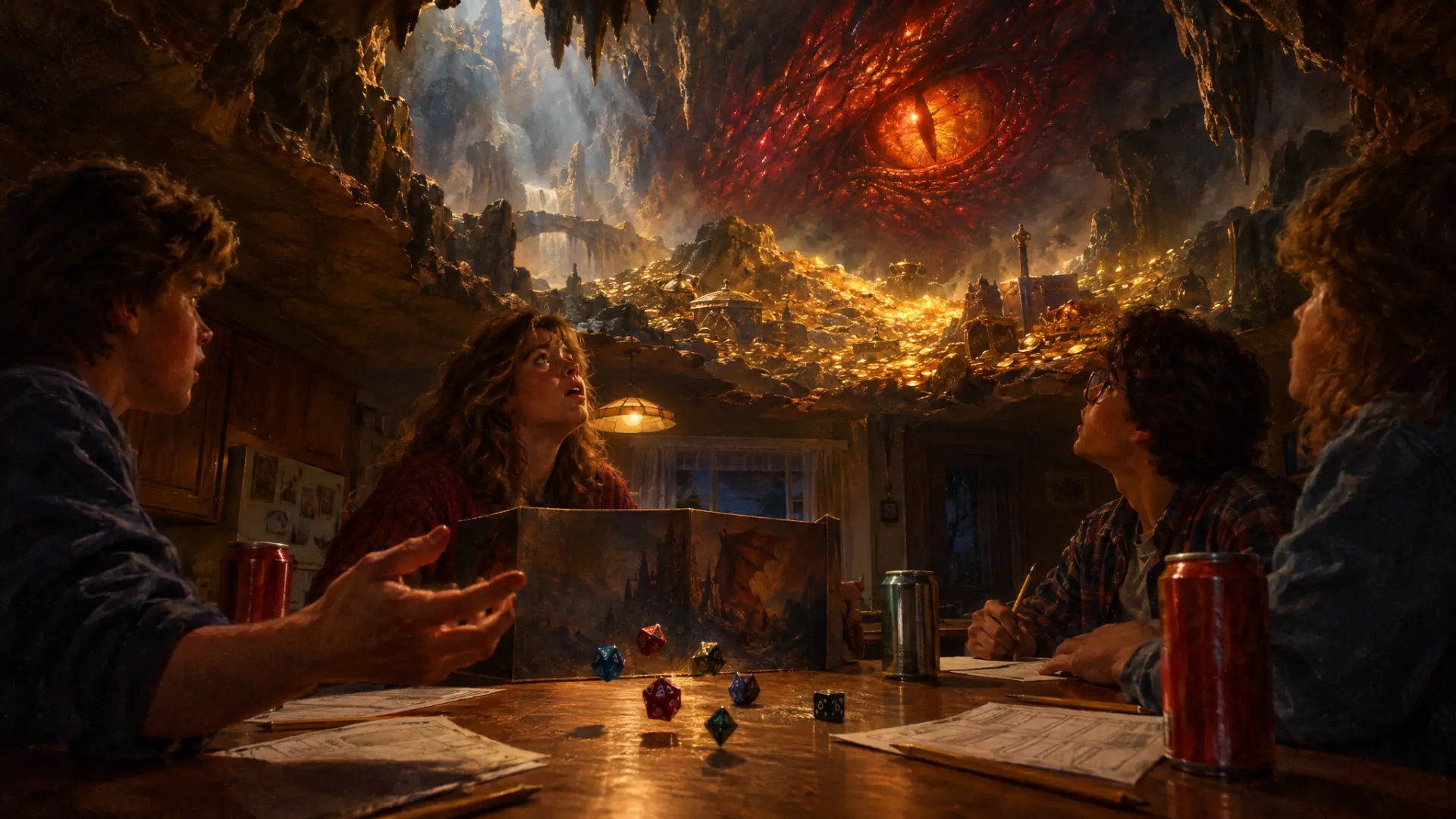
Sechi designed two of the most distinctive independent fantasy RPGs of the 1980s. The Atlantean Trilogy rebuilt D&D-style play around a mythic prehistoric Earth, and Talislanta showed that a setting could matter more than its rules.
Life
Little of Stephan Michael Sechi's early life is on the public record. No reliable source gives his birth date or birthplace, and he has spoken about himself mostly in interviews about his games. What he has shared is vivid. As a boy he loved comics, DC's Green Lantern and the Martian Manhunter and later Marvel's Doctor Strange, and he read widely: fantasy and science fiction, but also William S. Burroughs, Thomas De Quincey, Herodotus, military history and, later, Borges.
He came to roleplaying late and almost unwillingly. He was busy playing in a band when a younger cousin from Seattle kept urging him to try Dungeons & Dragons. When he finally sat down to play, he was hooked. He bought the books, began running games as Game Master, and started writing his own material, as most referees did. Gaming also led him to Jack Vance, who remained his favorite fantasy writer. About a year later he decided to publish.
Work
In 1982 Sechi and two friends, Steven Cordovano and Vernie Taylor, all musicians, each put $600 into a company they called Bard Games. Their group had been playing a heavily customized D&D with new character classes and spells, and they sold those ideas as supplements that could fit any system but plainly assumed D&D. A friend helped get the books into Waldenbooks, and Sechi recalls that for a time they were the only RPG books there apart from D&D. Three "Compleat" books appeared in 1983: The Compleat Alchemist by Cordovano and Sechi, which introduced a magic-item-making class; The Compleat Adventurer, Sechi's variants of fighters and thieves; and The Compleat Spell Caster with Taylor.
Their success led to the project Sechi oversaw for the next three years, which became The Atlantean Trilogy. The Arcanum (1984), a 156-page rulebook by Sechi and Taylor, combined the Compleat material into a full game system. The Lexicon (1985), with Ed Mortimer, supplied the setting: Earth in a mythic antediluvian age, where continents such as Mediterranea, Gondwana and Jambu share the map with Atlantis, Lemuria, Mu and Hyperborea. The Bestiary (1986), with J. Andrew Keith, filled that world with the monsters of myth, illustrated by Marvel artist Bill Sienkiewicz. Historian Shannon Appelcline notes that the system was clearly derived from AD&D, but it added character skills and point-based character creation. Rick Swan later called The Arcanum "one of the best treatments of magic ever published." A revised Arcanum followed in 1985, and in 1988 Sechi combined the setting books into Atlantis: The Lost World.
The trilogy also split the partnership. After disagreements over money and direction, Sechi sold his shares to Cordovano and left in 1986. He banked the money and spent about three months writing the core of a new game: The Chronicles of Talislanta, The Talislantan Handbook and A Naturalist's Guide to Talislanta. By the time he finished, Cordovano no longer wanted to run Bard Games and sold it back to him. With a new partner, Joel Kaye, Sechi published Talislanta in 1987.
Talislanta was, in his words, mostly shaped by "the fantasy and sci-fi books of Jack Vance." The Chronicles was dedicated to Vance, and the setting's baroque peoples and decadent magocracies recall The Dying Earth. He also cited Dave Hargrave's Arduin Grimoire, Clark Ashton Smith's Zothique tales, Lord Dunsany, and Lovecraft's The Dream-Quest of Unknown Kadath. He cared most about how it looked. He drew more than 200 sketches of its creatures and peoples to guide artists, and P. D. Breeding-Black's illustrations fixed its appearance. The rules were simple on purpose: one d20 table resolved everything, and players chose from more than 80 archetypes instead of rolling up adventurers. Reviewers noticed what was missing. Stewart Wieck praised "a fantasy world without orcs and goblins."
Bard Games did well for a while. Sechi has said the 1989 Talislanta Handbook & Campaign Guide sold more than 12,000 copies in about two years. The company then overreached. The later Cyclopedia Talislanta volumes sold poorly, and an inexperienced Waldenbooks buyer placed a huge order for Atlantis: The Lost World. A year later the returns forced Bard to refund about $20,000. Sechi paid the debts, repaid his partner and closed the company in 1990, but kept the rights.
He licensed Talislanta to a small, new company called Wizards of the Coast, whose 1992 third edition was revised with Jonathan Tweet; Peter Adkison co-wrote the map text for its Talislanta Geographica. When Wizards dropped the line, Sechi used his settlement to buy a small digital recording setup and returned to music. He built a career writing for production-music libraries, with work used in television, film and advertising, and recorded orchestras in Bulgaria and Prague. Meanwhile Talislanta passed through other publishers, including Shooting Iron's fourth edition (2001) and Morrigan Press's fifth (2006–07).
Legacy
Sechi's games reached fewer tables than D&D, but they have lasted. Players still use The Arcanum as a source of spells and classes, and in 2019 ZiLa Games published a 30th-anniversary edition. Atlantis continued as Atlantis: The Second Age from Khepera Publishing. In 2010 Sechi gave Talislanta away, placing nearly every book under a Creative Commons license as free PDFs to thank fans who had stuck with the game through years of licensing trouble. A crowdfunded "Epic" sixth edition from Everything Epic followed in 2023–24.
His design principle has aged well: "keep the system as simple as possible, and put all the detail into developing an original milieu." Games that treat setting as the main attraction, and weird fantasy that steps away from the Tolkien template, owe something to the musician who spent three months in a cheap apartment inventing a continent.
Marginalia
- He started Bard Games in 1982 with two fellow musicians, Steven Cordovano and Vernie Taylor, each putting in $600.
- The Atlantean Trilogy took about three years: The Arcanum (1984), The Lexicon (1985) and The Bestiary (1986), the last illustrated by comics artist Bill Sienkiewicz.
- He wrote the first Talislanta books in about three months, living on the money from selling his Bard Games shares.
- The first Talislanta release, The Chronicles of Talislanta, was dedicated to Jack Vance, his favorite fantasy writer.
- A single oversized Waldenbooks order of Atlantis: The Lost World came back as returns costing about $20,000, which helped sink Bard Games.
- In 2010 he placed nearly the entire Talislanta corpus online as free PDFs under a Creative Commons license.
Quick answers
- Who is Stephan Michael Sechi?
- A musician turned game designer who co-founded Bard Games on $600 a partner, built the antediluvian Atlantean Trilogy, then gave the hobby Talislanta, a Vance-haunted world without the usual orcs and goblins.
- What is Stephan Michael Sechi known for?
- Stephan Michael Sechi is best known for The Atlantean Trilogy and Talislanta.
- Why does Stephan Michael Sechi matter to fantasy and games?
- Sechi designed two of the most distinctive independent fantasy RPGs of the 1980s. The Atlantean Trilogy rebuilt D&D-style play around a mythic prehistoric Earth, and Talislanta showed that a setting could matter more than its rules.