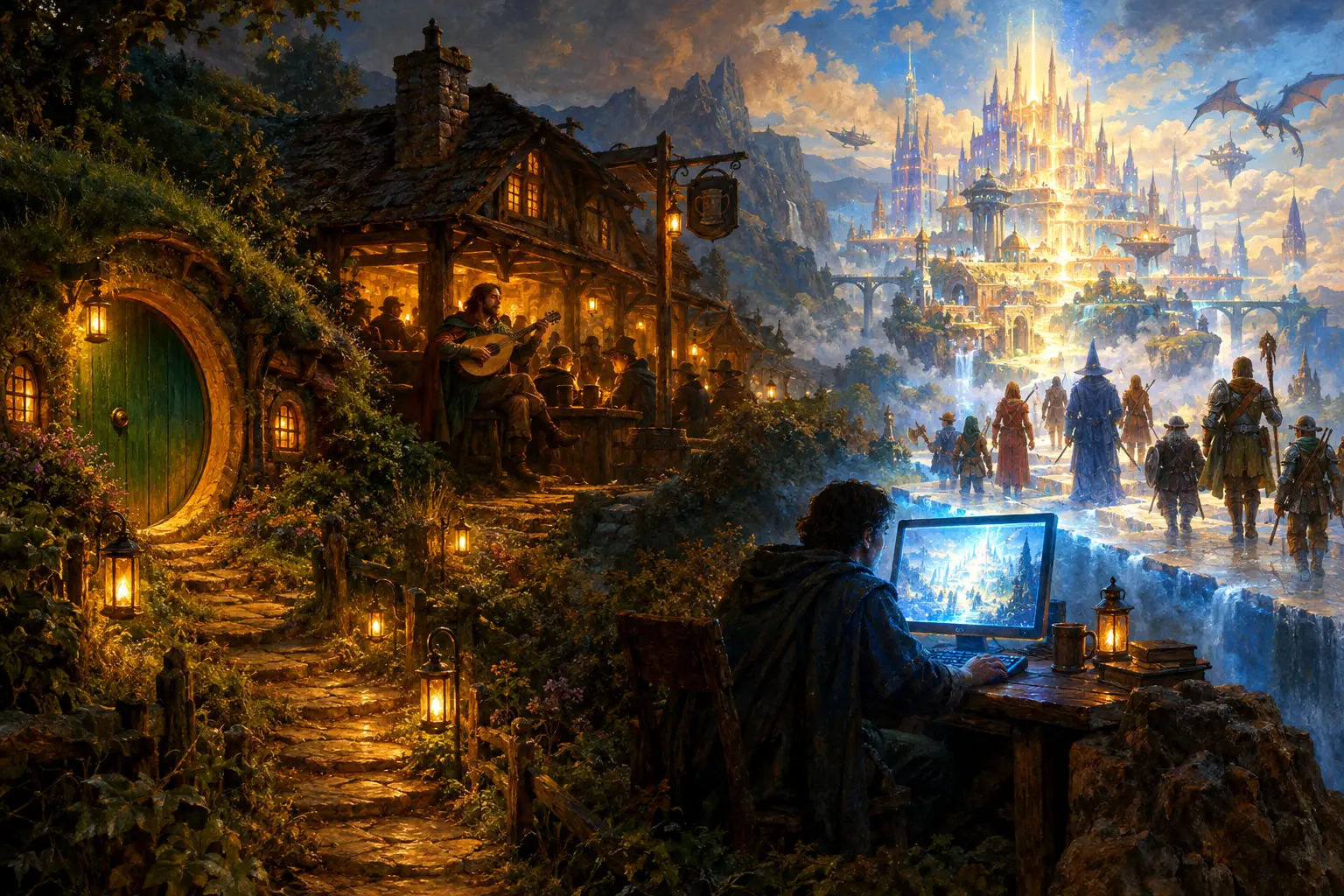
The Classic Path
From a hobbit hole to the lawless streets of Britannia
This is the road many of our patrons actually walked. It begins with a paperback in a school bag and ends with a modem screeching in the dark, and at every step a new medium picks up what the last one dreamed of.
The path runs in five movements. First come the books: The Hobbit and The Lord of the Rings, the stories that taught a generation what a quest, a party and a dungeon were, and the 1965 paperback war that made Tolkien a campus sensation. Then the dice: Chainmail and the original Dungeons & Dragons, where wargamers in the American Midwest turned Middle-earth's battles into rules and then into something no one had seen before, a game with a referee and no winner. Advanced Dungeons & Dragons made that game a canon.
The third movement is the disk drive. Wizardry: Proving Grounds of the Mad Overlord and The Bard's Tale took the dungeon crawl onto the Apple II and the Commodore 64, trading the referee's voice for code, maps drawn on graph paper, and the thrill of a party wiped out in the dark. The fourth is a detour back to the table: Bard Games' The Atlantean Trilogy, proof that tabletop designers kept pushing magic, setting and monsters while programmers borrowed their work.
The last movement belongs to Richard Garriott. From his home-made Akalabeth: World of Doom to Ultima IV: Quest of the Avatar, Ultima grew from a teenager's hobby into the first computer RPG to make morality the goal, and then, with Ultima Online, into a shared world where thousands of strangers lived, traded and fought.
Walk it in order. Notice how each stop answers a question left open by the one before: how do you play a story? How do you play it alone? How do you play it with everyone? Stop notes are small lessons; follow the links inside each exhibit when a thread tugs at you, and return to the path when you are ready to move on.
- 1The HobbitNovel · 1937
Begin at a round green door. Tolkien's 1937 children's book gave fantasy its first great map and its basic plot: a small, comfortable person hired onto a treasure hunt with a party of specialists. Notice the dwarves, the goblins under the mountain and the dragon on his hoard, because every dungeon on this tour descends from that one expedition.
- 2The Lord of the RingsNovel · 1954–1955
The 'new Hobbit' Tolkien began in December 1937 took twelve years and turned the treasure hunt into a war of the world. Its lesson is depth: invented languages, histories and appendices that make a secondary world feel older than the story told in it. Rangers, elves, dwarves and a fellowship of mixed races would all walk straight onto the gaming table.
- 3The Ace Paperback AffairControversy · 1965–1966
A connecting stop. In 1965 Ace Books printed an unauthorized 75-cent paperback edition, Ballantine answered with an authorized one, and the fight put Tolkien in every American campus bookstore. The wargamers who would invent D&D a few years later were among those new readers.
- 4ChainmailWargame · 1971
A connecting stop: a 1971 medieval miniatures wargame from Lake Geneva with a short Fantasy Supplement for heroes, wizards, elves and dragons. Here Tolkien's battles become rules, with fireballs, lightning bolts and Law-versus-Chaos creatures fielded as units on a tabletop. Watch for the moment rules for armies shrink to rules for one hero.
- 5Dungeons & DragonsTabletop RPG · 1974
The heart of the tour: three booklets in a woodgrain box, January 1974. Dave Arneson's refereed dungeon campaign and Gary Gygax's wargame rules become a game with no board and no winner, only characters who return next week stronger. Look for the hobbits, ents and balrogs borrowed from Tolkien, names the lawyers would soon remove.
- 6Advanced Dungeons & DragonsTabletop RPG · 1977–1989
The three orange-spined hardcovers of 1977–79 turned D&D's scattered booklets into a canon, with nine alignments, a Monster Manual and Appendix N's reading list pointing players back to the books. This was the D&D most early computer designers had on their shelves, and its rules are what the games at the next stops tried to automate.
- 7Wizardry: Proving Grounds of the Mad OverlordDungeon crawler · 1981
A connecting stop. Sir-Tech's 1981 Apple II maze put a party of six into a ten-level dungeon, graph paper included, with no saving below ground. It set the template for the party-based dungeon crawl on a computer, and the next stop was built openly in its image.
- 8The Bard's TaleComputer RPG · 1985–2019
Interplay's 1985 crawl through the frozen city of Skara Brae took Wizardry's formula, added color, animated portraits and a bard whose songs were spells. Mage spells were cast by typing four-letter codes printed only in the manual. By one count it sold 407,000 copies, making it the best-selling computer RPG of the 1980s.
- 9The Atlantean TrilogyTabletop RPG · 1984–1986
Back to paper, and a reminder that tabletop kept innovating while computers borrowed from it. Bard Games' Arcanum, Lexicon and Bestiary (1984–86) rebuilt D&D-style play for drowned Atlantis, with a magic-and-alchemy grimoire that critics singled out for praise. Compare the Bestiary, illustrated by Bill Sienkiewicz, with the Monster Manual two stops back.
- 10Akalabeth: World of DoomComputer RPG · 1979
Step back to 1979–80 to meet the road's last traveler: a Texas teenager, Richard Garriott, selling his Apple II dungeon game in Ziploc bags at a ComputerLand. The quest-giver is Lord British and the world is seeded from a 'lucky number.' Everything Ultima became starts in this hobby project.
- 11Ultima IV: Quest of the AvatarComputer RPG · 1985
The turn. Ultima IV (1985) has no final villain: the Avatar wins by living eight virtues built from Truth, Love and Courage, and a fortune-teller's moral questions choose your class. It is the moment the CRPG asked what kind of person the player's character is, not merely how strong. Note the cloth map and metal ankh in the box.
- 12Ultima OnlineMMORPG · 1997
The road ends where thousands of travelers share it. Ultima Online (1997) turned Britannia into a persistent world where players built houses, ran shops and killed each other, and where Lord British himself was assassinated in the beta. From a single hobbit's journey to a whole society online: the tour's final lesson is that players, not designers, finish every world.