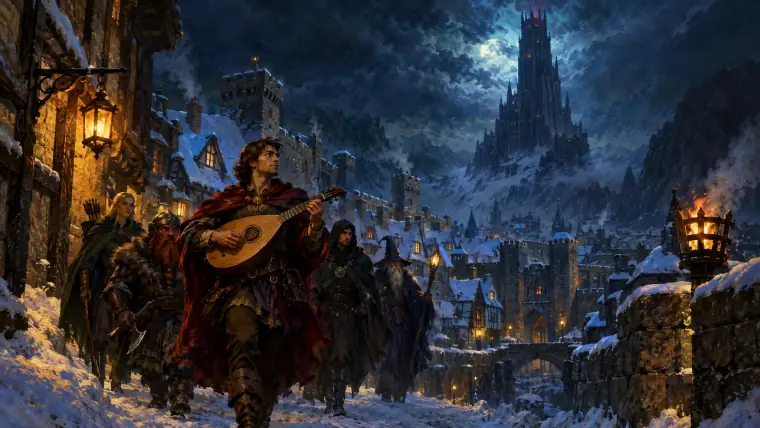
Interplay links the first great era of computer RPGs to the Infinity Engine renaissance: it made The Bard's Tale, created Fallout, founded Black Isle and published BioWare's Baldur's Gate.
History
Interplay Productions began in October 1983 as a work-for-hire shop in Irvine, California. Brian Fargo, Rebecca Heineman, Jay Patel and Troy Worrell founded it with backing from investor Chris Wells, and their first contract was Mindshadow, a graphical text adventure for Activision. Fargo then recruited an old high-school friend, Michael Cranford, to build a role-playing game for a new publisher called Electronic Arts. The result, The Bard's Tale (1985), turned the tiny team into one of the most important names in the young computer RPG.
Through the late 1980s Interplay produced the Bard's Tale sequels, the post-apocalyptic Wasteland (1988) and Dragon Wars (1989), all under the EA label. In 1988 Fargo turned the company into a publisher in its own right, starting with Battle Chess and Neuromancer, and two years later it released J.R.R. Tolkien's The Lord of the Rings, Vol. I, an early licensed attempt to put The Lord of the Rings on the home computer. In the mid-1990s MCA (later Universal) took a large minority stake, and Interplay grew into a publisher with hundreds of employees, publishing everything from Descent to Star Trek adventures to the Forgotten Realms game Descent to Undermountain (1997).
That same year Interplay released Fallout (1997), a turn-based RPG that became its most celebrated original creation. Around it the company built an in-house RPG division, Black Isle Studios, led by Feargus Urquhart, and signed a young Canadian developer, BioWare, whose Baldur's Gate (1998) revived licensed AD&D on the PC.
Success did not fix the balance sheet. Interplay went public on NASDAQ on June 19, 1998, at $5.50 a share; losses continued, and the Paris-based Titus Interactive invested from March 1999, holding 57% of the company by August 1999 and 72.5% by April 2001. BioWare ended its partnership in November 2001 over unpaid royalties. Fargo resigned on January 24, 2002, and Titus co-founder Hervé Caen became CEO. The company was delisted to over-the-counter trading, sold Shiny Entertainment, closed Black Isle on December 8, 2003, licensed Fallout to Bethesda Softworks in 2004 and, to pay creditors, sold the franchise outright in April 2007.
Notable work
Interplay's fantasy legacy runs in two waves. The first is the 1980s party RPG: The Bard's Tale and its sequels brought first-person dungeon crawling to a mass audience in the wake of Wizardry: Proving Grounds of the Mad Overlord, with the city of Skara Brae, a singing bard and a hand-drawn look that made the Apple II and Commodore 64 feel like windows into another world. Its early contracts even reached into the future of the industry: in 1991 Interplay published the first game by Fargo's friend Allen Adham and his partner Mike Morhaime, whose small studio would become Blizzard Entertainment: RPM Racing.
The second wave is the late-1990s renaissance. As publisher, Interplay put out BioWare's Baldur's Gate, Baldur's Gate II (2000) and the console spin-off Baldur's Gate: Dark Alliance (2001). Through Black Isle it released Planescape: Torment (1999), the talkiest and strangest RPG of its time, and Icewind Dale (2000), a combat-first descent into the frozen north of the Forgotten Realms. Together these games made the Real-time with pause The party RPG the dominant PC form of the era.
Legacy
Few companies did more to shape the computer RPG and then lost so much of it. Interplay's people scattered into the studios that define the genre today: Fargo founded inXile Entertainment, which revived Wasteland and The Bard's Tale; Urquhart, Chris Avellone and colleagues founded Obsidian Entertainment; Fallout became one of Bethesda's pillars. BioWare's time with Interplay launched the line that leads to Baldur's Gate 3.
Interplay itself never closed. Under Hervé Caen it has survived as a small Los Angeles company that licenses and re-releases its catalog — it revived the Black Isle name in 2012, re-released Baldur's Gate: Dark Alliance on modern consoles in 2021, and co-published Kingpin: Reloaded in 2023. Its logo on an old box remains a reliable sign of the golden age of Western RPGs.
Marginalia
- Interplay was founded in October 1983 in Irvine, California, by Brian Fargo, Rebecca Heineman, Jay Patel and Troy Worrell, with investor Chris Wells.
- Its early RPGs — The Bard's Tale (1985), Wasteland (1988) and Dragon Wars (1989) — were all published by Electronic Arts.
- In 1990 Interplay released J.R.R. Tolkien's The Lord of the Rings, Vol. I, one of the first licensed Middle-earth computer RPGs.
- Interplay went public on NASDAQ in June 1998 at $5.50 a share; by August 1999 France's Titus Interactive owned 57% of it.
- Brian Fargo resigned on January 24, 2002, and went on to found inXile Entertainment.
- Interplay closed Black Isle Studios on December 8, 2003, and sold the Fallout IP outright to Bethesda Softworks in April 2007.
Quick answers
- What is Interplay Productions?
- The Irvine house that gave the world The Bard's Tale, Wasteland and Fallout, then published Baldur's Gate and Planescape: Torment before collapsing under debt in the early 2000s.
- When was Interplay Productions founded?
- Interplay Productions was founded in 1983 and is based in Irvine, California (now Los Angeles).
- Who founded Interplay Productions?
- Brian Fargo and Rebecca Heineman.
- What is Interplay Productions known for?
- The Bard's Tale, Baldur's Gate, Planescape: Torment, Icewind Dale and Baldur's Gate II.
- What happened to Interplay Productions?
- Went public in 1998; controlled by Titus Interactive from 1999–2001; sold Fallout to Bethesda in 2007. Survives in Los Angeles as a small company licensing and re-releasing its back catalog.