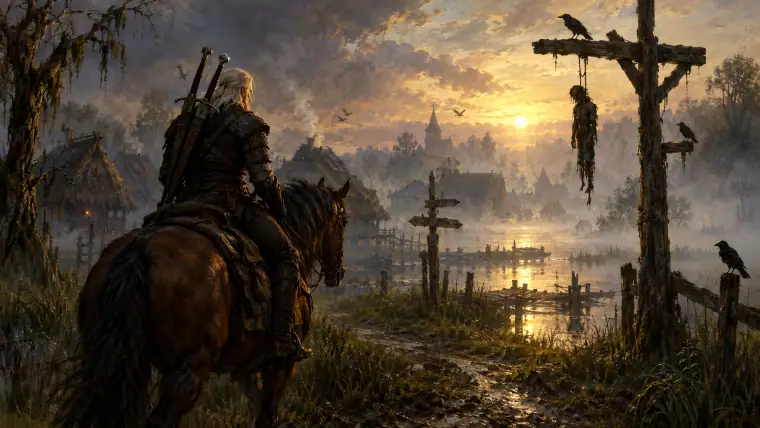
Sapkowski's Witcher books brought Slavic folklore, political cynicism and Chandleresque wit into epic fantasy, and CD Projekt Red's games built on them became landmarks of the modern computer RPG.
Life
Andrzej Sapkowski was born on June 21, 1948, in Łódź, in central Poland. His father had served in the Polish People's Army and fought in the Battle of Berlin. Sapkowski studied economics at the University of Łódź and worked for years as a senior sales representative for a foreign trade company. His entry into literature came through translation, especially of science fiction; among his early translations was Cyril M. Kornbluth's "The Words of Guru." He still lives in Łódź. His son Krzysztof (1972–2019), an avid reader of the magazine Fantastyka, was the reader for whom the first Witcher story was written.
He has said he wrote that story on a whim, to enter a Fantastyka competition, and that his business experience taught him how to sell. "Wiedźmin" ("The Witcher") took third prize and appeared in the magazine in 1986 to acclaim from readers and critics. Within a few years he was one of the best-known fantasy writers in Poland, and he has since collected six Janusz A. Zajdel Awards, the Gloria Artis Medal and the World Fantasy Award for Life Achievement.
Work
Geralt of Rivia is a witcher, a professional monster hunter mutated in childhood by alchemy and training, who takes coin to kill things that prey on people. He is cynical and principled at once, and critics have compared him to Raymond Chandler's Philip Marlowe, one of Sapkowski's favorite authors. The early stories, collected in Sword of Destiny (1992) and The Last Wish (1993), often twist familiar fairy tales, Beauty and the Beast or Snow White, into morally murky cases where the monster is rarely the worst thing in the room. The world draws heavily on Slavic folklore, and its conflicts between humans, elves and dwarves echo the ethnic strife and occupations of Central and Eastern European history.
Reader demand pushed him from stories to novels. The Witcher Saga, five books from Blood of Elves (1994) to The Lady of the Lake (1999), follows Geralt, the sorceress Yennefer and Ciri, a princess with a dangerous bloodline, through a continental war. It mixes battle, court politics and Dark Fantasy with a playful literary self-awareness, including Arthurian echoes and shifting narrators. He later wrote the Hussite Trilogy (2002–06), a historical fantasy of the fifteenth-century Hussite Wars that some critics consider his real masterpiece, and two Witcher prequels, Season of Storms (2013) and Crossroads of Ravens (2024; in English 2025). His Manuscript Found in a Dragon's Cave (2001) is an idiosyncratic encyclopedia of the genre, with entries on Tolkien, Howard, Le Guin, Zelazny and George R. R. Martin.
Legacy
Games carried Geralt far beyond Poland. A Polish tabletop roleplaying game, Wiedźmin: Gra wyobraźni, appeared from MAG in 2001, but the decisive step came when CD Projekt, the Warsaw company co-founded by Marcin Iwiński, built a development studio around the license. CD Projekt Red's The Witcher (2007) was followed by The Witcher 2: Assassins of Kings (2011) and The Witcher 3: Wild Hunt (2015), whose open world and branching quests made it one of the most celebrated RPGs of its decade. By September 2026 the series had sold about 90 million copies. Spin-offs include the card game Gwent, The Witcher Adventure Game with Fantasy Flight Games (2014), R. Talsorian Games' The Witcher RPG (2018), and The Witcher IV, starring Ciri, which CD Projekt Red plans for 2028.
The relationship has not always been easy. Sapkowski had sold the game rights for a lump sum, and in 2018 he demanded 60 million zloty in additional royalties; the parties reached an undisclosed amicable settlement in December 2019. The games' success fed the books' global audience, a point commentators made pointedly during the dispute.
On screen, a Polish film (2001) and TV series (2002), both called The Hexer, were poorly received. Netflix's The Witcher premiered in December 2019 with Henry Cavill as Geralt, with Sapkowski briefly consulting; Liam Hemsworth took the role in the fourth season (October 2025), and a fifth and final season finished filming in 2025. The show briefly made Sapkowski the top-selling author on Amazon, ahead of J. K. Rowling and Stephen King, and a generation of players and viewers came to his Fantasy Television & Animation and game worlds before his books.
Marginalia
- His first story, "The Witcher" (1986), was written for a Fantastyka magazine contest and took third prize.
- The five-novel Witcher Saga appeared one book a year from Blood of Elves (1994) to The Lady of the Lake (1999).
- He sold the video game rights for a flat fee; in 2018 he demanded 60 million zloty from CD Projekt, and the dispute was settled amicably in December 2019.
- The Witcher games had sold about 90 million copies by September 2026, most of them The Witcher 3: Wild Hunt.
- He has won Poland's Janusz A. Zajdel Award six times, most recently in 2024 for Crossroads of Ravens.
- The English translation of Blood of Elves won the David Gemmell Legend Award in 2009.
Quick answers
- Who is Andrzej Sapkowski?
- The Łódź sales rep who entered a magazine contest in 1986 with a story about a mutant monster hunter, Geralt of Rivia, and ended up with one of the most successful fantasy franchises in games and television.
- When was Andrzej Sapkowski born?
- Andrzej Sapkowski was born in 1948 in Łódź, Poland.
- What is Andrzej Sapkowski known for?
- Andrzej Sapkowski is best known for The Witcher Saga, The Witcher and The Witcher 3: Wild Hunt.
- Why does Andrzej Sapkowski matter to fantasy and games?
- Sapkowski's Witcher books brought Slavic folklore, political cynicism and Chandleresque wit into epic fantasy, and CD Projekt Red's games built on them became landmarks of the modern computer RPG.