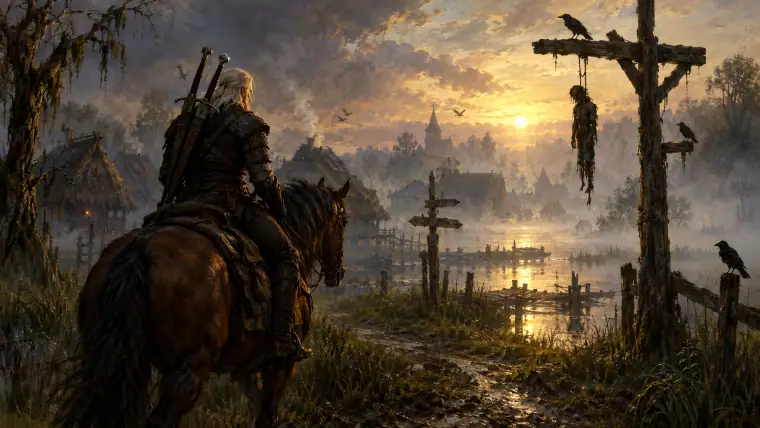
The Witcher introduced Geralt of Rivia to players worldwide and launched CD Projekt Red as a developer. Its morally gray choices and delayed consequences, drawn from Sapkowski's fiction, became the foundation of one of the most successful series in RPG history.
Overview
Geralt of Rivia wakes in the witchers' fortress of Kaer Morhen with no memory of who he is, just before bandits storm its walls and steal the secret mutagens that make witchers. Following the thieves, he comes to Vizima, capital of Temeria, a city quarantined by plague and split between religious zealots, racist mobs and elven guerrillas. Nobody in it is innocent. The Witcher, released in Europe on October 26, 2007, and in North America four days later, was the first game by Poland's CD Projekt Red and the first to bring Andrzej Sapkowski's witcher saga to an international audience. It was rough, ambitious and unmistakably Eastern European, and it began one of the great franchises in role-playing games.
Origins
CD Projekt, founded in 1994 by Marcin Iwiński and Michał Kiciński, began by importing and localizing Western games for Poland, including Baldur's Gate and the German Gothic series, which the developers later called a primary influence. Around 1997 another Polish studio, Metropolis Software, had licensed Sapkowski's novels, but the project got no further than early material and a single playable level. CD Projekt approached Sapkowski and bought the rights for about 35,000 złoty. The author wanted the whole sum up front instead of royalties; he later said he had no interest in video games and looked at the deal purely financially.
The new studio, CD Projekt Red, licensed BioWare's Aurora Engine, the technology behind Neverwinter Nights, and rebuilt much of it. Environments were modeled individually rather than assembled from tiles, and the team added its own renderer, weather, a day-night cycle and motion-captured animation. Atari signed on to publish outside Central and Eastern Europe.
How it plays
The game can be played from two isometric cameras or over Geralt's shoulder. Combat is built on timing: the player chooses among fast, strong and group styles, clicks in rhythm to chain blows into combos, and switches between Geralt's two swords, steel for humans and silver for monsters. Witcher signs provide simple magic. Alchemy matters as much as swordplay: Geralt brews potions that let him see in the dark or regenerate faster, oils for his blades and bombs, and each potion raises his body's toxicity.
The heart of the game is choice, borrowed from the books' preference for lesser evils over clear heroes. Geralt must decide whether to side with the Order of the Flaming Rose, a knightly order with a fanatical streak, or the Scoia'tael, elven insurgents who resort to terror, or with neither. Consequences are deliberately delayed, often surfacing acts later, so players cannot easily reload to undo them. Familiar characters from the novels, among them the bard Dandelion, the sorceress Triss Merigold, the dwarf Zoltan Chivay and King Foltest, appear alongside new ones, and the story reaches toward the saga's larger threats: the Wild Hunt and the prophesied White Frost. Sexual encounters were marked by collectible cards, a feature censored for the North American release and much criticized since.
Reception & impact
Reviews were largely positive, with a Metacritic score of 81. Critics admired the atmosphere, the mature writing and the alchemy, and complained about long loading times, clumsy translation and cut dialogue in the English version. It was nominated for Role-Playing Game of the Year by the Academy of Interactive Arts & Sciences, losing to Mass Effect. In September 2008 CD Projekt Red released an Enhanced Edition, free to existing owners, with rewritten translations, over 200 new animations, load times cut by about 80 percent and two new adventures. Co-founder Kiciński said it cost about $1 million, a significant investment for the young company. The same instinct to support players after release would define the studio's reputation.
An attempt to bring the game to consoles as The Witcher: Rise of the White Wolf, rebuilt by the French developer Widescreen Games with a new combat system, was halted in April 2009 amid a dispute over payments and missed deadlines.
Legacy
The Witcher 2: Assassins of Kings followed in 2011, on CD Projekt Red's own engine, and The Witcher 3: Wild Hunt in 2015 made Geralt one of the most famous characters in games and paved the way for Netflix's The Witcher series, which premiered in 2019. Much of the series' DNA is present in the first game: the grim humor, the monster contracts, the refusal to let the player be simply good. In October 2022 CD Projekt Red announced a remake of The Witcher in Unreal Engine 5, first teased under the codename "Canis Majoris" and developed mainly by Fool's Theory under the studio's creative supervision.
Marginalia
- Sapkowski sold the game rights for about 35,000 złoty and insisted on being paid up front rather than in royalties; he later said he had no interest in video games at the time.
- An earlier Witcher game licensed around 1997 by Metropolis Software never got past a playable level.
- It was built on BioWare's Aurora Engine, which powered Neverwinter Nights, heavily modified with CD Projekt's own renderer.
- Many choices take effect only acts later, which the designers intended to discourage save-and-reload decision-making.
- Geralt carries two swords: steel for humans and silver for monsters.
- A planned console version, Rise of the White Wolf, was halted in 2009 after a payment dispute with its French developer.
- A remake built in Unreal Engine 5 was announced in October 2022, developed by Fool's Theory under CD Projekt Red's supervision.
Quick answers
- When was The Witcher first released?
- The Witcher was first released in 2007 (Windows).
- Who created The Witcher?
- The Witcher was made by Andrzej Sapkowski (author of the source saga).
- Who published or developed The Witcher?
- CD Projekt / CD Projekt Red.
- What kind of work is The Witcher?
- The Witcher is an action RPG in the Action RPGs & Hack-and-Slash and Western Computer RPGs (CRPG) tradition, released for Microsoft Windows and Mac OS X (2012).
- Why is The Witcher important?
- The Witcher introduced Geralt of Rivia to players worldwide and launched CD Projekt Red as a developer. Its morally gray choices and delayed consequences, drawn from Sapkowski's fiction, became the foundation of one of the most successful series in RPG history.