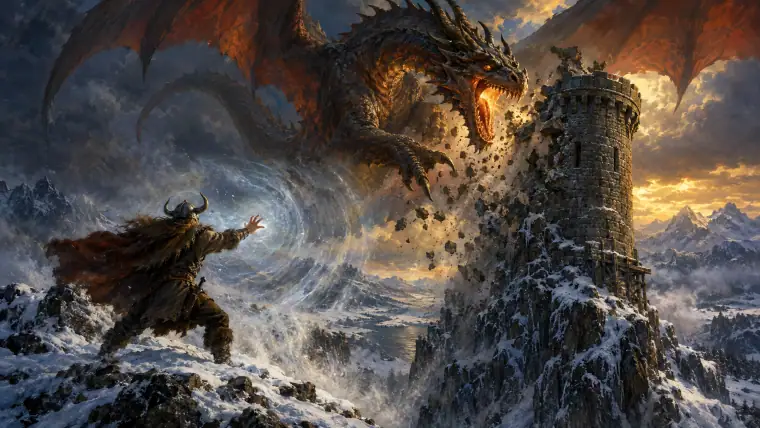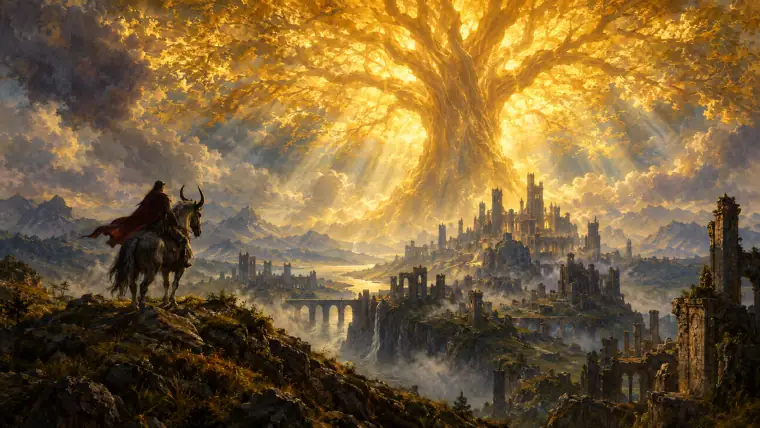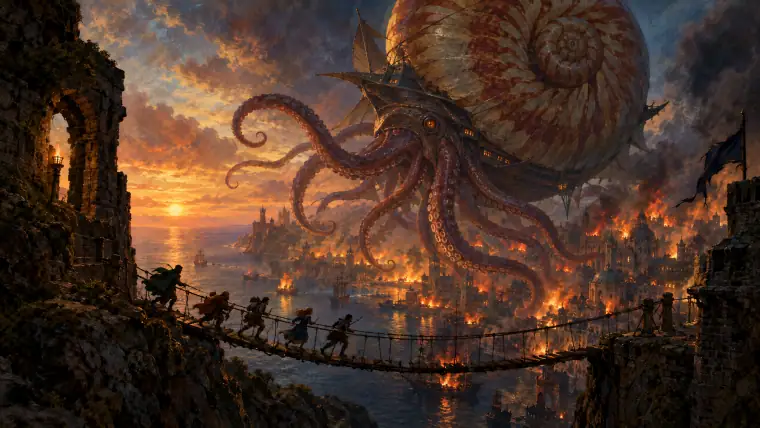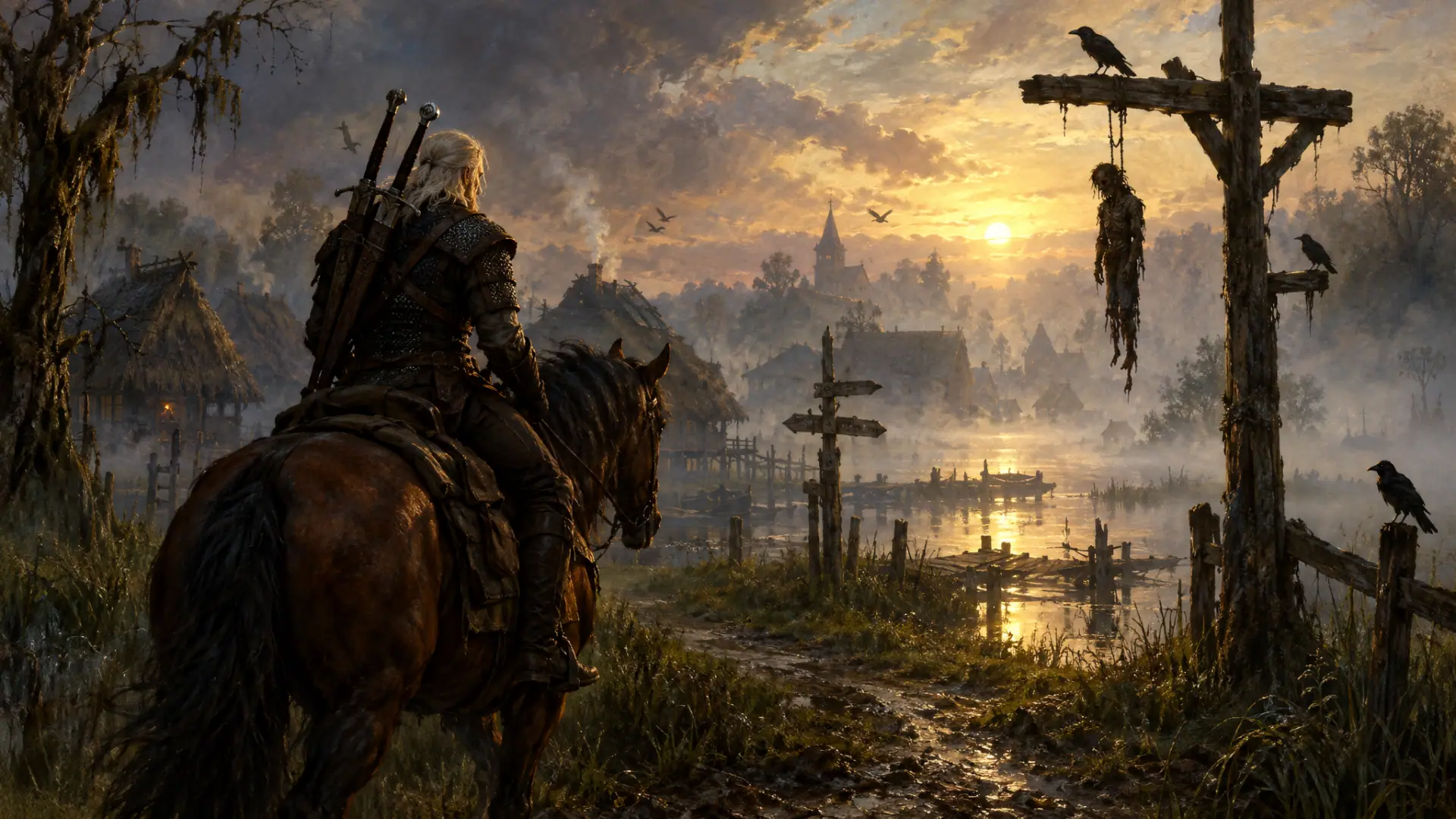
The Witcher 3 raised the bar for storytelling in open-world games, turning even minor side quests into morally complex short stories. It made CD Projekt Red a world-class studio and brought Sapkowski's saga to tens of millions of players.
Overview
Geralt of Rivia is looking for Ciri, the girl he raised as a daughter, who has come back into the world with the Wild Hunt, a host of spectral riders, on her trail. The search takes him through Velen, a swampland stripped bare by the war between the Nilfgaardian Empire and the Northern Kingdoms; the free city of Novigrad, where witch hunters burn mages; and the Viking-flavored isles of Skellige. Along the way he takes contracts on monsters, plays cards, and gets drawn into other people's tragedies, like that of the Bloody Baron, a drunken warlord searching for the wife and daughter he drove away.
The Witcher 3: Wild Hunt, developed and published by CD Projekt Red and released on May 19, 2015, for PlayStation 4, Windows and Xbox One, completed the trilogy begun with The Witcher (2007) and moved it into a vast open world. It sold four million copies in two weeks and more than 60 million by May 2025, won more than 250 Game of the Year awards, and is widely ranked among the greatest games ever made.
Origins
Production was planned for 2008 but delayed by the abortive console version of the first game; it began in earnest in 2011 and lasted about three and a half years. The self-funded budget has been estimated at between $67 million and $81 million. The team grew from 150 to more than 250 in-house staff, with about 1,500 people involved worldwide. The game drew on Andrzej Sapkowski's witcher saga, but is not an official continuation; Sapkowski's involvement was limited to the game's map. The script, about 450,000 words with 950 speaking roles, was written in Polish and English simultaneously.
The world drew on Poland, Amsterdam and Scandinavia, and on Slavic folklore for its monsters: nekkers, leshens, noonwraiths and the three grotesque Crones of Crookback Bog. When the developers first played through the open world it felt empty, so they filled it with points of interest. Game director Konrad Tomaszkiewicz and senior designer Damien Monnier cited Dark Souls and Demon's Souls as influences on combat, and level designers pointed to The Legend of Zelda and Red Dead Redemption. Writing was meant to be witty and morally ambiguous, and side quests were given personalities rather than being simple fetch tasks. Composer Marcin Przybyłowicz worked with the Polish folk band Percival, who play reconstructed medieval instruments, and battle sounds were recorded at a reenactment of the Battle of Grunwald.
How it plays
Geralt fights with two swords, steel for humans and silver for monsters, dodges and parries, and uses five magical Signs: a telekinetic blast, a mind trick, fire, a trap and a shield. For the first time in the series he can jump, climb and swim. Preparation matters: players research monsters in the bestiary, brew potions and blade oils, and choose tactics. "Witcher Senses" let Geralt track clues like a detective. His horse, Roach, carries him across the countryside.
The quests are the heart of the game. Monster contracts usually conceal human stories; side quests read like "dark fantasy short stories," as GamesRadar put it; and choices in the main story, including how Geralt treats Ciri, decide among three endings. Gwent, a collectible card game played in taverns, became a craze of its own.
Reception & impact
Critics praised its world, writing, characters and scale; GameSpot and Eurogamer gave it their highest ratings. Complaints concerned clumsy combat, bugs, a visual downgrade from early trailers and, from Polygon, the sexualization of female characters and the lack of people of color. It won Game of the Year at The Game Awards 2015 (along with Best RPG and Studio of the Year) and at the 2016 Game Developers Choice Awards, and was for several years the most-awarded game in history. Poland's president and prime minister visited the studio to celebrate its launch.
Two expansions deepened its reputation. Hearts of Stone (October 2015) set Geralt against a sinister Man of Glass; Blood and Wine (May 2016), set in the sunlit duchy of Toussaint, won Best RPG at The Game Awards 2016. Sales kept climbing, and the Netflix series drove a 554 percent jump in December 2019. A Switch port followed in 2019 and a free next-generation update in December 2022.
Legacy
The Witcher 3 set a new benchmark for quest design in open-world games, and its Bloody Baron questline is often held up as a model of how to write one. Hidetaka Miyazaki named it among the influences on Elden Ring. Gwent was spun off as a standalone free-to-play game in 2018. The studio's next game, Cyberpunk 2077 (2020), had a troubled launch, but The Witcher 3 remained its foundation, and a sequel, The Witcher IV, is in development. In August 2026 CD Projekt Red announced a remastered edition, as a free upgrade for owners, and a third expansion, Songs of the Past, planned for 2027. Few games have had so long and profitable a life: CD Projekt reported more than 65 million copies sold by May 2026.
Marginalia
- It was marketed, in co-founder Marcin Iwiński's words, as 'Skyrim in a Game of Thrones sauce.'
- Andrzej Sapkowski's involvement was limited to helping create the game's map; the story is not an official continuation of his novels.
- Game director Konrad Tomaszkiewicz cited Dark Souls and Demon's Souls as influences on its combat.
- Writers on early side quests were limited to 15 lines of dialogue and had to justify going over.
- The card game Gwent beat out other minigame ideas, including a drinking game, knife throwing and ice skating; it later became a standalone game.
- A reenactment of the Battle of Grunwald was recorded for battle sounds, with the speakers wearing helmets.
- Sales rose 554 percent in December 2019, when Netflix's Witcher series premiered, compared with the year before.
Quick answers
- When was The Witcher 3: Wild Hunt first released?
- The Witcher 3: Wild Hunt was first released in 2015 (PS4, Windows, Xbox One).
- Who created The Witcher 3: Wild Hunt?
- The Witcher 3: Wild Hunt was made by Andrzej Sapkowski (author of the source saga; contributed to the game's map) and Marcin Iwiński (CD Projekt co-founder).
- Who published or developed The Witcher 3: Wild Hunt?
- CD Projekt / CD Projekt Red.
- What kind of work is The Witcher 3: Wild Hunt?
- The Witcher 3: Wild Hunt is an action RPG in the Action RPGs & Hack-and-Slash, Open-World RPGs and Dark Fantasy tradition, released for PlayStation 4, Microsoft Windows, Xbox One, Nintendo Switch, PlayStation 5 and Xbox Series X/S.
- Why is The Witcher 3: Wild Hunt important?
- The Witcher 3 raised the bar for storytelling in open-world games, turning even minor side quests into morally complex short stories. It made CD Projekt Red a world-class studio and brought Sapkowski's saga to tens of millions of players.