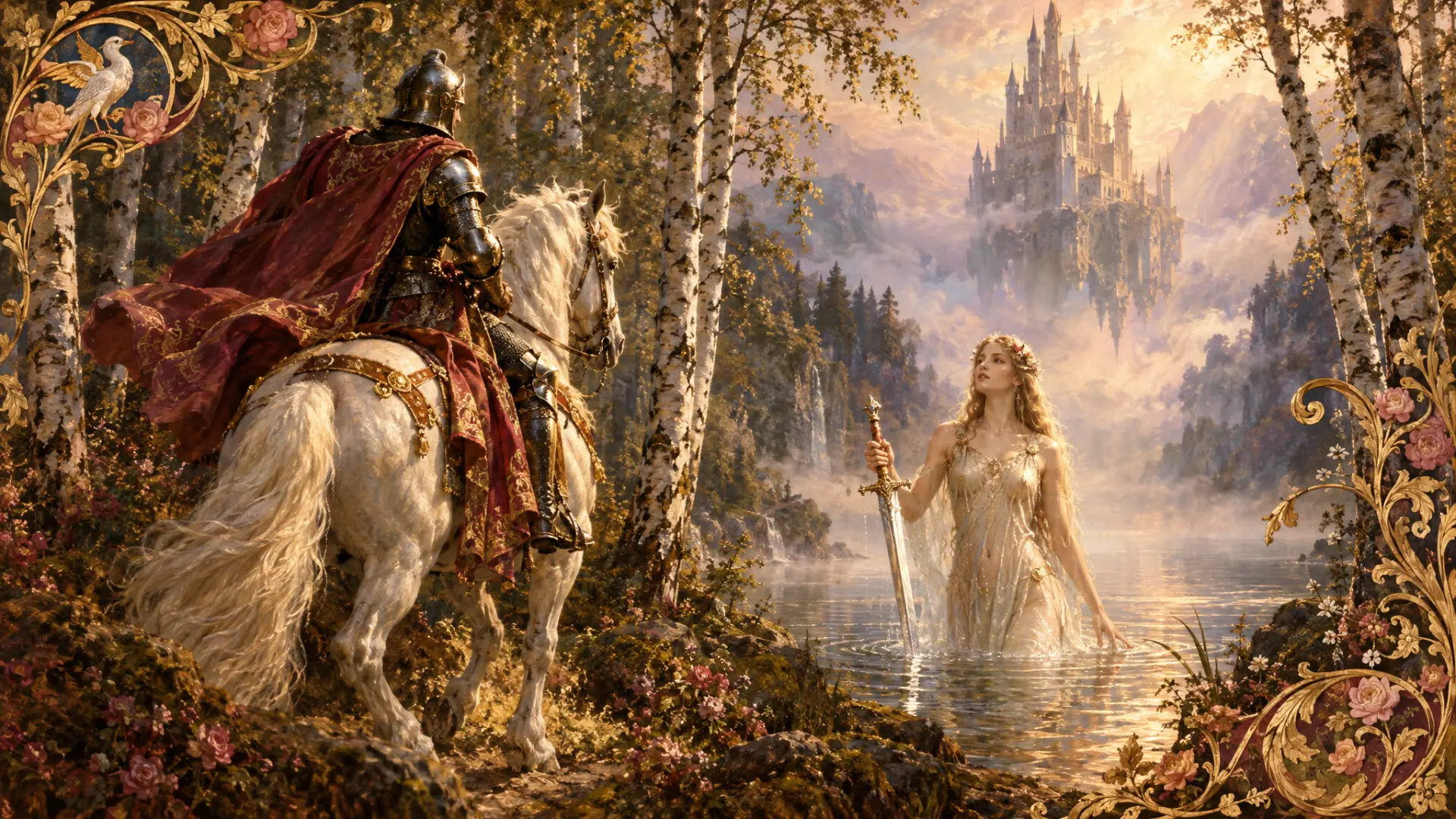
Hippogriffs over Ferrara, a fairy queen for Elizabeth, Mother Goose in Paris, haunted castles and the Brothers Grimm: three centuries in which Europe reinvented the marvelous.
In the ducal court of Ferrara in 1516, readers opened a new poem in which a knight named Astolfo climbs onto a winged horse with an eagle's head, flies to the Earthly Paradise, and rides on to the Moon in the prophet Elijah's fiery chariot. There, in a valley where everything lost on Earth ends up (squandered time, broken vows, unanswered prayers), he finds a flask containing the wits of his cousin Orlando, who has gone mad for love, and brings it home so the champion can sniff his sanity back up his nose. The poem was Ludovico Ariosto's Orlando Furioso, and its flying beast, the hippogriff, was a creature no one had ever described before. It is a fine emblem for the three and a half centuries in this chapter: the age when European writers took the inherited stories of the Middle Ages and began, playfully, knowingly, to invent. They gave fantasy its knights errant and fairy courts, its literary fairy tales, its haunted castles and vampires, and finally its scholars, the collectors who went out to gather the stories of the common people before they vanished. By the chapter's end the pieces of modern fantasy were lying on the workbench, waiting to be assembled.
Paladins take flight
The old French chansons de geste had sung of Charlemagne and his twelve peers, the paladins, fighting Saracens at Roncevaux. In Renaissance Italy these stern war-songs were crossed with the love-and-magic plots of Arthurian romance. Matteo Maria Boiardo's Orlando Innamorato (Orlando in Love, published after his death in 1495) left its story unfinished; Ariosto picked up the threads and wove Orlando Furioso, first printed in 1516 and published complete in 1532. It is a vast, laughing, multi-stranded poem of enchanted castles, magic rings and lances, the sorceress Alcina whose island turns lovers into trees, a sea monster called the Orc, and the warrior-woman Bradamante, whose armored adventures make her one of literature's great heroines. Torquato Tasso's Jerusalem Delivered (1581) gave the crusades the same treatment, with the enchantress Armida and her pleasure-garden.
Print made romance a mass commodity. In 1508 Garci Rodríguez de Montalvo published, in Zaragoza, his four-volume edition of Amadís de Gaula, a Spanish chivalric romance whose roots reach back to the fourteenth century, and it set off a century-long craze for sequels, imitations and continuations. Amadís and his countless successors fought giants, broke enchantments, rescued princesses from towers and were aided by wise enchantresses and hindered by wicked sorcerers, in books that sold like modern paperback series. This was fantasy's first commercial boom, complete with its first complaints from moralists that readers, especially young ones, were wasting their time.
These poems were the fantasy blockbusters of their day, and their DNA runs straight into games. Ariosto's Griffin-born hippogriff became a fixture of bestiaries and a mount in D&D. His interlaced plot, in which a dozen heroes pursue separate quests that cross and recross, is the structure of a long roleplaying campaign. And the Carolingian legend of the paladin had a direct modern descendant. The Danish paladin Ogier (Holger Danske) became the hero of Poul Anderson's Three Hearts and Three Lions (1953 magazine novella, 1961 novel), in which a modern engineer finds himself in a Carolingian fairy world as its champion of Law. From that novel D&D took its first Alignment axis of Law against Chaos, its Troll that regenerates unless burned, and much of the inspiration for the paladin class that appeared in the Greyhawk supplement of 1975. Gygax himself reportedly preferred to credit Charlemagne's paladins and the Arthurian knights directly, which only confirms the point: the holy warrior of a thousand character sheets was born in these poems.
The fairy queen's England
In 1590 Edmund Spenser published the first three books of The Faerie Queene, adding three more in 1596; at nearly 35,000 lines it remains one of the longest poems in English. Its fairyland is an allegory of Elizabethan England and its virtues, with Queen Elizabeth figured as Gloriana, but it reads as a sequence of quests. The Redcrosse Knight, the knight of Holiness, fights a monstrous serpent called Error and, after three days, a Dragon; the female knight Britomart rides out in disguise to find her destined love; the knight of Justice travels with Talus, a man of iron who punishes wrongdoers with an iron flail. Spenser is the missing link between Malory's romances and the invented worlds of the nineteenth century, and he was lovingly studied by C. S. Lewis, whose The Allegory of Love (1936) championed him.
Meanwhile the English stage was busy shrinking fairies. In William Shakespeare's A Midsummer Night's Dream (written between 1594 and 1596), Oberon and Titania quarrel in a wood near Athens while the mischievous Puck sets lovers at cross purposes; in Romeo and Juliet, Mercutio describes Queen Mab, no bigger than an agate stone. Shakespeare's The Tempest (around 1611) gave the stage the magus Prospero, his airy servant Ariel and the earthy Caliban. Christopher Marlowe's Doctor Faustus gave it the scholar who sells his soul for magical power. Between them these plays fixed the English image of elves and fairies as small, capricious and beautiful, an image that Tolkien would later reject in favor of the tall, grave, dangerous elves of older tradition.
The age's most influential response to romance, though, was a satire. Miguel de Cervantes's Don Quixote (1605, 1615) is about a Spanish gentleman who reads so many chivalric romances that he decides to become a knight errant, renames his nag, recruits a squire and rides out to live the stories. Readers of this museum will recognize the impulse. Don Quixote is the first great portrait of a person who wants to step into a fantasy world as a character, the desire that roleplaying games would one day organize and share.
Salons and the invention of the fairy tale
Oral folktales are as old as speech, but the literary fairy tale was an Italian and French invention. Giovanni Francesco Straparola's The Pleasant Nights (Venice, 1550s) slipped magical tales into a frame of storytelling evenings, including an early version of "Puss in Boots." Giambattista Basile's Neapolitan Pentamerone (published posthumously in 1634 and 1636) gathered fifty tales in a riotous dialect, among them early versions of Cinderella, Rapunzel and Sleeping Beauty. The Grimms would later acknowledge using his collection heavily.
The fashion came to a head in the Parisian salons of the 1690s. Aristocratic women, the conteuses, competed to tell elegant, ironic tales of fairies and enchanted princes, and in 1697 Marie-Catherine d'Aulnoy published Les Contes des Fées ("tales of the fairies"), which gave the genre its name and introduced a "Prince Charmant." That same year, on January 11, 1697, Charles Perrault published his Histoires ou contes du temps passé, better known as Mother Goose Tales: "Little Red Riding Hood," "Cinderella," "Sleeping Beauty," "Puss in Boots," "Bluebeard." Each ended with a neat verse moral. Beauty and the Beast followed in Gabrielle-Suzanne de Villeneuve's long novella of 1740, abridged by Jeanne-Marie Leprince de Beaumont in 1756 into the version still told today. And from 1704 Antoine Galland's French translation of One Thousand and One Nights fed the craze with genies, sorcerers and Baghdad.
These were the building blocks of Fairy-Tale Fantasy: talking animals and cursed princes, wicked stepmothers, godmothers, spells that break at midnight, and the rule-bound logic of the wish. They would pass to Disney, and they would be deliberately turned inside out by later writers. Andrzej Sapkowski's first Witcher stories, for instance, rework Beauty and the Beast and Snow White with a monster-hunter's cynicism, and so the fairy tale reached The Witcher 3: Wild Hunt.
The Gothic shudder
In 1764 the connoisseur and politician Horace Walpole published The Castle of Otranto, a novel about a usurper's family in a medieval castle where a giant helmet falls from the sky, portraits walk, and a prophecy comes true in blood. It is generally regarded as the first Gothic novel; in the second edition Walpole subtitled it "A Gothic Story." Its trappings, the crumbling castle, the secret passage, the tyrant, the curse, the persecuted heroine, the supernatural that may or may not be real, spread rapidly. William Beckford's Vathek (1786), an "Arabian tale" of a caliph who descends into the fiery halls of Eblis, introduced the Arabic Ghoul to English. Ann Radcliffe's The Mysteries of Udolpho (1794) and Matthew Lewis's lurid The Monk (1796) became bestsellers.
In the wet summer of 1816, at the Villa Diodati on Lake Geneva, Lord Byron proposed that each of his guests write a ghost story. Mary Shelley produced Frankenstein (1818). Byron's physician John Polidori developed a fragment of Byron's into The Vampyre (1819), whose aristocratic, seductive, predatory Lord Ruthven created the literary Vampire that Bram Stoker would inherit. The Romantic poets gave the same dread a lyric voice: in John Keats's ballad "La Belle Dame sans Merci" (1819), a knight is found alone and palely loitering on a cold hillside after a fairy lady took him to her grotto, where he dreamed of pale kings and warriors she had enthralled before him. Fairyland, in this telling, is beautiful and lethal, a note that later writers from Dunsany to Susanna Clarke would sound again. The Gothic also revived interest in the Werewolf and other shape-shifters of folklore, and it established the key of dread that runs through Dark Fantasy: the sense that the past is not dead, that noble houses are rotten, and that curiosity is punished.
The Gothic's afterlife in games is enormous. TSR's Ravenloft module (1983), with its vampire count brooding in his castle above a fog-bound village, is Walpole and Polidori in dungeon form, and it grew into an entire Gothic horror Campaign setting. White Wolf's Vampire: The Masquerade (1991) made Polidori's aristocratic predator a playable character. And the Gothic's other great invention, the unreliable old manuscript and the story of forbidden knowledge, passed down through Lovecraft (see Pulps, Weird Tales & Sword-and-Sorcery) to Call of Cthulhu.
The folk, the nation and the philologists
The eighteenth century ended with a new idea: that the true poetry of a nation lived not in courts but among its common people, in ballads and tales passed from mouth to mouth. James Macpherson's Fingal (1761), supposedly translated from an ancient Gaelic bard named Ossian, was a European sensation, and much of it was his own invention, a scandal argued over for decades. Thomas Percy's Reliques of Ancient English Poetry (1765) collected real ballads. In Germany the philosopher Johann Gottfried Herder urged scholars to gather the songs of the people. German Romanticism made the marvelous serious: Novalis's unfinished novel Heinrich von Ofterdingen (1802) gave the movement its symbol, a mysterious blue flower; Friedrich de la Motte Fouqué's Undine (1811) told of a water spirit who marries a knight to gain a soul; E. T. A. Hoffmann's "The Nutcracker and the Mouse King" (1816) brought fantasy into a bourgeois Christmas parlor.
Two brothers from Hesse, Jacob and Wilhelm Grimm, were philologists before they were storytellers, scholars of the history of language. On December 20, 1812 they published the first volume of their Kinder- und Hausmärchen, Children's and Household Tales, with 86 stories; a second volume of 70 followed in 1815, and through seven editions, the last in 1857, Wilhelm smoothed, softened and Christianized them into 200 tales plus ten legends. Jacob's Deutsche Mythologie (1835) reconstructed the lost pagan beliefs of the Germanic peoples from folktales and place names. Their world was full of the creatures fantasy still uses: the Kobold, a German house and mine sprite blamed for troubles underground (miners' lore is said to have given its name to the metal cobalt); goblins, witches in gingerbread houses, talking wolves, dwarves in the mountains, giants and enchanted unicorns.
The Grimms' method, collecting, comparing and reconstructing, spread across Europe as a patriotic science. In Finland the doctor Elias Lönnrot assembled folk songs into the Kalevala (1835; expanded 1849), which became a national epic; its tragic hero Kullervo would inspire Tolkien's Túrin Turambar. In Denmark, Hans Christian Andersen published his first Fairy Tales Told for Children on May 8, 1835, beginning a career of original, often heartbreaking tales like "The Little Mermaid" and "The Snow Queen." In Britain, Grímur Thorkelin's 1815 edition of Beowulf and Lady Charlotte Guest's translation of The Mabinogion (1838–45) made medieval texts readable for new audiences, while Walter Scott's Ivanhoe (1819) made the Middle Ages a popular fashion.
This is the direct academic ancestry of modern fantasy. Tolkien was, before anything else, a philologist in the Grimms' tradition, a man who thought that languages implied peoples and peoples implied myths, and who set out to write a mythology for England because he felt it had lost its own. George MacDonald, who opens the next chapter, was steeped in Novalis and the German Romantics.
1812: a coincidence of beginnings
It is worth pausing on the year 1812. In December the Grimms published their first volume of tales, the founding act of the scholarly fantasy tradition. That same year, in Prussia, Georg Leopold von Reisswitz presented his tabletop war game to King Frederick William III, the first step toward Kriegsspiel and the long chain of games that would lead to Dungeons & Dragons. One strand gathered the stories. The other built the machinery for playing them. They would not meet for a century and a half, until the fantasy supplement of Chainmail in 1971. The machinery's story has its own chapter, From Kriegsspiel to Dungeons & Dragons (with Georg von Reisswitz and his son in its opening pages); the story of the tales continues here.
What came next
By 1850 Europe had its fairy tales in print, its Gothic horrors on every circulating library's shelf, and its medieval epics edited and translated. What it did not yet have was a new kind of book: a novel set wholly in an invented world of magic, written for adults and meant to be believed while it was read. That invention belongs to Victorian Britain, to a Scottish minister's dream-romance, an Oxford mathematician's rabbit hole and a designer-socialist's quest romances, and it is the subject of The Invention of Modern Fantasy.