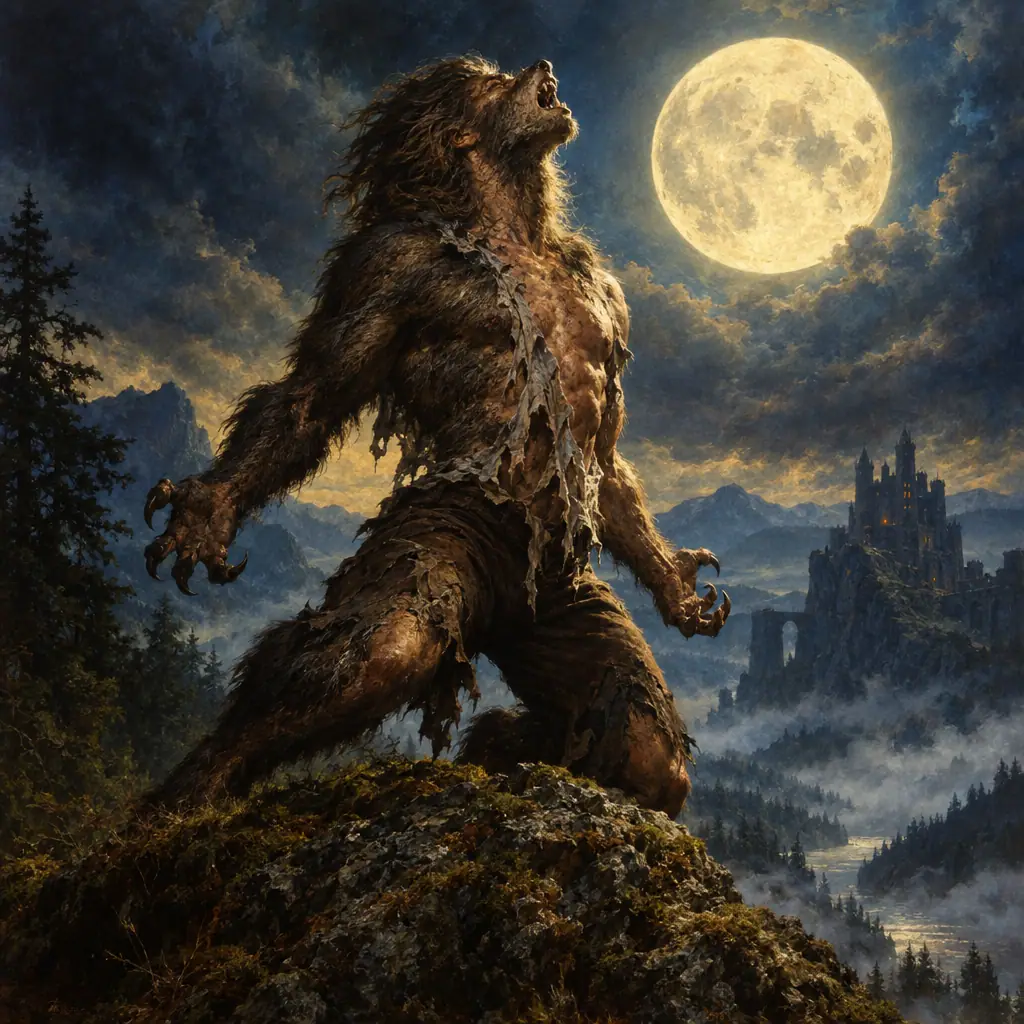
The werewolf is the rare monster that is also a condition: a curse, a disease or a gift that players can catch. That made it uniquely suited to roleplaying games, where the monster and the hero can be the same character.
Origins
Stories of people who become wolves are among the oldest in the menagerie. In the sixth tablet of the Epic of Gilgamesh, the hero refuses the goddess Ishtar by listing her former lovers and their fates — among them a shepherd she turned into a wolf, now chased by his own herd boys and bitten by his own dogs. Herodotus, writing around 430 BCE, reported that the Neuri, a people beyond Scythia, became wolves for a few days each year, though he did not believe it. Greek myth supplied the name: King Lycaon of Arcadia served human flesh to Zeus and was turned into a wolf, a story told by Pausanias and, most famously, by Ovid in the Metamorphoses. Around 60 CE Petronius put the first real werewolf tale into the Satyricon: a soldier strips off his clothes by a graveyard under the moon, urinates in a circle around them, and runs off howling as a wolf.
The word itself is Germanic — Old English werwulf, "man-wolf" — and medieval Europe was full of such creatures. Marie de France's Bisclavret (c. 1200) made one a sympathetic hero; later centuries made them defendants. In the witch-trial era lycanthropy and sorcery blurred together, and men such as Peter Stumpp, executed at Bedburg in 1589, were condemned as werewolves. Many of today's "rules" are much younger. Transmission by bite, the full moon as trigger and the silver bullet were codified by Hollywood, above all by Universal's The Wolf Man (1941) and its 1943 sequel, Frankenstein Meets the Wolf Man, the first film to tie the change to the full moon.
Into the dungeon
Dungeons & Dragons (1974) put the werewolf at the head of a family of lycanthropes — werewolves, wereboars, weretigers and werebears — with wererats added in the Greyhawk supplement (1975). A werewolf's face drawn by Tom Keogh, a childhood friend of Gary Gygax, is thought to be the oldest illustration in the game. D&D turned the curse into rules. Lycanthropy became both hereditary and infectious: natural lycanthropes change at will, while the afflicted change at the full moon and lose control of themselves. Early editions made werewolves immune to ordinary weapons, so a party needed silver or magic — a lesson in preparation that doubled as a nod to the movies. And because a bitten Player character could catch the disease, the werewolf became one of the first monsters players could turn into.
Computer RPGs seized on that possibility. Bethesda's Daggerfall (1996) let players contract lycanthropy and live with its hungers; Skyrim (2011) made it a questline, as the warriors of the Companions offer the player their secret "beast blood". On the tabletop, White Wolf followed Vampire: The Masquerade with Werewolf: The Apocalypse (1992), whose Garou are furious ecological warriors rather than cursed victims.
Variations
Folklore and games have multiplied the shape-shifter far beyond the wolf. D&D's were-creatures include rats, boars, bears and tigers; Japanese and Chinese tales offer fox spirits; West African and Central American traditions speak of people who share a soul with an animal. The werewolf also varies by meaning. The cursed werewolf of Ovid and the witch trials is punished for a crime; the afflicted werewolf of The Wolf Man is an innocent victim; the empowered werewolf of Skyrim and Werewolf: The Apocalypse embraces the beast as strength. Its nearest neighbors in the bestiary are the Vampire, its frequent rival in modern fiction, and the Ghoul, another hungry figure from the edge of the village.
Migration
How the creature traveled from story to story.
- 1200 BCEEpic of Gilgamesh, Tablet VIGilgamesh taunts Ishtar for turning a shepherd who loved her into a wolf; the Standard Babylonian version is dated only approximately.
- 430 BCEHerodotus, HistoriesThe Neuri of Scythia are said to become wolves for a few days each year.
- 8Ovid, Metamorphoses (c. 8 CE)Zeus turns King Lycaon of Arcadia into a wolf for serving him human flesh, giving 'lycanthropy' its root.
- 60Petronius, Satyricon (c. 60 CE)Niceros tells a banquet of a soldier who strips by moonlight and becomes a wolf.
- 1589Bedburg, GermanyPeter Stumpp is executed as a werewolf, one of many trials in which lycanthropy and witchcraft blurred.
- 1941The Wolf Man (Universal)Hollywood fixes the modern rules: a bite spreads the curse and silver kills; the full-moon trigger followed in its 1943 sequel.
- 1974Original D&D boxed setWerewolves lead a family of lycanthropes whose condition spreads like a disease.
- 2011The Elder Scrolls V: SkyrimJoining the Companions lets the player take the 'beast blood' and hunt as a werewolf.
Marginalia
- 'Werewolf' is from Old English werwulf, 'man-wolf'; 'lycanthrope' is from Greek lykánthrōpos, 'wolf-human'.
- The silver-bullet cure is largely modern; the claim that the Beast of Gévaudan was shot with silver appears only in retellings from 1935 on.
- Marie de France's lai Bisclavret (c. 1200) makes its werewolf a sympathetic nobleman betrayed by his wife.
- A werewolf's face by Tom Keogh, Gygax's childhood friend, is thought to be the oldest piece of art in original D&D.
- In D&D, lycanthropy is both hereditary and infectious, and early editions required silver or magic weapons to harm a werewolf.
- Daggerfall (1996) let players catch lycanthropy and become werewolves or wereboars.
Quick answers
- Where does the Werewolf come from?
- Ancient Near Eastern and Greek myth (Gilgamesh, Herodotus, Lycaon); European folklore and witch trials.
- When did the Werewolf first appear?
- c. 1200 BCE, in Epic of Gilgamesh, Tablet VI.
- How did the Werewolf get into games?
- Key appearances: Original D&D boxed set (1974) and The Elder Scrolls V: Skyrim (2011).
- Why is the Werewolf significant?
- The werewolf is the rare monster that is also a condition: a curse, a disease or a gift that players can catch. That made it uniquely suited to roleplaying games, where the monster and the hero can be the same character.