Spenser fused Malory's Arthur with Ariosto's enchantments into the English quest epic, gave literature the knight defined by a virtue, and shaped C. S. Lewis — while provoking Tolkien's famous distaste for allegory.
Overview
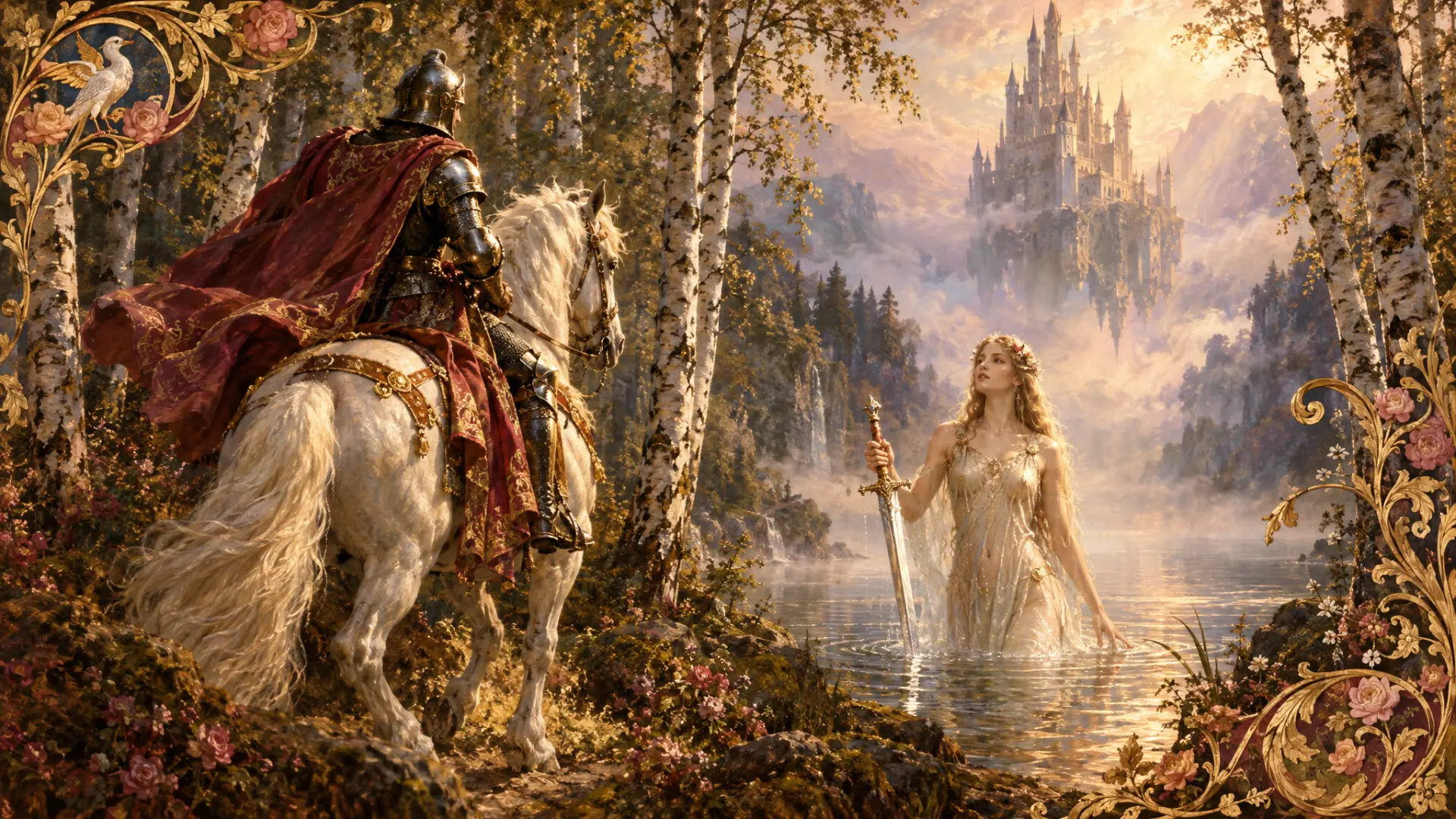
The Faerie Queene is the most ambitious poem of the English Renaissance: an epic romance in which knights errant ride out from the court of Gloriana, the Faerie Queene, each to accomplish a single quest and, in doing so, to embody a single virtue. Holiness, Temperance, Chastity, Friendship, Justice and Courtesy each have a book and a champion. Through all of them wanders Prince Arthur, the future king, in love with the Faerie Queene he has seen only in a dream.
The poem is at once a fantasy adventure — dragons, giants, witches, enchanted castles, false wizards and shape-shifting temptresses — and a dense allegory of Protestant theology, moral philosophy and Elizabethan politics. Gloriana stands for Elizabeth I, to whom the poem is dedicated.
Origins
Edmund Spenser was an English poet and colonial official in Ireland, and he wrote the poem partly as a bid for royal favor. He modeled it on Italian romance epics, above all Ludovico Ariosto's Orlando Furioso and Torquato Tasso's Jerusalem Delivered, and drew his Arthur from the British legendary history of Geoffrey of Monmouth and the romance tradition behind Le Morte d'Arthur.
He devised a new verse form for it, the Spenserian stanza: eight lines of iambic pentameter followed by a longer alexandrine, rhymed ababbcbcc. Books I–III appeared in 1590 and Books IV–VI in 1596. A fragment of a seventh book, the "Cantos of Mutabilitie", was published in 1609, a decade after Spenser's death. Of the planned twelve books, only half were ever finished.
The story
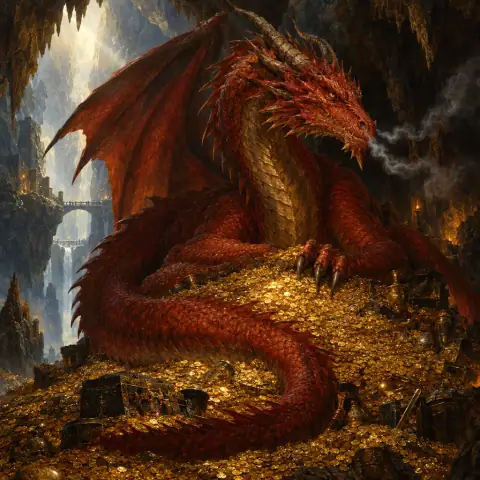
Book I is the most self-contained and the best loved. The Redcrosse Knight rides out with the lady Una to free her parents from a dragon. In the Wandering Wood he kills the serpent-woman Error; he is then separated from Una by the sorcerer Archimago, seduced by the witch Duessa, imprisoned by the giant Orgoglio and nearly talked into suicide by Despair, before Arthur rescues him and he is restored in the House of Holiness. His final battle with the dragon lasts three days; twice he falls, and twice he is healed — by the Well of Life and the balm of the Tree of Life — before he slays the beast.
Later books widen the canvas. Guyon, Knight of Temperance, descends into the Cave of Mammon and destroys the Bower of Bliss. Britomart, a warrior-maiden modeled on Ariosto's Bradamante, rides in search of the knight she has seen in a magic mirror. Artegall, Knight of Justice, is attended by Talus, a tireless iron man who dispenses merciless justice with a flail. Calidore, Knight of Courtesy, hunts the Blatant Beast, a monster of slander that is captured but finally breaks loose into the world again.
Reception & impact
Spenser was hailed in his own time and became, in Charles Lamb's phrase, "the poets' poet". Milton called him a better teacher than Scotus or Aquinas; Keats's first known poem was an "Imitation of Spenser"; the Romantics loved him for his dreamlike landscapes. For readers of fantasy, the poem's lasting significance is that it made the quest through a perilous enchanted land the vehicle of an inner, moral struggle.
That idea split the two greatest Oxford fantasists. C. S. Lewis revered Spenser: The Allegory of Love (1936) ends with a major study of the poem, and his lectures on it were published posthumously as Spenser's Images of Life. The author of The Chronicles of Narnia, with their knights, witches and Christian symbolism, was one of the 20th century's great Spenserians. J. R. R. Tolkien, by contrast, declared in the foreword to the second edition of The Lord of the Rings that he cordially disliked allegory "in all its manifestations", and his Middle-earth was built to be history, not emblem.
Legacy
No rulebook cites Spenser the way Dungeons & Dragons cites Robert E. Howard, but the poem's building blocks are everywhere in fantasy gaming. Book I is a complete dungeon-crawl campaign in miniature: a monster in a wood, a false wizard, a giant's castle, a rescue, and a climactic three-day Dragon fight with restorative springs along the way. Talus, the tireless iron servant, belongs to the long lineage of artificial guardians. Britomart and her Italian original stand behind the armored woman knight who became a staple of fantasy art and fiction.
Most striking is the idea of heroes defined by moral virtues. Spenser's knights of Holiness and Justice are ancestors, in spirit, of the virtue-bound paladin and of games that treat character as a question of ethics — from D&D's Alignment to Richard Garriott's Ultima IV: Quest of the Avatar (1985), which made the pursuit of eight virtues the goal of play. The parallel is one of kinship rather than documented debt, but four centuries apart, both Spenser and Garriott asked an adventure story to make its hero better, not just stronger.
Marginalia
- Spenser planned twelve books, each following a knight who embodies one virtue; he finished six.
- Spenser invented his own nine-line stanza for the poem, closing each with a longer alexandrine line.
- In Book I the Redcrosse Knight fights a dragon for three days, falling twice and being revived by the Well of Life and the balm of the Tree of Life.
- Artegall, Knight of Justice, is attended by Talus, an iron man who never sleeps or tires.
- The warrior-maiden Britomart, Knight of Chastity, is modeled on Ariosto's Bradamante.
- Keats's first known poem was titled 'Imitation of Spenser'.
Quick answers
- When was The Faerie Queene first published?
- The Faerie Queene was first published in 1590 (Books I–III); 1596 (Books IV–VI); 1609 (Mutability Cantos).
- What kind of work is The Faerie Queene?
- The Faerie Queene is an epic poem in the Arthurian Fantasy, Myth & Epic and High / Epic Fantasy tradition.
- Why is The Faerie Queene important?
- Spenser fused Malory's Arthur with Ariosto's enchantments into the English quest epic, gave literature the knight defined by a virtue, and shaped C. S. Lewis — while provoking Tolkien's famous distaste for allegory.