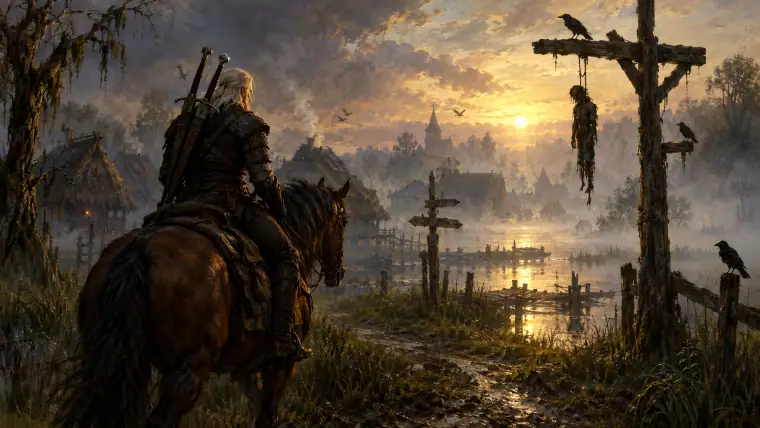
The Witcher is the most successful book-to-game translation in the history of the RPG, and the pre-eminent case of a non-English fantasy conquering the Anglophone market largely because players met it first on screen.
Overview
For most of the world, Geralt of Rivia was a video game character before he was a literary one. That is the peculiar and revealing fact at the heart of The Witcher. Andrzej Sapkowski's stories and novels, written in Polish between 1986 and 1999, were already a national phenomenon when CD Projekt Red turned them into a computer RPG in 2007. The games carried Geralt, Yennefer and Ciri to tens of millions of players, and the players, in turn, carried the books onto English-language bestseller lists. No other fantasy saga has traveled so far by that route.
Origins
Sapkowski, born in Łódź in 1948, was working as a senior sales representative for a foreign trade company when, at his son's urging, he entered a short-story competition run by the magazine Fantastyka in 1986. His story, "Wiedźmin" ("The Witcher"), took third prize and delighted readers: a grim retelling of a Polish folk tale about a cursed princess, narrated with modern irony. More stories followed, collected as Sword of Destiny (1992) and The Last Wish (1993), and in 1994 Sapkowski began a five-novel saga with the Warsaw publisher superNOWA: Blood of Elves (1994), Time of Contempt (1995), Baptism of Fire (1996), The Tower of the Swallow (1997) and The Lady of the Lake (1999).
The story
Geralt is a witcher, one of a dwindling brotherhood of mutants trained from childhood at the fortress of Kaer Morhen and altered by alchemy to hunt monsters for money. The early stories subvert fairy tales — Snow White, Beauty and the Beast — and put Geralt into moral traps where the monster is rarely the worst thing in the room. The novels widen into war: the southern empire of Nilfgaard invades the Northern Kingdoms, and everyone wants Ciri, the princess of fallen Cintra, whose Elder Blood gives her power over time and space. Geralt is bound to her by the Law of Surprise, and with the sorceress Yennefer he becomes her unlikely father.
The saga's tone — political, profane, skeptical of heroes, attentive to racism against elves and dwarves — made it a cornerstone of Central European Dark Fantasy and a precursor of the Grimdark turn in English-language fiction.
Reception & impact
In Poland the books were bestsellers, and Sapkowski became a six-time winner of the Zajdel Award; a film and television series, both called The Hexer, appeared in 2001–02. The decisive adaptation came from CD Projekt, the company co-founded by Marcin Iwiński in 1994. Sapkowski had sold the game rights for a lump sum, declining a share of profits; the first game, The Witcher (2007), built on a modified version of BioWare's Aurora engine, continued the story roughly five years after The Lady of the Lake. The Witcher 2 (2011) and The Witcher 3: Wild Hunt (2015) followed; The Witcher 3 alone passed 60 million copies sold by 2025.
The games' success sent English publishers scrambling. Gollancz published Danusia Stok's translation of Blood of Elves in 2008, with Orbit following in the US; the novel won the David Gemmell Legend Award in 2009. The remaining saga volumes reached English readers over the next decade, many translated by David French. In October 2018 Sapkowski invoked Polish copyright law to demand 60 million złoty in further compensation from CD Projekt; the parties settled amicably on December 20, 2019.
Legacy
Netflix's series premiered on December 20, 2019, with Henry Cavill as Geralt; Liam Hemsworth took over the role in the fourth season in 2025, and the fifth and final season finished filming in October 2025. Sapkowski returned to the Continent with the prequels Season of Storms (2013) and Crossroads of Ravens (Polish, November 2024; English, September 30, 2025), about the young Geralt's first days on the Path. CD Projekt Red is developing a fourth game.
The books have been translated into 37 languages and had sold more than 15 million copies by 2020. Their journey — Polish magazine, national bestseller, game franchise, global book sensation, streaming series — is the clearest demonstration that in the 21st century, games can make a literary reputation as surely as critics can.
Marginalia
- The first Witcher story won third prize in a 1986 short-story competition run by the Polish magazine Fantastyka.
- Sapkowski sold the video game rights for a lump sum rather than royalties; in 2018 he demanded 60 million złoty, and the dispute was settled amicably in December 2019.
- CD Projekt Red's first Witcher game (2007) is set about five years after the final novel, The Lady of the Lake.
- Blood of Elves won the David Gemmell Legend Award in 2009, fifteen years after its Polish debut.
- A new prequel, Crossroads of Ravens, appeared in Poland in November 2024 and in English on September 30, 2025.
- By September 2026 the Witcher games had sold more than 90 million copies, over 65 million of them The Witcher 3.
Quick answers
- When was The Witcher Saga first published?
- The Witcher Saga was first published in 1986 (first story); 1993–99 (books); 2013, 2024.
- Who created The Witcher Saga?
- The Witcher Saga was made by Andrzej Sapkowski (author).
- What kind of work is The Witcher Saga?
- The Witcher Saga is a book series in the Dark Fantasy and Low Fantasy tradition.
- Why is The Witcher Saga important?
- The Witcher is the most successful book-to-game translation in the history of the RPG, and the pre-eminent case of a non-English fantasy conquering the Anglophone market largely because players met it first on screen.