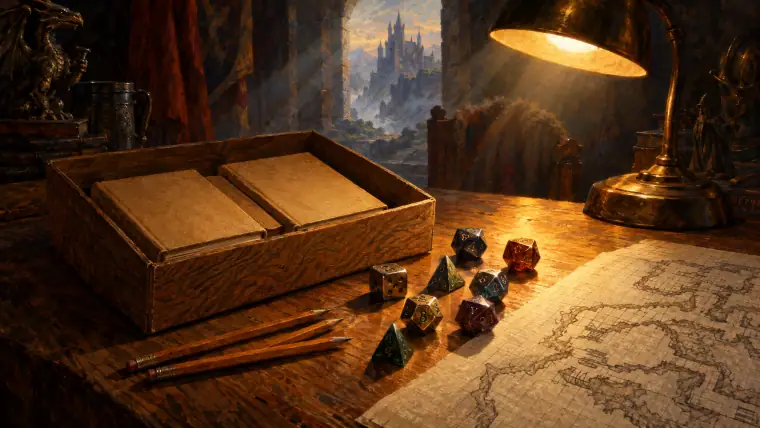
The OSR preserved and reinterpreted the original play style of D&D after the company moved on, and its zines, blogs and small presses became one of the most creative corners of 21st-century tabletop design.
Hallmarks
- Rulings over rules: the referee adjudicates clever plans instead of consulting a rulebook
- Player skill over character abilities — outwit the monster, don't just out-fight it
- High lethality, fast character creation and no guaranteed story arc
- Dungeons, hexcrawls and sandboxes built for exploration and treasure
- Retro-clones and compatible rules modeled on 1974–1983 editions of D&D
- A DIY culture of blogs, zines, small presses and striking art
What it is
The Old-School Renaissance — or Revival; the OSR — is a movement of players and designers who draw on the earliest era of roleplaying, especially the editions of Dungeons & Dragons published between 1974 and the early 1980s. It is less a single game than a play style and a community. At the table, OSR play means characters who are quick to make and easy to lose, dungeon crawls and hexcrawls built for exploration, treasure as the main source of experience, and a referee who makes rulings on the spot rather than looking up rules. It deliberately rejects the assumption that a campaign should deliver a satisfying story arc for each character: the dice, and the players' choices, decide.
Matthew Finch's Quick Primer for Old School Gaming (2008) boiled the ethos into four principles: rulings over rules; player skill over character abilities; heroic rather than superheroic; and game balance is not important — if the monster is too strong, run away.
Origins
When D&D moved to its third edition in 2000, many long-time players stayed with the older games. Some of the first attempts to serve them were HackMaster (2001) and Castles & Crusades (2004). On forums such as Dragonsfoot, Knights & Knaves Alehouse and Original D&D Discussion, players talked about what "old school" meant, and the terms "old school revival" (2004) and "old school renaissance" (2005) appeared.
The key tool was, ironically, a product of the new edition: Wizards of the Coast's The Open Game License. It allowed independent designers to reproduce game mechanics, and they used it to build retro-clones — legal restatements of out-of-print rules — beginning with OSRIC (2006), which emulated first-edition AD&D, and Labyrinth Lord (2007) and Swords & Wizardry (2008). With the rules in print again, new adventures could be published for them.
Evolution
From 2008 zines such as Fight On! and Knockspell appeared, and a dense network of blogs spread ideas about dungeon design, random tables and sandbox play. Print-on-demand and PDF storefronts made small-press publishing viable. James Raggi's Lamentations of the Flame Princess (2010) pushed the scene toward weird, early-modern horror; Goodman Games' Dungeon Crawl Classics Role Playing Game (2012) built a lavish game around Gygax's Appendix N reading list, famously starting each player with a "funnel" of doomed peasants. Necrotic Gnome's Old-School Essentials (2019) restated the 1981 Basic/Expert rules with exceptional clarity.
The movement also became an art scene. Pelle Nilsson and Johan Nohr's Swedish Mörk Borg (2019) married a stripped-down, doom-laden ruleset with graphic design that looks like a black-metal zine. By the early 2020s the scene had split into sub-labels — "Classic OSR," "OSR-adjacent," "Nu-OSR" or "NSR" and more. Its influence reached the mainstream too: Wizards of the Coast began reprinting classic D&D materials in 2012, possibly in response to the demand the OSR had revealed.
Its design culture has distinctive tools. OSR books favor random tables, one-page dungeons, "megadungeons" meant to be explored over dozens of sessions, and Sandbox campaigns in which players choose where to go and the referee reacts. A TPK is treated not as a failure of design but as a possible outcome of bad choices — and a reason to roll new characters in minutes.
How to tell it apart
- OSR vs. modern D&D: both descend from the same game, but modern editions give characters many defined abilities, assume heroic survival and balance encounters; OSR games expect players to avoid fights, solve problems in the fiction and accept death. The question at the table is "what do you do?" rather than "what's on your character sheet?"
- OSR vs. Narrative & Story Games (incl. Powered by the Apocalypse): both were reactions to 1990s–2000s mainstream design, in opposite directions. Narrative games share authorial control over the story; OSR games keep the referee as neutral arbiter of a world and let story emerge from play.
- OSR vs. nostalgia: "Revival" emphasizes returning to old rules; "Renaissance" emphasizes new work in the old spirit — Mörk Borg shares almost no rules with 1974 D&D but much of its ethos.
Where to start
- Dungeons & Dragons and Dungeons & Dragons Basic Set — the source texts.
- Old-School Essentials — the clearest modern presentation of B/X D&D.
- The Keep on the Borderlands — the classic starting adventure, still widely played.
- Dungeon Crawl Classics Role Playing Game — Appendix N as a game, funnel and all.
- Mörk Borg — the OSR as punk art object.
Marginalia
- The phrases "old school revival" and "old school renaissance" first appeared on the Dragonsfoot forum in 2004 and 2005.
- Retro-clones such as OSRIC (2006), Labyrinth Lord (2007) and Swords & Wizardry (2008) used the Open Game License to legally reproduce early D&D rules.
- Matthew Finch's free Quick Primer for Old School Gaming (2008) set out four principles, including "rulings, not rules" and "player skill, not character abilities."
- A 2018 survey found most respondents read the R in OSR as "renaissance" rather than "revival."
- Necrotic Gnome's Old-School Essentials (2019) restates the 1981 Basic/Expert rules in a clean modern layout.
- Wizards of the Coast began reissuing early D&D books and PDFs in 2012, possibly responding to demand the OSR had revealed.
Quick answers
- What is Old-School Renaissance (OSR)?
- A movement to play roleplaying games the way they were played in the 1970s — deadly dungeons, clever players, rulings not rules — built on legal clones of early D&D and grown into a vibrant DIY scene.
- What are the hallmarks of Old-School Renaissance (OSR)?
- Rulings over rules: the referee adjudicates clever plans instead of consulting a rulebook; Player skill over character abilities — outwit the monster, don't just out-fight it; High lethality, fast character creation and no guaranteed story arc; Dungeons, hexcrawls and sandboxes built for exploration and treasure; Retro-clones and compatible rules modeled on 1974–1983 editions of D&D; A DIY culture of blogs, zines, small presses and striking art.
- When did Old-School Renaissance (OSR) emerge?
- Terms coined 2004–05; retro-clones from 2006; a broad movement by the 2010s.
- Where does the name “Old-School Renaissance (OSR)” come from?
- "Old school revival" (2004) and "old school renaissance" (2005) were first used on the Dragonsfoot forum.
- What are the key works of Old-School Renaissance (OSR)?
- Old-School Essentials, Dungeon Crawl Classics Role Playing Game, Mörk Borg, Dungeons & Dragons, Dungeons & Dragons Basic Set, The Keep on the Borderlands and Tomb of Horrors.