Tomb of Horrors made the killer dungeon a genre of its own: a puzzle-box of traps rather than a gauntlet of monsters. It remains D&D's most infamous adventure and has been updated for nearly every edition.
Overview
Tomb of Horrors is an Adventure module by Gary Gygax, first run as a tournament dungeon at the 1975 Origins convention and published by TSR, Inc. in 1978 as S1, the first of its "Special" series. Its premise is simple: somewhere in a lonely hill lies the crypt of Acererak, a wizard who has lingered for centuries in undead form, guarding treasure the player characters want. Its execution is famously, gleefully cruel.
Where most dungeons of the era tested characters with a procession of monsters, the Tomb tests players. It is full of tricks, illusions and traps designed, in the words of Lawrence Schick's later foreword, not to challenge intruders but "to kill them dead." Surviving it depends on caution, observation and luck far more than on sword arm or spell list.
Origins
Gygax wrote the adventure for the official D&D tournament at Origins I, the first Origins convention, in 1975, developing it from an idea by Alan Lucien, one of his playtesters. He gave two reasons for building it. His own Lake Geneva campaign had several very expert players whose characters had come to seem invincible — he specifically named Rob Kuntz's Robilar and Ernie Gygax's Tenser — and he wanted something to test them. And he was ready, he said, for convention players who boasted of mighty characters able to beat anything.
When TSR began publishing the Lake Geneva tournament scenarios as modules, Gygax revised the Tomb in late 1977 for the new Advanced Dungeons & Dragons rules. The 1978 edition came in a folder with a twenty-page adventure booklet and a separate twelve-page book of illustrations, and it was reissued in 1981 with a full-color cover.
How it plays
A module like this is a script for the referee, not a game in itself. The Game Master reads the booklet in advance, then describes the Tomb to the players room by room, playing its guardians and applying its traps, while the players — running high-level characters, often pregenerated for the purpose — decide what to touch, open or avoid. The illustration book let the referee show players exactly what their characters saw: a painted corridor, a leering stone face, an altar.
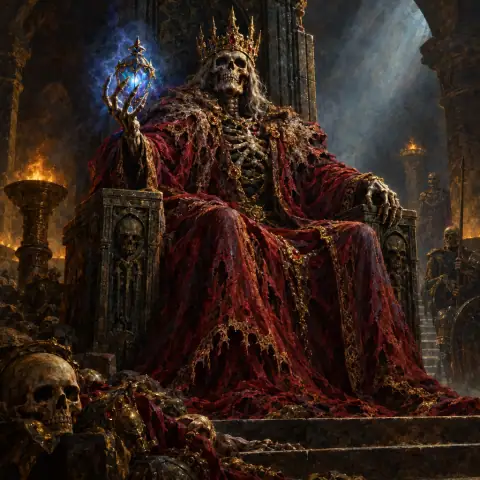
That is where the danger lies. The Tomb has thirty-three keyed encounters, starting with two false entrances. Its most famous feature is a great green devil face whose open mouth is filled with blackness; an unwary character who crawls inside is simply annihilated. There is a "Huge Pit Filled with 200 Spikes," a cavern of gold and silver mists that can render characters idiots, doors that are not doors, and messages from Acererak taunting the intruders. Many of the deaths offer no dice roll to escape and no warning beyond what an attentive player might notice in the description. At the end waits Acererak, who has become a demi-lich — a floating skull set with gems, far more dangerous than the Lich he once was.
A typical session is slow and tense: players poke at walls with ten-foot poles, argue over riddles, and watch characters die one by one. A TPK, or total party kill, is a common outcome and part of the legend.
Reception & impact
Reviewing it in White Dwarf #13, Don Turnbull gave the module ten out of ten, warning that the Tomb was "very hard" and that a referee needed to study it carefully to run it properly. Reviewers since have agreed it was a departure: a dungeon built as a collection of puzzles and maps rather than a monster hunt. Players developed notorious countermeasures, including driving cattle ahead of the party to trigger traps. The adventure earned bumper-sticker boasts of "I survived the Tomb of Horrors," and in 2004 Dungeon magazine ranked it the third-greatest D&D adventure of all time.
It also crystallized a debate that has never ended, over whether such "gotcha" design is great fun or bad refereeing. Its defenders and critics agree on one thing: nobody forgets it.
Legacy
Few adventures have been revisited so often. TSR published Return to the Tomb of Horrors (1998) for second edition; Wizards of the Coast released a 3.5-edition update as a free download for Halloween 2005, two 2010 versions for fourth edition, a D&D Next playtest version in 2013, and a fifth-edition conversion in Tales from the Yawning Portal (2017). Acererak returned as the mastermind of the 2017 campaign Tomb of Annihilation.
Its influence spread to computer games — Black Isle's Feargus Urquhart cited the Tomb when describing the trap-filled dungeons of Icewind Dale — and to fiction, most visibly Ernest Cline's novel Ready Player One, whose hero must survive a virtual recreation of the Tomb. Among the "deadly dungeon" tradition in the Old-School Renaissance (OSR), it remains the benchmark.
Marginalia
- Gygax wrote it for the tournament at the first Origins convention in 1975; TSR published it as module S1 in 1978.
- He said he meant it to foil the invincible characters of his own veteran players, among them Rob Kuntz's Robilar and Ernie Gygax's Tenser.
- The module came with a separate book of illustrations to show players as they explored — a novelty at the time.
- Its villain, Acererak, has become a demi-lich: a Lich reduced to a jeweled skull.
- Some players drove herds of cattle ahead of them to spring its traps, a tactic Wired's Lore Sjöberg judged "a bit less than heroic."
- It is the dungeon at the heart of Ernest Cline's 2011 novel Ready Player One.
Quick answers
- When was Tomb of Horrors first released?
- Tomb of Horrors was first released in 1975 (Origins tournament); 1978 (published as module S1).
- Who created Tomb of Horrors?
- Tomb of Horrors was made by Gary Gygax (designer and writer).
- Who published or developed Tomb of Horrors?
- TSR, Inc. and Wizards of the Coast.
- What kind of work is Tomb of Horrors?
- Tomb of Horrors is an adventure module in the Tabletop Roleplaying Games tradition, released for Adventure module (booklet plus illustration booklet in a folder).
- Why is Tomb of Horrors important?
- Tomb of Horrors made the killer dungeon a genre of its own: a puzzle-box of traps rather than a gauntlet of monsters. It remains D&D's most infamous adventure and has been updated for nearly every edition.