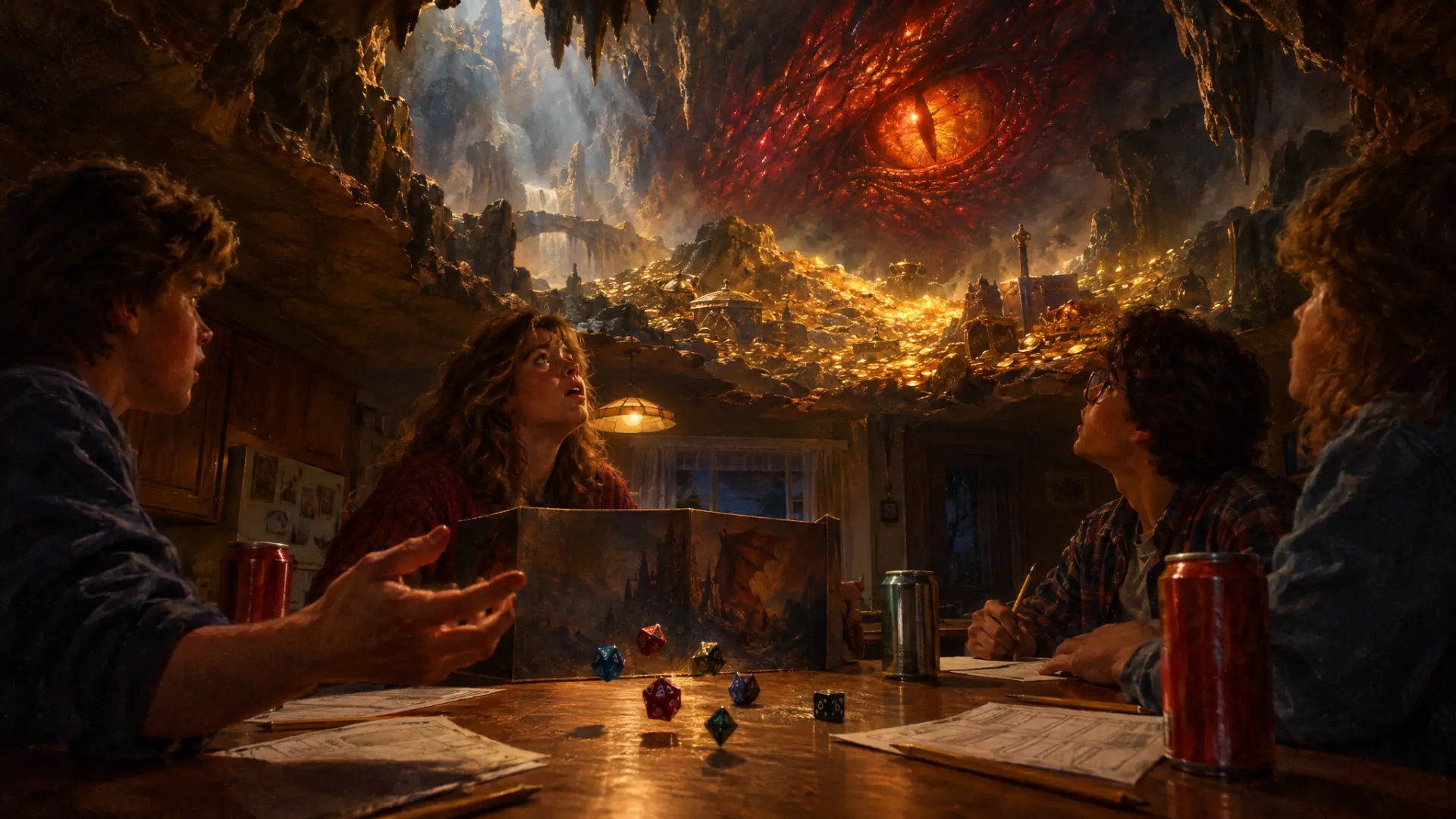
Stafford made myth, religion and culture the heart of roleplaying. Glorantha, RuneQuest and Pendragon offered an alternative to the dungeon-crawl model, and the company he founded published games from Call of Cthulhu to Stormbringer that shaped the whole hobby.
Life
Francis Gregory Stafford was born on February 9, 1948. As a freshman at Beloit College in Wisconsin in 1966 he began writing stories and myths about an imaginary world, and he never stopped. That world, Glorantha, would occupy him for more than fifty years. He settled in the San Francisco Bay Area, where in 1975 he founded Chaosium, and spent most of his working life as its guiding spirit.
Stafford's interest in myth was not only literary. He was a lifelong student of world mythology and himself a practicing shaman, an experience that fed directly into the cults, rituals and spirit worlds of his games. He died on October 10, 2018, at the age of 70, having returned three years earlier to lead the company he had founded.
Work
Glorantha's first public form was a board game. White Bear and Red Moon (1975) was a wargame of the struggle between the expanding Lunar Empire and the barbarian kingdoms of Dragon Pass. After publishers turned it down, Stafford founded Chaosium to print it himself. The game was notable for its mythic depth, with heroes and magic on the battlefield and hints of a vast history behind the conflict.
Chaosium soon grew into one of the most important publishers of the roleplaying boom. Its first great RPG was RuneQuest (1978), designed by Steve Perrin and colleagues to explore Glorantha, with Stafford supplying the world. In RuneQuest, characters belonged to cultures and joined the cults of particular gods, whose magic they learned in exchange for devotion; the result made religion and mythology as central to play as combat. Stafford wrote or co-wrote much of the Glorantha material that followed, including, with Sandy Petersen, Trollpak (1982), a celebrated sourcebook on the setting's trolls, and he co-wrote Griffin Mountain (1981) with Jennell Jaquays and Rudy Kraft.
As publisher he gave Chaosium a remarkable range. Out of RuneQuest's rules came Basic Role-Playing (1980), the engine of Call of Cthulhu (1981), Ken St. Andre's Stormbringer (1981) and more. Stafford also co-designed Ghostbusters (1986) for West End Games with Petersen and Lynn Willis, a light system whose dice-pool ideas later grew into West End's d6 System.
His own favorite work was King Arthur Pendragon (1985), a roleplaying game of Arthurian chivalry based closely on Sir Thomas Malory's Le Morte d'Arthur. Players ran knights whose personality traits (Chaste or Lustful, Merciful or Cruel) were measured and tested, and whose families carried the campaign forward across the generations of Arthur's reign. Stafford considered it his masterpiece. He followed it with the Prince Valiant storytelling game (1989), based on Hal Foster's comic strip.
In 1998 Stafford left Chaosium, taking Glorantha with him, and founded Issaries, Inc. to publish Hero Wars (2000), later renamed HeroQuest, a narrative-driven game built for mythic storytelling. He also worked on King of Dragon Pass (1999), a computer game of clan leadership in Glorantha. In 2015, after the Glorantha publisher Moon Design took over Chaosium, he returned as president and chief executive, overseeing a revival of RuneQuest and Glorantha before his death.
Legacy
Stafford's influence is visible wherever a roleplaying world is built from culture outward rather than from the dungeon up. Glorantha's gods, heroes and history made it, with M. A. R. Barker's Tékumel, a model of Mythic Fantasy worldbuilding in games, and Pendragon's trait system anticipated later games that reward playing to a character's personality.
He received the industry's highest honors, including induction into the Origins Hall of Fame in 1987 and the Diana Jones Award, and Pyramid magazine named him in 1999 among the most influential people in adventure gaming of the millennium.
Marginalia
- Stafford began creating Glorantha in 1966 as a freshman at Beloit College in Wisconsin.
- When no publisher would take his Glorantha board game White Bear and Red Moon, he founded Chaosium in 1975 to publish it himself.
- Chaosium published RuneQuest (1978), Call of Cthulhu (1981) and King Arthur Pendragon (1985), which Stafford considered his masterpiece.
- He co-designed West End Games' Ghostbusters RPG (1986) and worked on the Glorantha computer game King of Dragon Pass (1999).
- He left Chaosium in 1998 with the Glorantha rights, founding Issaries, Inc., and returned as its president and CEO in 2015.
- Stafford was a practicing shaman, and his study of myth and ritual shaped the religions of his games.
Quick answers
- Who was Greg Stafford?
- The founder of Chaosium and creator of Glorantha, a mythic world he began imagining as a college freshman in 1966, who later considered his Arthurian RPG King Arthur Pendragon his masterpiece.
- When was Greg Stafford born?
- Greg Stafford was born in 1948 and died in 2018.
- What is Greg Stafford known for?
- Greg Stafford is best known for RuneQuest, King Arthur Pendragon and Call of Cthulhu.
- Why does Greg Stafford matter to fantasy and games?
- Stafford made myth, religion and culture the heart of roleplaying. Glorantha, RuneQuest and Pendragon offered an alternative to the dungeon-crawl model, and the company he founded published games from Call of Cthulhu to Stormbringer that shaped the whole hobby.