The tarrasque shows the full migration from saint's legend to game statistics. A local Provençal dragon became the tabletop's ultimate threat, the kaiju that high-level parties measure themselves against.
Origins
The tarrasque began as the Tarasque, a Dragon of the lower Rhône. According to legends written down between the late twelfth and the thirteenth century, a monster lived in the woods and waters between Arles and Avignon, at a place then called Nerluc. It overturned boats and ate the men who tried to cross the river. The texts describe it as half beast and half fish, thicker than an ox and longer than a horse, with teeth like swords. The Golden Legend of Jacobus de Voragine (c. 1260s), the most widely read telling, said it was the offspring of the biblical Leviathan. The people asked Saint Martha, the sister of Lazarus, who in Provençal tradition had come to Gaul after the Crucifixion, to help. She found the beast devouring a man, sprinkled it with holy water, held up a cross, and led it, now tame, on her girdle to the townspeople. They killed it with stones and spears. The town, today's Tarascon, made the beast its emblem.
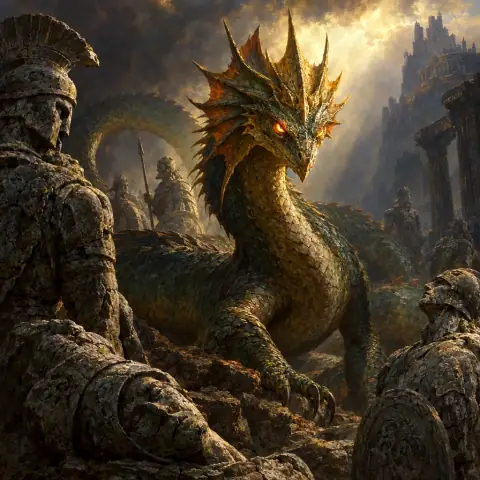
Local art settled the monster's look: a lion's head, a turtle-like shell, six clawed legs and a serpent's tail, often with a man's legs sticking out of its mouth. By tradition, in 1474 René of Anjou began parading an effigy of the Tarasque at Pentecost. The festival continues each June, and in 2005 the Tarasque was listed among the "Processional Giants and Dragons in Belgium and France" that UNESCO named Masterpieces of the Oral and Intangible Heritage of Humanity.
Into the dungeon
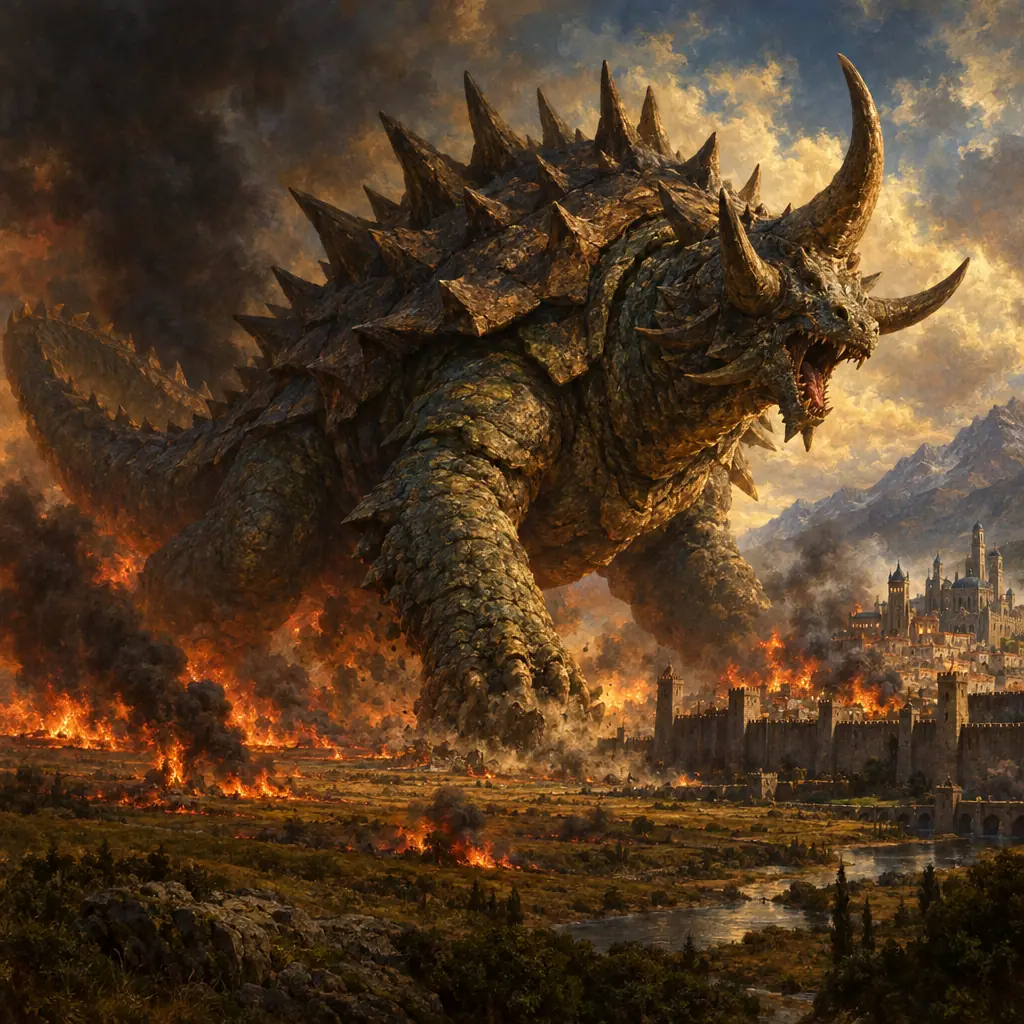
Gary Gygax took the name, added an R, and made something far larger. The tarrasque of Monster Manual II (1983), for Advanced Dungeons & Dragons, is only very loosely based on the legend. It is a lizard 50 feet tall and 70 long, built like a Tyrannosaurus but broader, with a caramel-colored shell over its back and two horns jutting forward. Later rulebooks called it "the most dreaded monster native to the Prime Material plane." Its hide was excellent armor, most magic had no effect on it, and it regenerated wounds quickly, like a Troll on an enormous scale. Under the rules, the only certain way to kill it was to drive it far below zero Hit points and then use a wish.
The tarrasque was built as a monster almost no party should fight, and so it became the benchmark for the highest-level parties. The second edition added rules for salvaging treasure from its carcass, and in 1991 the Spelljammer book Practical Planetology invented a world, Falx, that held several hundred of them. Third edition (2000) kept it as the Monster Manual's ultimate brute. Because it was included in the open d20 rules, Paizo could use it in Pathfinder's first Bestiary (2009), where it is the mightiest of the Spawn of Rovagug, a monster that can return even from death. Fourth edition recast it as an "abomination," a living weapon made by the primordials to use against the gods. The fifth edition Monster Manual (2014) gave it 676 hit points, Challenge Rating 30, the highest in the book, and a reflective carapace that can send a spell back at its caster.
Variations
Critics compare the tarrasque to a kaiju, and the comparison fits. It is closer to Godzilla than to the chained dragon of Tarascon, and it belongs with the Kraken among the few monsters built to threaten cities, not parties. The medieval Tarasque has its own descendants. The Spanish tarasca is a float in Corpus Christi processions, and the French army named a 20 mm anti-aircraft gun after it.
In the game the tarrasque is less a creature than a problem to be solved. Groups have long debated how to defeat it: by trapping it, banishing it or distracting it, since few can simply kill it. That makes it the tabletop's best-known end-of-the-world threat. The story it came from was different. There, the monster was defeated without a fight by a woman armed with holy water, a cross and a belt.
Migration
How the creature traveled from story to story.
- 1200Latin lives of Saint Martha (pseudo-Marcella, c. 1187–1221)The earliest texts describe a river monster on the Rhône near Tarascon, half beast and half fish, subdued by Martha with holy water and a cross.
- 1260The Golden Legend (Jacobus de Voragine, c. 1260s)The most influential telling: a lion-headed, shell-backed, six-legged dragon with a serpent's tail, said to be the offspring of the biblical Leviathan.
- 1474Tarascon, ProvenceBy tradition René of Anjou begins parading an effigy of the Tarasque at Pentecost, a festival that survives today.
- 1983AD&D Monster Manual II (TSR)Gygax turns the local dragon into a unique, all-devouring colossus: armored, spell-resistant and regenerating.
- 2000D&D 3rd Edition Monster ManualThe tarrasque is the book's apex monster and enters the open d20 rules that other publishers could use.
- 2005UNESCOTarascon's Tarasque is listed among the Processional Giants and Dragons of Belgium and France, a Masterpiece of the Oral and Intangible Heritage of Humanity.
- 2009Pathfinder Roleplaying Game Bestiary (Paizo)Paizo makes the tarrasque the mightiest Spawn of Rovagug, herald of its god of destruction.
- 2014D&D 5th Edition Monster ManualChallenge Rating 30, the highest in the book, with a carapace that can reflect spells back at their caster.
Marginalia
- The Tarasque of legend was tamed by Saint Martha, who led it on her girdle to the townspeople, who then stoned it to death.
- Tarascon, the town on the Rhône, bears the beast on its coat of arms, and its effigy is still paraded at an annual festival in late June.
- The D&D version debuted in Gary Gygax's Monster Manual II (1983), only very loosely based on the French legend.
- The game added an R: the saint's dragon is the Tarasque, the D&D monster the tarrasque.
- In the 5th Edition Monster Manual (2014) it has 676 hit points and Challenge Rating 30.
- A 1991 Spelljammer book, Practical Planetology, placed several hundred tarrasques on the planet Falx.
Quick answers
- Where does the Tarrasque come from?
- The Tarasque of Tarascon, a Provençal dragon tamed by Saint Martha in medieval legend; reimagined by Gary Gygax in Monster Manual II (1983)
- When did the Tarrasque first appear?
- 1983, in AD&D Monster Manual II (TSR).
- How did the Tarrasque get into games?
- Key appearances: AD&D Monster Manual II (TSR) (1983), D&D 3rd Edition Monster Manual (2000), Pathfinder Roleplaying Game Bestiary (Paizo) (2009) and D&D 5th Edition Monster Manual (2014).
- Why is the Tarrasque significant?
- The tarrasque shows the full migration from saint's legend to game statistics. A local Provençal dragon became the tabletop's ultimate threat, the kaiju that high-level parties measure themselves against.