4th Edition was the most mechanically radical D&D ever published; its controversy split the player base and gave rise to Pathfinder, while many of its ideas quietly survived into 5th Edition.
Overview
Fourth Edition is the Dungeons & Dragons that dared to start over. Announced at Gen Con on August 15, 2007 and released in June 2008, it rebuilt the game around a clear tactical engine: every character, whether wizard or fighter, chose from a menu of powers usable at will, once per encounter or once per day, and combat played out on a grid of squares with miniatures. The result was the most balanced and the most divisive edition in the game's history.
For its admirers it was an elegant tactics game with a roleplaying layer, easy for a game master to prepare and hard to break. For its critics it felt like a board game or a video game rather than D&D. Both camps agreed it was different.
Origins
By 2007 3rd Edition and its 3.5 revision had grown heavy with supplements, and high-level play had become notoriously difficult to run: spellcasters dominated, and monsters took hours to stat. Wizards of the Coast set out to fix those problems at the root. Rob Heinsoo led the design, and the Player's Handbook was credited to Heinsoo, Andy Collins and James Wyatt. Preview books appeared in December 2007 and January 2008 ahead of the June launch.
Wizards also rethought the business. The new rules were not released under the Open Game License; third parties instead signed a more restrictive Game System License. The company invested in D&D Insider, a subscription of online tools including a character builder and a rules compendium.
How it plays
Every class in 4th Edition used a shared structure. At-will powers could be used every turn; encounter powers once per fight; daily powers once per day. A fighter's "Brute Strike" and a wizard's "Sleep" were written in exactly the same format. This parity ended the old imbalance in which spellcasters grew godlike while warriors swung swords, and it made every character's turn tactically interesting.
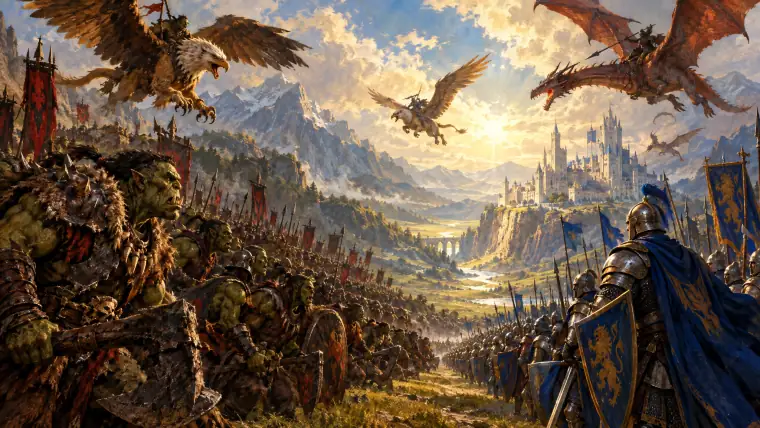
Classes were organized by roles. Defenders (fighter, paladin) held enemies' attention; leaders (cleric, warlord) healed and buffed; strikers (rogue, ranger, warlock) dealt concentrated damage; controllers (wizard) shaped the battlefield with area effects. Powers imposed conditions, created zones and pushed, pulled or slid enemies across the grid, making positioning central.
Other rules reshaped play. Healing surges gave each character a daily reservoir of recovery, spent during short rests or by allies' powers. Action points allowed an occasional extra action. Monsters were "bloodied" at half their Hit points, a cue that often triggered special abilities, and "minions" with a single hit point let game masters field hordes. Non-combat challenges used skill challenges — structured sequences of checks. Characters advanced through thirty levels in three tiers: heroic, paragon and epic. Defenses beyond Armor Class — Fortitude, Reflex and Will — became static targets that attackers rolled against.
Reception & impact
The launch was commercially strong: the initial print run sold out during preorders. But the reaction among existing players was sharp. Many compared its roles, cooldown-like powers and grid combat to MMORPGs such as World of Warcraft, and online "edition wars" grew bitter. Some groups stayed with 3.5, and a large number followed Paizo to the Pathfinder Roleplaying Game, built on the open 3.5 rules; for stretches between 2011 and 2014 Pathfinder was the top-selling roleplaying game.
Wizards responded with Essentials in September 2010, a simplified line with more traditional class designs intended to lower the barrier to entry. It also revived settings for the new rules, including Dark Sun in 2010. By 2012 Wizards had announced a new edition developed through public playtesting.
Legacy
4th Edition's reputation has softened with time. Its encounter design, monster math and clear roles are widely admired by game masters, and its ideas spread into other games: 13th Age (2013), from Heinsoo and Jonathan Tweet, carried much of its spirit forward. Dungeons & Dragons 5th Edition rejected 4th Edition's grid-first presentation but kept short rests, hit-dice healing descended from healing surges, and the idea that every class should have meaningful choices every turn.
Its greatest historical consequence may be the one it did not intend. By closing the door to open licensing, 4th Edition made room for Pathfinder — proof that the D&D rules had become a commons larger than D&D itself.
Marginalia
- Every class, fighter included, used the same power structure: at-will, once-per-encounter and once-per-day abilities.
- Classes were defined by party roles — defender, leader, striker and controller.
- Healing surges let characters recover between fights without relying entirely on a cleric.
- Minions — monsters with a single hit point — let game masters stage cinematic battles against hordes.
- The initial print run of the core books sold out during preorders.
- Wizards replaced the open The Open Game License with a more restrictive Game System License for third parties.
Quick answers
- When was Dungeons & Dragons 4th Edition first released?
- Dungeons & Dragons 4th Edition was first released in 2008 (June).
- Who published or developed Dungeons & Dragons 4th Edition?
- Wizards of the Coast.
- What kind of work is Dungeons & Dragons 4th Edition?
- Dungeons & Dragons 4th Edition is a tabletop RPG in the Tabletop Roleplaying Games tradition, released for Player's Handbook, Dungeon Master's Guide, Monster Manual and D&D Insider online tools.
- Why is Dungeons & Dragons 4th Edition important?
- 4th Edition was the most mechanically radical D&D ever published; its controversy split the player base and gave rise to Pathfinder, while many of its ideas quietly survived into 5th Edition.