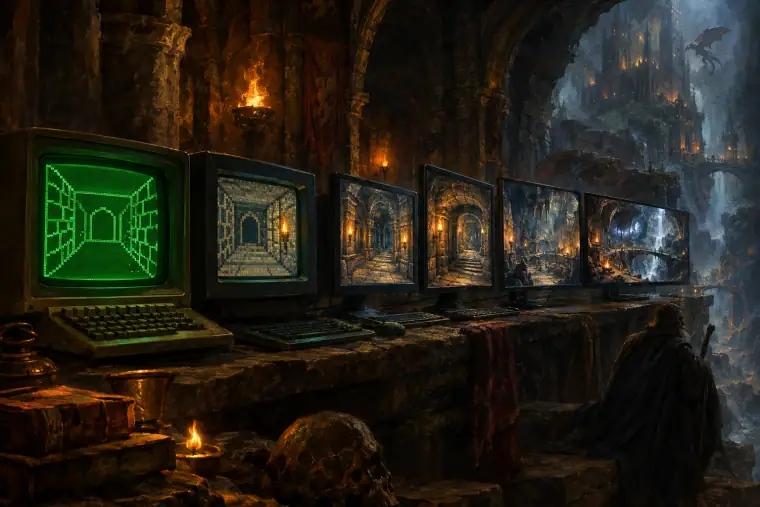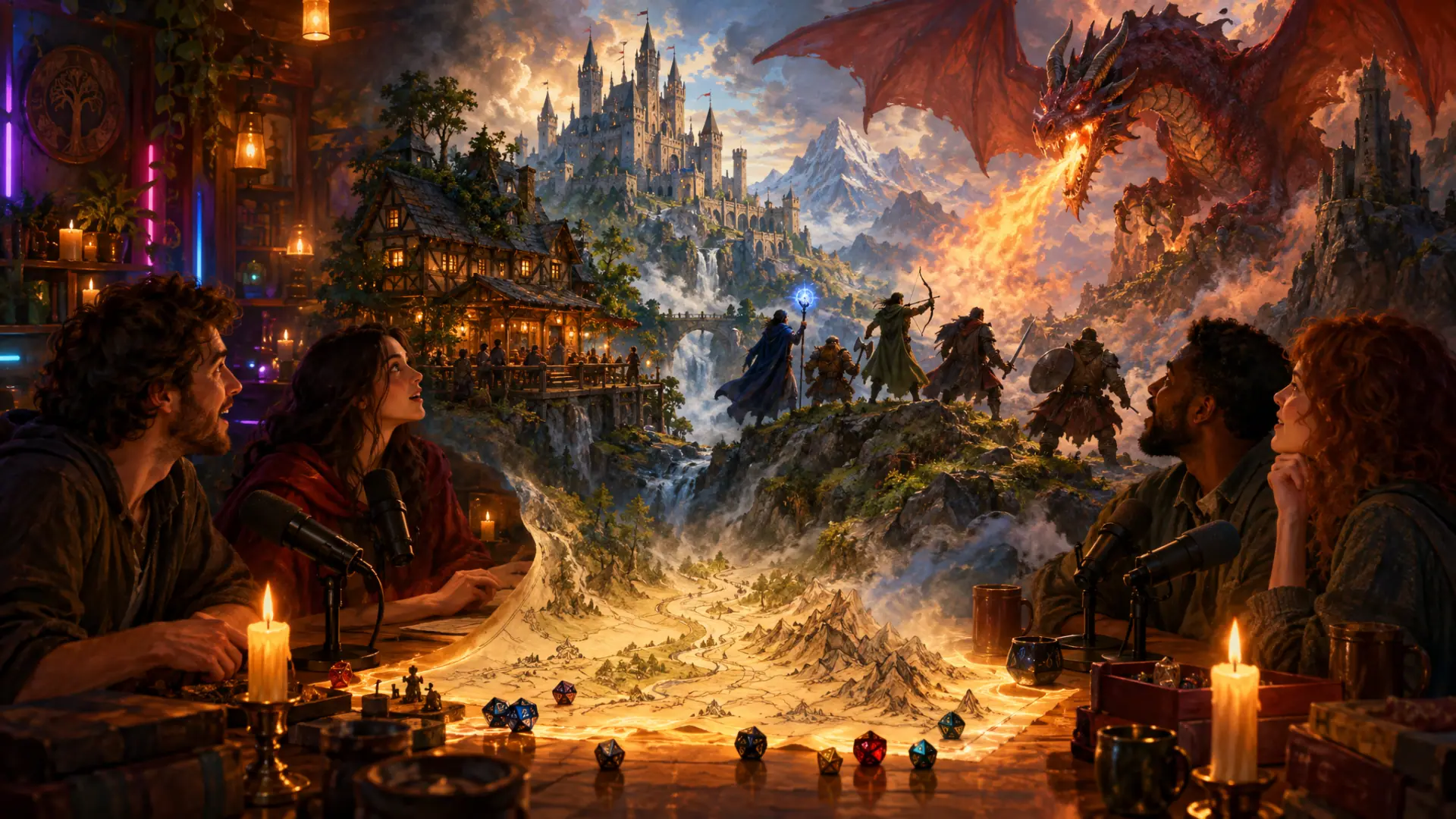
Virtual tabletops dissolved geography: groups could play across cities and continents, streams could show the battle map, and publishers gained a digital shelf. By 2023 Hasbro's chief executive estimated that close to half of D&D games involved some kind of digital tabletop.
What happened
Tabletop players have tried to take their games online for almost as long as there has been an online. On the PLATO network of the 1970s, students turned D&D into pedit5 and dnd; in the 1990s and 2000s groups played by email and forum post, rolled dice with chat bots, and traded maps as image files. In 2002 BioWare's Neverwinter Nights shipped with a Dungeon Master client that let a human referee run adventures live inside a computer game. What was missing was a dedicated space that behaved like a real table: a shared map, tokens, dice anyone could see and character sheets that did the arithmetic.
Fantasy Grounds, released in 2004 by SmiteWorks, a company then based in Espoo, Finland, was one of the first such programs. Its successor generation arrived in 2012, when three college roommates who wanted to keep their D&D game going after graduation launched Roll20 through a Kickstarter that raised almost $40,000 (see Crowdfunding & the Kickstarter Era). Roll20 ran in a web browser, was free to start and supported almost any system. It reached one million users in July 2015 and two million in January 2017. Official licenses followed: SmiteWorks and Roll20 both secured licenses for Wizards of the Coast's fifth-edition content, in 2015 and 2016 respectively, and Paizo's Pathfinder came to both.
Wizards had already tried to build its own. D&D Insider, the subscription service for fourth edition, included a virtual tabletop in beta from 2010 to 2012 that never fully launched. For fifth edition the company partnered instead with Curse, then part of Twitch, on D&D Beyond, a digital library, character builder and rules compendium launched in August 2017.
Why it mattered
Virtual tabletops changed who could play together. Friends scattered by jobs and moves could keep a campaign alive; strangers could find a game any night of the week; and actual-play shows could broadcast the battle map alongside the players' faces, which made Roll20 part of the toolkit of the streaming era. Scholars of actual play credit it with letting players "document and broadcast" their games at scale.
The COVID-19 pandemic made them essential. As in-person play stopped in 2020, groups flooded onto the platforms: D&D Beyond's registered users tripled in a month, and Wizards said virtual play rose 86 percent that year. Foundry Virtual Tabletop, a self-hosted program begun in 2018 by developer Andrew Clayton, known online as Atropos, left private beta that May, offering a one-time license, a lighting and line-of-sight engine and hundreds of community-built game systems. Roll20 passed eight million users by 2021.
Legacy
Digital play became a strategic prize. In 2022 Hasbro bought D&D Beyond from Fandom for $146.3 million, and Roll20 merged with the digital storefront company OneBookShelf. Hasbro's chief executive said in 2023 that close to half of D&D games were played using some kind of digital tabletop. The OGL crisis of January 2023 turned partly on these tools, since the leaked license would have barred third parties from publishing D&D-compatible content for virtual tabletops and fans canceled D&D Beyond subscriptions in protest.
Wizards' own ambitions proved difficult. Its 2D "Maps" tool entered testing in 2023, but Sigil, a lavish 3D tabletop built in Unreal Engine 5, launched in March 2025 missing key features; within weeks most of its developers were laid off, and in October 2025 Wizards announced that its servers would close at the end of October 2026. Independent tools kept growing instead, and in November 2025 SmiteWorks made Fantasy Grounds free for all users.
The virtual tabletop has not replaced dice and paper, but for millions of players it has become the hobby's second home.
Marginalia
- Fantasy Grounds, one of the first dedicated virtual tabletops, was released in 2004 by SmiteWorks, originally based in Espoo, Finland.
- Roll20 was built by three college roommates who wanted to keep their D&D game going after graduation; it launched publicly in September 2012 after a Kickstarter.
- Wizards of the Coast tested a virtual tabletop for fourth-edition D&D from 2010 to 2012 as part of D&D Insider, but never fully launched it.
- D&D Beyond, the official fifth-edition toolset, launched on August 15, 2017; Hasbro bought it from Fandom for $146.3 million in 2022.
- Foundry Virtual Tabletop, a self-hosted program by developer Andrew Clayton ("Atropos"), left private beta in May 2020.
- D&D's head of publishing and licensing said virtual play rose 86 percent in 2020, aided by platforms such as Roll20 and Fantasy Grounds.
- Wizards' 3D tabletop Sigil launched in March 2025; within weeks most of its team was laid off, and its servers were scheduled to close at the end of October 2026.
Quick answers
- What is Virtual Tabletops?
- Fantasy Grounds, Roll20, Foundry and D&D Beyond moved the map, the dice and the character sheet onto the screen, and when the pandemic closed the kitchen tables of 2020, virtual tabletops kept the hobby playing.
- When did Virtual Tabletops begin?
- 2004 to the present.
- Why does Virtual Tabletops matter?
- Virtual tabletops dissolved geography: groups could play across cities and continents, streams could show the battle map, and publishers gained a digital shelf. By 2023 Hasbro's chief executive estimated that close to half of D&D games involved some kind of digital tabletop.