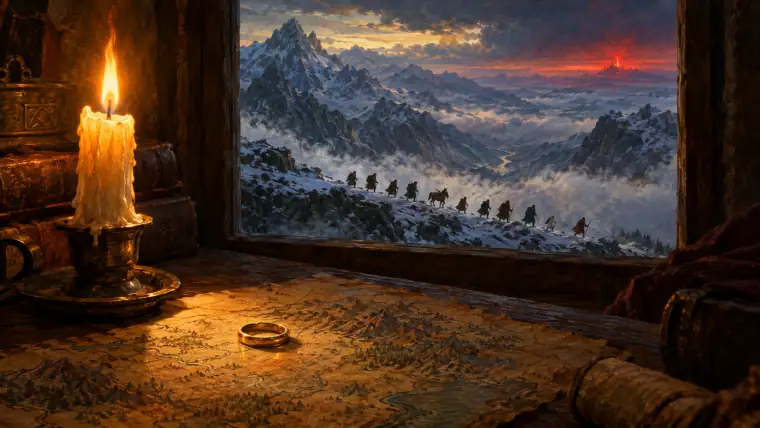
Brooks's commercial breakthrough turned post-Tolkien fantasy into a bestselling category, and his Shannara saga has since run for more than four decades, with a 1995 adventure game and an MTV television series along the way.
Life
Terence Dean Brooks was born on January 8, 1944, in Sterling, Illinois, a small Midwestern town where he spent much of his life. He wrote from high school onward, trying science fiction, westerns and nonfiction. In his early college years someone handed him The Lord of the Rings, and the experience focused him on a single genre, though he has always insisted that his narrative style owes as much to William Faulkner and to the adventure writing of Walter Scott and Alexandre Dumas as it does to Tolkien. He took a BA in English at Hamilton College in 1966 and a law degree at Washington and Lee University, and practiced as an attorney until his writing could support him full-time.
Brooks later moved to the Pacific Northwest and lives in Seattle with his wife, Judine. The World Fantasy Convention gave him its Life Achievement Award in 2017. In March 2025 he announced his semi-retirement and passed the Shannara saga to the novelist Delilah S. Dawson.
Work
The Sword of Shannara (1977) was a deliberate experiment. Brooks set out to put "Tolkien's magic and fairy creatures" into a Scott-and-Dumas adventure while stripping away the songs, appendices and invented languages. Lester del Rey, who with Judy-Lynn del Rey was building a science fiction and fantasy list at Ballantine, saw it as the first long epic fantasy that could satisfy Tolkien's readers and used it to launch the new Del Rey Books imprint. The Del Reys were, as Greg Hildebrandt remembered, "obsessed with the project," and commissioned a cover from the Brothers Hildebrandt, fresh from their Tolkien calendars. It became the first fantasy novel on the New York Times trade paperback bestseller list and sold about 125,000 copies in its first year.
Critics were less kind. Brian Attebery called it "undigested Tolkien," and Tom Shippey mapped its cast point by point onto Tolkien's: a Dark Lord in Brona, a wizard in Allanon, a pair of hobbit-like half-elves in Shea and Flick. Brooks has since acknowledged that the first book shows him "heavily under the influence." Yet Shippey also drew the lesson that mattered: readers had developed a taste for this kind of story, and there was not nearly enough of it.
Brooks spent the next four decades supplying it. The Elfstones of Shannara (1982) and The Wishsong of Shannara (1985) deepened the world, and later cycles such as The Heritage of Shannara, The Voyage of the Jerle Shannara and High Druid of Shannara extended it across generations. The contemporary Word and the Void trilogy (1997–99) and the Genesis of Shannara books eventually revealed what careful readers had long suspected: the Four Lands are a far-future Pacific Northwest, rebuilt after war, plague and magic. The four-volume Fall of Shannara (2017–20), ending with The Last Druid, closed the main chronology. In between came the lighter comic Magic Kingdom of Landover series, beginning with Magic Kingdom for Sale—Sold! (1986), and the novelizations of Steven Spielberg's Hook (1991) and Star Wars: Episode I – The Phantom Menace (1999).
Legacy
David Pringle's verdict is the standard one: Brooks proved in 1977 that the success of Tolkien "had not been a fluke" and that fantasy could be a mass-market genre. The same year brought Stephen R. Donaldson's Thomas Covenant and Christopher Tolkien's edition of The Silmarillion, and bookstores began to shelve fat, multi-volume High / Epic Fantasy as a category of its own. The readers created by that wave overlapped heavily with the first generation of tabletop roleplayers; Shannara's quest-party structure of druid, elves, dwarf and reluctant heir was exactly the shape of a The party around a table.
Shannara reached screens in two forms. Legend Entertainment's Shannara (1995) was a point-and-click adventure game for MS-DOS and Windows, telling an original story set between the first two novels; reviews were mixed. The Shannara Chronicles adapted Elfstones for MTV in January 2016, moved to Spike for a 2017 second season, and was cancelled in January 2018. Its shots of ruined Seattle landmarks made visible the buried apocalypse that underpins the whole saga.
Marginalia
- The Sword of Shannara (1977) was chosen by editor Lester del Rey to launch Ballantine's new Del Rey Books imprint.
- It became the first fantasy novel to appear on the New York Times trade paperback bestseller list and sold about 125,000 copies in its first year.
- The first edition's cover was painted by the Brothers Hildebrandt, who had just made their name with Tolkien calendars.
- Brooks wrote the novelizations of Hook (1991) and Star Wars: Episode I – The Phantom Menace (1999).
- The Shannara Chronicles ran on MTV in 2016 and Spike in 2017; it began with the second novel, The Elfstones of Shannara.
- In March 2025 he announced his semi-retirement, naming Delilah S. Dawson to continue the Shannara saga.
Quick answers
- Who is Terry Brooks?
- The Illinois lawyer whose Tolkien-shaped debut, The Sword of Shannara, launched Del Rey Books in 1977 and proved that epic fantasy could be a mass-market genre rather than a one-book phenomenon.
- When was Terry Brooks born?
- Terry Brooks was born in 1944 in Sterling, Illinois.
- What is Terry Brooks known for?
- Terry Brooks is best known for The Sword of Shannara.
- Why does Terry Brooks matter to fantasy and games?
- Brooks's commercial breakthrough turned post-Tolkien fantasy into a bestselling category, and his Shannara saga has since run for more than four decades, with a 1995 adventure game and an MTV television series along the way.