The mythology beneath Middle-earth, and the proof that fantasy could be built like a real culture's scripture; its posthumous 1977 publication topped bestseller lists and even named one of the first computer RPGs.
Overview
The Silmarillion is the book J. R. R. Tolkien worked on for almost his entire adult life and never finished. It is not a novel but a compressed mythology in the manner of the Eddas or the Old Testament: a creation story, a pantheon, and a chronicle of the elves in the Elder Days, told in a high, grave style across thousands of years. Edited by his son Christopher Tolkien and published by George Allen & Unwin on 15 September 1977, four years after the author's death, it is the bedrock beneath The Hobbit and The Lord of the Rings — the "legendarium" whose ruins the hobbits keep stumbling across.
Origins
The mythology began in the trenches and hospitals of the First World War. Around 1917 Tolkien was writing the prose tales later published as The Book of Lost Tales, among them the fall of the elven city of Gondolin. Over the next two decades he rewrote the matter again and again: a "Sketch of the Mythology" in 1926, the Quenta Noldorinwa around 1930, and a fuller Quenta Silmarillion in the mid-1930s. After The Hobbit succeeded in 1937, Tolkien offered this material to Allen & Unwin. The publisher's reader was unenthusiastic, finding it obscure and too "Celtic," and Stanley Unwin asked instead for another hobbit story. That request produced The Lord of the Rings — which in turn drew so deeply on the older mythology that Tolkien spent 1949–52 trying to persuade Collins to publish the two together. The effort failed, and in his last two decades Tolkien revised, reconceived and fretted over the material without ever completing it.
After his death in 1973, Christopher Tolkien assembled a single coherent text from manuscripts of many dates, working with Guy Gavriel Kay, then a young Canadian philosophy student. Christopher later admitted that some passages had required editorial invention where the drafts left gaps.
The story
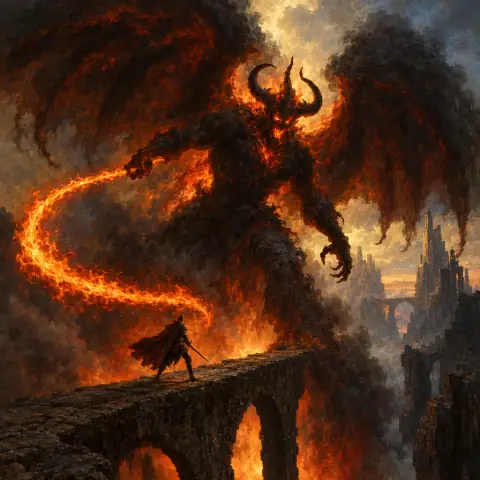
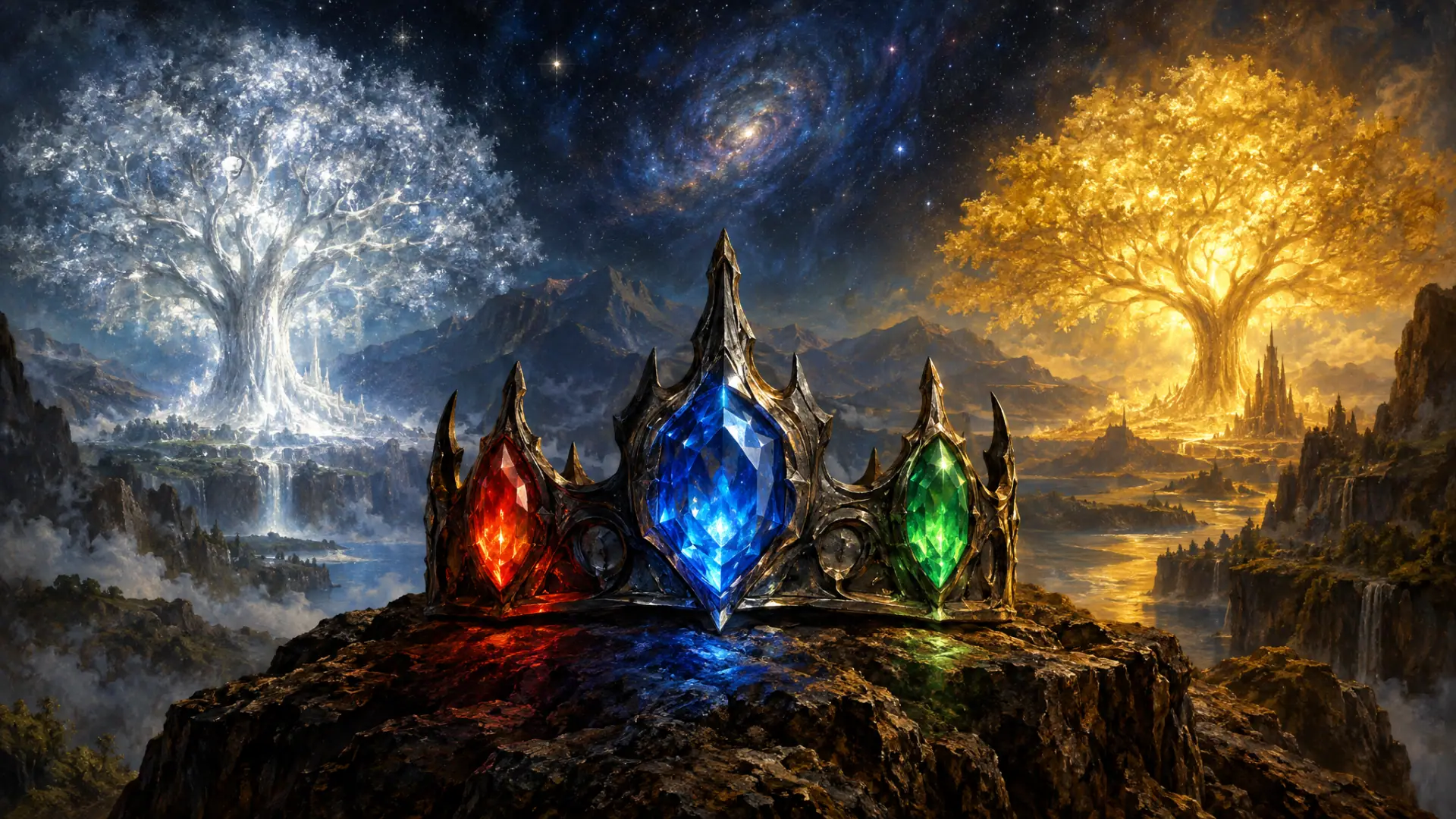
The book has five parts. The Ainulindalë tells how the One, Eru Ilúvatar, and his angelic Ainur sing the world into being, and how the rebel Melkor's discord is woven into the theme. The Valaquenta describes the Valar, the powers who enter the world, and their servants — including Sauron and the fiery spirits later called Balrogs. The long Quenta Silmarillion is the heart: the elf Fëanor makes three jewels, the Silmarils, holding the light of the Two Trees of Valinor; Melkor, now Morgoth, destroys the Trees, steals the jewels and flees to Middle-earth; and Fëanor's people swear a terrible oath to recover them. The resulting war against Morgoth's fortress of Angband spans centuries of tragedy, including the love of the mortal Beren and the elf-maiden Lúthien, who wrest a Silmaril from Morgoth's crown, and the doomed Túrin Turambar. The Akallabêth recounts the rise and drowning of Númenor, the island kingdom of men, and the Of the Rings of Power and the Third Age bridges into the events of The Lord of the Rings.
Reception & impact
Critics in 1977 were largely cool, finding the book austere, archaic and crowded with names. Readers disagreed: it topped the New York Times fiction bestseller list in October 1977 and won the Locus Award for Best Fantasy Novel in 1978. It has sold over a million copies — modest beside its siblings, but remarkable for a book that reads like a scripture. It arrived at the height of the Paperback Boom & the Counterculture, the same year as The Sword of Shannara and The Chronicles of Thomas Covenant, confirming that Tolkien's world had a market deeper than any imitator.
Its influence on games came quickly. Richard Garriott, a high-school Dungeons & Dragons player and fan of The Lord of the Rings, named his first commercial game Akalabeth: World of Doom (1980) after the Akallabêth — although the game borrowed only the name, not the story. Tolkien's cosmology of fallen angels, a dark god and a lost island kingdom became a template for game worlds with deep, layered histories; Angband, the name of Morgoth's fortress, became the name of a famous roguelike in 1990.
Legacy
The Silmarillion opened a second career for Christopher Tolkien as his father's editor and scholar. Unfinished Tales followed in 1980, then the twelve volumes of The History of Middle-earth (1983–96), which published the drafts behind both the mythology and The Lord of the Rings; late in life he issued standalone editions of The Children of Húrin (2007), Beren and Lúthien (2017) and The Fall of Gondolin (2018). Illustrators such as Ted Nasmith have repeatedly returned to its landscapes.
Its greatest legacy may be the idea it models: that a fantasy world is more convincing when it has an older, half-remembered past. That conviction runs through modern Worldbuilding, from the lore-books of The Elder Scrolls to the deep histories of A Song of Ice and Fire. Amazon's The Rings of Power (2022– ) dramatizes the Second Age, whose fullest account is the Akallabêth, though the series was widely reported to be licensed from The Lord of the Rings and its appendices rather than from The Silmarillion itself.
Marginalia
- Tolkien began the mythology during the First World War; the first tales, later The Book of Lost Tales, date from around 1917.
- Allen & Unwin rejected a version in 1937 and asked for more hobbits instead — which is how The Lord of the Rings began.
- Christopher Tolkien edited it with the help of a young Canadian, Guy Gavriel Kay, later a noted fantasy novelist himself.
- It reached number one on The New York Times fiction bestseller list in October 1977.
- Richard Garriott's Akalabeth: World of Doom takes its name from the book's Akallabêth, the tale of the downfall of Númenor.
- Christopher Tolkien went on to publish the drafts behind it in the twelve-volume History of Middle-earth (1983–96).
Quick answers
- When was The Silmarillion first published?
- The Silmarillion was first published in 1977 (written c. 1917–1973).
- Who created The Silmarillion?
- The Silmarillion was made by J. R. R. Tolkien (author) and Christopher Tolkien (editor).
- Who published or developed The Silmarillion?
- George Allen & Unwin.
- What kind of work is The Silmarillion?
- The Silmarillion is a myth cycle in the High / Epic Fantasy and Mythic Fantasy tradition.
- Why is The Silmarillion important?
- The mythology beneath Middle-earth, and the proof that fantasy could be built like a real culture's scripture; its posthumous 1977 publication topped bestseller lists and even named one of the first computer RPGs.