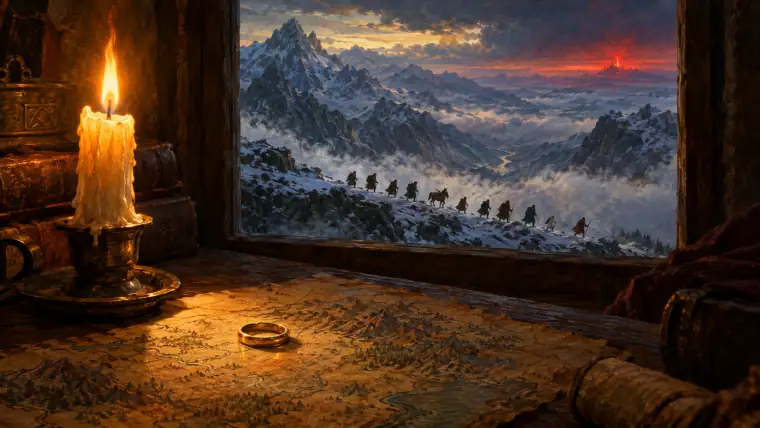
Bakshi's 1978 Lord of the Rings was the first feature film of Tolkien's epic; flawed and unfinished, it brought Middle-earth to cinemas two decades before Peter Jackson and helped lead Jackson to the book.
Life
Ralph Bakshi was born on October 29, 1938, in Haifa, Mandatory Palestine, to a Krymchak Jewish family that emigrated to the United States the following year. He grew up poor in the Brownsville neighborhood of Brooklyn, with a brief, formative spell in segregated Washington, D.C., where police removed him from the Black school he had chosen to attend with his friends. At fifteen he taught himself cartooning from a library book, and he graduated from Manhattan's School of Industrial Art in 1956 with an award in cartooning.
At eighteen he was hired as a cel polisher at the Terrytoons studio in New Rochelle, commuting four hours a day. He talked and bluffed his way up to cel painter, layout artist, and animator, and at 25 was made a director. After eight months as head of Paramount's animation division, which closed in December 1967, he founded Bakshi Productions in 1968. Through the 2000s he concentrated on painting and teaching, co-founding the Bakshi School of Animation in 2003, and in 2013 he funded a short film, Last Days of Coney Island, through Kickstarter; it was released in 2015.
Work
Bakshi made his name with adult animation. Fritz the Cat (1972), adapted from Robert Crumb's comic, became the first animated film rated X by the Motion Picture Association of America and one of the most successful independent animated features ever made. Heavy Traffic (1973) and the furiously controversial Coonskin (1975) followed, gritty urban films that treated animation as a medium for adults rather than children.
In the mid-1970s he turned to fantasy. Wizards (1977), developed from drawings he had made as a teenager and from a failed TV pitch, pitted a good wizard against his technology-worshipping brother in a post-apocalyptic world. Short of money, Bakshi paid for the battle scenes himself by rotoscoping, tracing over enlarged frames of existing war-film footage, including Eisenstein's Alexander Nevsky, which he printed at a penny a page on an industrial IBM photocopier. George Lucas, finishing Star Wars at the same studio, asked him to drop the original title War Wizards, and in return let Mark Hamill record a voice for the film.
That same year Bakshi learned that John Boorman was attempting a one-film adaptation of The Lord of the Rings for United Artists. Bakshi lobbied to direct it himself and eventually found backing from the producer Saul Zaentz, who covered the costs already sunk into the project and agreed to fund it. Zaentz's company went on to control the film rights to Tolkien's novels for decades, a central thread of the Tolkien Rights Saga. Bakshi and Zaentz insisted that the Tolkien estate receive residuals. The plan was to tell the story in two films. Bakshi shot the entire script in live action in Spain, then rotoscoped the footage, mixing it with cel animation and treated live-action shots. John Hurt voiced Aragorn.
The Lord of the Rings opened in the United States on November 15, 1978. United Artists marketed it with no indication that it covered only half the story, ending after Helm's Deep and the approach to Mordor, which left many viewers baffled. Reviews were mixed, generally judging it a "flawed but inspired" attempt; Roger Ebert called it "an entirely respectable, occasionally impressive job." Reports of its budget range from $4 million to $8 million or more, and it grossed about $30.5 million in North America, but after Bakshi fell out with Zaentz the second half was never made. The ending was eventually told on television instead, in Rankin/Bass's The Return of the King (1980), a follow-up to their The Hobbit.
Bakshi next made American Pop (1981), and then, with his friend Frank Frazetta, Fire and Ice (1983), a rotoscoped Sword & Sorcery adventure designed to move like a Frazetta painting, with backgrounds by James Gurney and Thomas Kinkade and layouts by Peter Chung. It arrived in the wake of Conan the Barbarian and flopped. Among the fantasy projects he tried and failed to set up afterward was an adaptation of E. R. Eddison's The Worm Ouroboros. He returned to television with Mighty Mouse: The New Adventures (1987), a training ground for John Kricfalusi's team, and made his last theatrical feature, Cool World, in 1992.
Legacy
Bakshi's Tolkien film occupies a strange, important place in this museum. It was the first feature-length screen version of the book, arriving at the height of the Paperback Boom & the Counterculture and the year after The Silmarillion, and for many fans in the late 1970s and 1980s it was the only moving image of Middle-earth they had. Its rotoscoped orcs and Black Riders were unsettling in a way conventional animation was not, and its cult following has lasted.
Its most consequential viewer was a teenager in Wellington. Peter Jackson has said that Bakshi's film introduced him to Tolkien and "inspired me to read the book"; he paid homage to one shot in The Fellowship of the Ring and remembered the Black Riders galloping out of Bree as an image that stayed with him. The relationship between the two directors was later soured by Bakshi's public complaints, for which he apologized in 2015. Beyond Tolkien, Bakshi proved that animation could serve adult audiences and grown-up fantasy, a proposition that adult animated fantasy, down to The Legend of Vox Machina, still relies on. He received the Annie Award for Distinguished Contribution to the Art of Animation in 1988.
Marginalia
- Bakshi started at the Terrytoons studio as a cel polisher at 18, commuting four hours a day, and was a director by 25.
- His debut feature, Fritz the Cat (1972), was the first animated film to receive an X rating from the MPAA.
- To finish Wizards (1977) cheaply, he photocopied frames of battle footage from films such as Alexander Nevsky on an industrial IBM copier.
- George Lucas asked him to shorten the title War Wizards to Wizards to avoid confusion with Star Wars.
- He and Saul Zaentz insisted that the Tolkien estate receive residuals from the 1978 film.
- Budget reports for The Lord of the Rings (1978) range from $4 million to $8 million or more; it grossed about $30.5 million in North America, but no second part was made.
- Peter Jackson has said Bakshi's film introduced him to Tolkien and inspired him to read the book.
Quick answers
- Who is Ralph Bakshi?
- The Brooklyn-raised maverick of adult animation who rotoscoped Tolkien onto the big screen in 1978, made fantasy films with Frank Frazetta, and inspired a teenage Peter Jackson to read The Lord of the Rings.
- When was Ralph Bakshi born?
- Ralph Bakshi was born in 1938 in Haifa, Mandatory Palestine.
- What is Ralph Bakshi known for?
- Ralph Bakshi is best known for The Lord of the Rings.
- Why does Ralph Bakshi matter to fantasy and games?
- Bakshi's 1978 Lord of the Rings was the first feature film of Tolkien's epic; flawed and unfinished, it brought Middle-earth to cinemas two decades before Peter Jackson and helped lead Jackson to the book.