One of the most beloved modern fairy tales: a wry, elegiac fantasy about mortality and regret whose 1982 animated film, made by the studio that became Studio Ghibli's core, made it a touchstone for a generation.
Overview
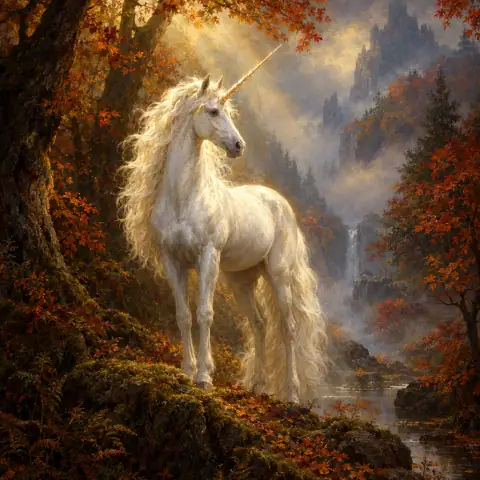
The Last Unicorn is Peter S. Beagle's 1968 novel about an immortal creature who discovers that she may be the last Unicorn in the world and leaves her enchanted forest to find the others. It is a fairy tale that knows it is a fairy tale: funny, self-aware, full of anachronisms and asides, and at the same time one of the most tender meditations on loss and mortality in fantasy. Published by Viking Press, it has sold more than six million copies, and through its 1982 animated film it has become a shared memory for generations of viewers.
Origins
Beagle had published his first novel, A Fine and Private Place, in 1960, while still in his early twenties. The Last Unicorn went through long and difficult drafts before its publication in 1968; an early, abandoned version was later published as The Last Unicorn: The Lost Journey in 2006. The finished book arrived just as American publishers were discovering an adult audience for fantasy in the wake of the Tolkien paperbacks, and it fitted perfectly into the literate, whimsical, bittersweet strand of the genre that the Ballantine Adult Fantasy series would celebrate.
The story
When the unicorn overhears hunters saying that she must be the last of her kind, she leaves her lilac wood to learn what has become of the others. Captured by the witch Mommy Fortuna for her shabby Midnight Carnival, where real monsters are displayed beside illusions, she is freed by Schmendrick, an incompetent magician whose true power surfaces only in moments of desperation. They are joined by Molly Grue, a tired, sharp-tongued woman who has spent her life cooking for a band of would-be outlaws and who weeps with anger that the unicorn came so late.
Their road leads to the grim castle of King Haggard, who has captured every unicorn in the world with the help of the monstrous Red Bull and drives them into the sea, because watching them is the only thing that gives him joy. To save the unicorn from the Bull, Schmendrick turns her into a human woman, the Lady Amalthea — and in a mortal body she begins to forget what she is, and falls in love with Haggard's adopted son, Prince Lír. The ending asks what it costs a creature who cannot die to know regret.
Reception & impact
The book has remained a steady seller for more than half a century. Its combination of humor and melancholy, and its insistence that heroes are ordinary, flawed people, made it a model of literary fantasy at a moment when the genre was being redefined by Tolkien's imitators.
The 1982 animated film, produced and directed by Arthur Rankin Jr. and Jules Bass, carried the story to a far larger audience. Beagle wrote the screenplay himself; the animation was produced in Japan by Topcraft, whose staff went on to form the core of Studio Ghibli, and which had also animated Rankin/Bass's The Hobbit. The voice cast was unusually starry — Mia Farrow as the unicorn, Jeff Bridges as Lír, Alan Arkin as Schmendrick, Tammy Grimes as Molly, Angela Lansbury as Mommy Fortuna and Christopher Lee as Haggard — and the songs by Jimmy Webb, performed by the band America, became as beloved as the images.
Legacy
Beagle returned to the characters in "Two Hearts" (2005), a novelette that won both the Hugo and Nebula awards. Stage versions appeared in 1988 and 2009, and IDW Publishing released a six-issue comic adaptation beginning in 2010.
In the broader history of fantasy, The Last Unicorn stands for a kind of fantasy that games have found harder to capture: a quest without battles to win, in which the monster is grief and the treasure is memory. Yet its images — the glowing white unicorn, the flame-colored Red Bull, the carnival of caged marvels — have become part of the genre's shared iconography, and Beagle's connection to Middle-earth runs deeper than most readers realize: he co-wrote the screenplay of Ralph Bakshi's The Lord of the Rings (1978).
Marginalia
- The Last Unicorn has sold more than six million copies worldwide since 1968.
- Beagle wrote the screenplay for the 1982 animated film himself.
- The film was animated in Japan by Topcraft, whose staff later formed the core of Studio Ghibli; Topcraft also animated Rankin/Bass's The Hobbit (1977).
- Its voice cast included Mia Farrow, Jeff Bridges, Alan Arkin, Angela Lansbury and Christopher Lee; the songs were written by Jimmy Webb and performed by America.
- Beagle's coda, 'Two Hearts' (2005), won both the Hugo and Nebula awards for best novelette.
- Beagle also co-wrote the screenplay of Ralph Bakshi's 1978 animated The Lord of the Rings.
Quick answers
- When was The Last Unicorn first published?
- The Last Unicorn was first published in 1968.
- Who created The Last Unicorn?
- The Last Unicorn was made by Peter S. Beagle (author; screenwriter of the 1982 film).
- What kind of work is The Last Unicorn?
- The Last Unicorn is a novel in the Fairy-Tale Fantasy and Comic Fantasy tradition.
- Why is The Last Unicorn important?
- One of the most beloved modern fairy tales: a wry, elegiac fantasy about mortality and regret whose 1982 animated film, made by the studio that became Studio Ghibli's core, made it a touchstone for a generation.