The first feature film of The Lord of the Rings, a bold, flawed experiment that turned a profit, launched the Zaentz company's decades-long control of Tolkien screen rights, and first led a teenage Peter Jackson to the book.
Overview
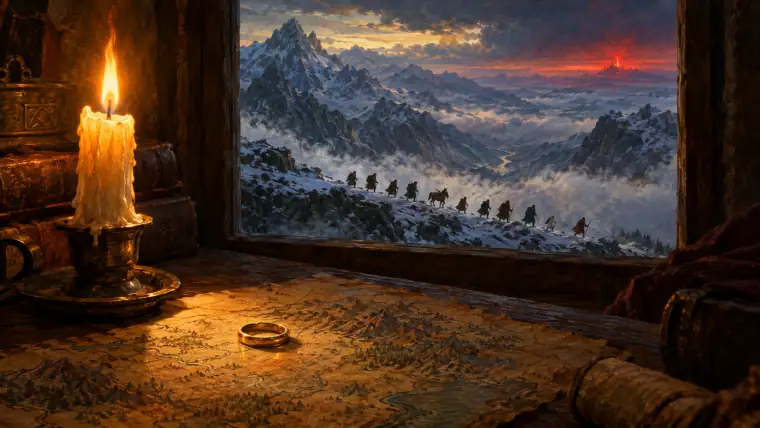
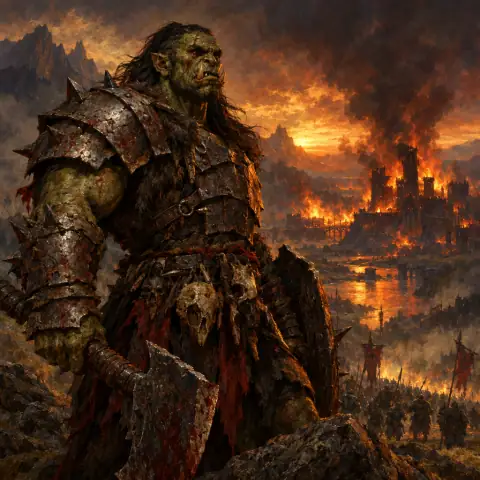
A year after the cheerful Rankin/Bass Hobbit appeared on television, Ralph Bakshi brought The Lord of the Rings to cinemas as a dark, strange, 133-minute animated feature. Released by United Artists in the United States on November 15, 1978, it was the first film ever made from Tolkien's trilogy, and it looked like nothing else in theaters: hand-drawn hobbits and wizards sharing the frame with rotoscoped riders and orcs traced from live actors, set against painted skies.
It covers roughly the first half of the story and then simply stops, a decision forced on it by marketing rather than art. The result is one of fantasy cinema's great "what ifs": admired for its ambition and its haunting set pieces, criticized for its uneven technique and truncated plot, and remembered as the film that stood between Tolkien's readers and a screen Middle-earth for more than twenty years.
Origins
Tolkien sold the film rights to his two Middle-earth books to United Artists at the end of the 1960s, one of the founding moves in the long The Tolkien Rights Saga. The studio tried to make a live-action epic; John Boorman was commissioned to write a script in late 1969, but it was judged too expensive, and some of its imagery later resurfaced in Boorman's Excalibur.
Bakshi, known for adult animation such as Fritz the Cat, read in a 1974 Variety item that Boorman's version was dead. In 1975 he persuaded UA executive Mike Medavoy to let him develop the story as two or three animated films. When the project stalled, he turned to Saul Zaentz, the record producer who had financed Fritz the Cat. In 1976 Zaentz's company acquired the film, stage and merchandising rights from United Artists, which kept distribution; the company soon organized the rights as Tolkien Enterprises, later renamed Middle-earth Enterprises.
The screenplay began with Chris Conkling and was rewritten by the fantasy novelist Peter S. Beagle. To animate a cast of hundreds on a modest budget, Bakshi relied heavily on rotoscoping: actors were filmed in costume on locations in Spain and in California's Death Valley, and the footage was traced and colored. The official budget was $4 million, though estimates reported over the years range up to $12 million. The composer Leonard Rosenman, who had scored Rebel Without a Cause, wrote the music.
The story
The film opens with a shadow-play prologue on the forging of the Rings and Gollum's theft of the One Ring, then follows the plot of The Fellowship of the Ring: Frodo (Christopher Guard) inherits the Ring from Bilbo, flees the Shire pursued by the Black Riders, is wounded at Weathertop, and joins the Fellowship at Rivendell. Gandalf (William Squire) falls with the Balrog in Moria, Boromir (Michael Graham Cox) is slain defending the hobbits, and the company breaks apart.
The second hour moves into The Two Towers, cutting between Aragorn (John Hurt), Legolas and Gimli in Rohan and Frodo and Sam being guided toward Mordor by Gollum (Peter Woodthorpe). It climaxes with the Battle of Helm's Deep and Gandalf's return at dawn, then ends with a narrator announcing that the forces of darkness have been driven back, leaving Frodo and Sam still on the road. Shelob, the Scouring of the Shire and the entire third volume never appear.
Reception & impact
United Artists removed the "Part One" that Bakshi intended as part of the title, reasoning that audiences would not pay to see half a film. Bakshi objected, saying later that "had it said 'Part One,' I think everyone would have respected it." Many viewers felt misled by the abrupt ending.
Critics were divided. Roger Ebert called it "a mixed blessing," and later reviewers have often described it as flawed but inspired. The rotoscoped figures, grainy and semi-real, struck some as eerie and others as crude. Rosenman's score was nominated for a Golden Globe, and the film was nominated for the Hugo Award for Best Dramatic Presentation and a Saturn Award, and won the Golden Gryphon at Italy's Giffoni Film Festival.
Commercially it succeeded: $30.5 million in North America and about $3.2 million in the United Kingdom, where it opened on July 5, 1979. Yet the planned second film never came. Bakshi fell out with Zaentz, and the Rankin/Bass team filled the gap with their own television Return of the King in 1980.
Legacy
The film's most lasting consequence was the one nobody saw: Zaentz's control of the screen and merchandise rights shaped Tolkien licensing for nearly half a century, from board and video games to the licensing behind Peter Jackson's trilogy, until the rights were sold to the Embracer Group in 2022.
Its images lasted too. Peter Jackson has said Bakshi's film "inspired me to read the book," and singled out the Black Riders galloping out of Bree as a memory that stayed with him. For a generation of tabletop gamers in the late 1970s, the painted Moria and the teeming orc armies were a rare moving picture of the kind of world they were building with Dungeons & Dragons.
Marginalia
- Live-action reference footage was shot in Spain and Death Valley, then traced onto animation cels by rotoscoping.
- The fantasy novelist Peter S. Beagle, author of The Last Unicorn, co-wrote the screenplay with Chris Conkling.
- United Artists dropped the planned "Part One" from the title, fearing audiences would not pay to see half a story; Bakshi opposed the change.
- It grossed $30.5 million in North America on an official budget of $4 million, though budget estimates run as high as $12 million.
- John Hurt voiced Aragorn and Anthony Daniels, C-3PO in Star Wars, voiced Legolas.
- Leonard Rosenman's score earned a Golden Globe nomination, and the film was a Hugo and Saturn nominee.
Quick answers
- When was The Lord of the Rings first released?
- The Lord of the Rings was first released in 1978 (U.S., November 15).
- Who created The Lord of the Rings?
- The Lord of the Rings was made by Ralph Bakshi (director) and Peter S. Beagle (co-screenwriter (with Chris Conkling)).
- What kind of work is The Lord of the Rings?
- The Lord of the Rings is a film in the Fantasy Film and High / Epic Fantasy tradition.
- Why is The Lord of the Rings important?
- The first feature film of The Lord of the Rings, a bold, flawed experiment that turned a profit, launched the Zaentz company's decades-long control of Tolkien screen rights, and first led a teenage Peter Jackson to the book.