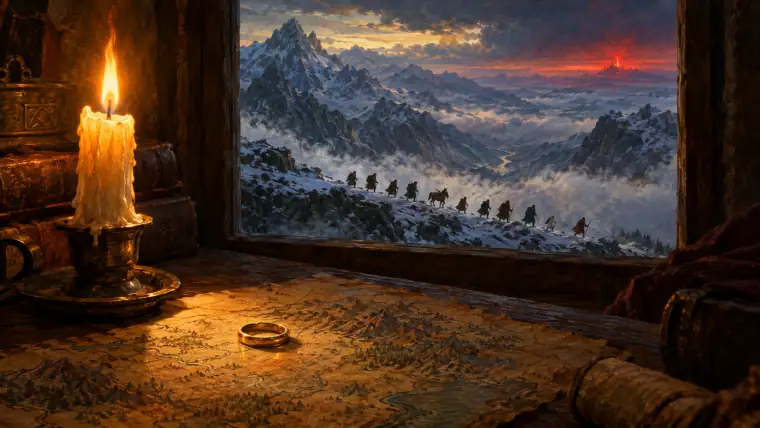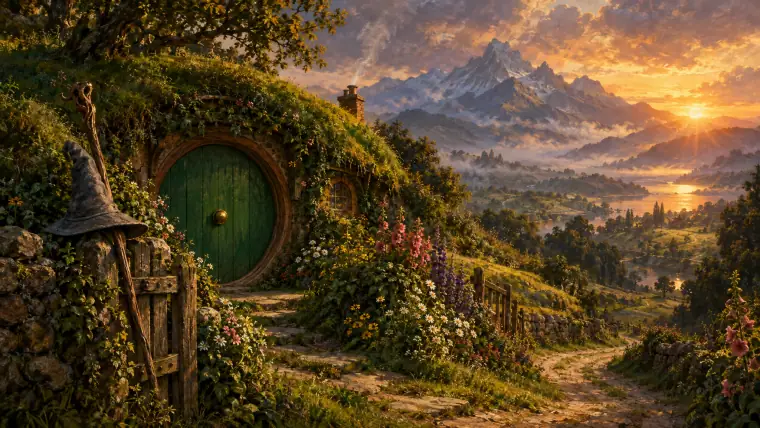
Jackson's trilogy proved that Tolkien could be filmed faithfully at epic scale, won eleven Oscars for its final chapter, and opened the door to the fantasy boom on film and television that followed.
Life
Peter Robert Jackson was born on October 31, 1961, in Wellington, New Zealand, and grew up in the coastal suburb of Pukerua Bay, the son of immigrants from England. A family friend's Super 8 camera turned a boy who loved Ray Harryhausen's stop-motion monsters, Thunderbirds, and Monty Python into a filmmaker; around the age of nine he tried to remake King Kong, his favorite film, with homemade models. As a young adult he watched Ralph Bakshi's animated Lord of the Rings and went looking for the book.
He had no formal film training. At sixteen he left school to work as a photo-engraver at The Evening Post in Wellington, living with his parents for seven years to save for equipment and teaching himself editing, effects, and makeup by trial and error. His long-time partner Fran Walsh became his most important collaborator, and with the writer Philippa Boyens they formed the screenwriting team behind his Tolkien films. Jackson was appointed a Companion of the New Zealand Order of Merit in 2002 and knighted in 2010.
Work
Jackson's first feature, Bad Taste (1987), was shot on weekends over years with friends as cast and crew, and was shown at Cannes in May 1987. Meet the Feebles (1989) and the zombie comedy Braindead (1992) followed, gleefully gory "splatstick." The change came with Heavenly Creatures (1994), a haunting drama about the Parker–Hulme murder case, which earned Jackson and Walsh an Academy Award nomination for their screenplay. The mockumentary Forgotten Silver (1995) and the Hollywood-funded but New Zealand-made The Frighteners (1996) followed. In 1993 he co-founded Weta Workshop and Weta Digital (now Wētā Workshop and Wētā FX) in Wellington, building a world-class effects industry at the bottom of the world.
In 1997 Jackson secured the right to adapt The Lord of the Rings after meeting Saul Zaentz, the producer who had backed Bakshi's film and whose company controlled the film rights, a key chapter of the Tolkien Rights Saga. Miramax initially wanted two films, then pressured him toward one; at the last moment New Line Cinema agreed to make three. All three were shot back to back across New Zealand between October 11, 1999, and December 22, 2000, with years of additional photography and post-production to follow. For the look of Middle-earth Jackson recruited the two artists who had spent decades painting it, Alan Lee and John Howe, wooing the reclusive Lee by couriering him copies of his earlier films.
The trilogy, released in December 2001, 2002, and 2003, was a critical and commercial triumph. The Return of the King won all eleven Academy Awards for which it was nominated, including Best Picture, the first fantasy film to do so; Jackson personally won for Best Picture, Best Director, and Best Adapted Screenplay. Weta's work, including the motion-captured Gollum performed by Andy Serkis, redefined what digital effects could do for character.
Jackson followed with a remake of King Kong (2005), and returned to Middle-earth when Guillermo del Toro left The Hobbit in 2010. Expanded from two films to three in 2012, the Hobbit trilogy (2012–14) was commercially enormous but more coolly received. He then turned to documentary restoration, colorizing First World War footage in They Shall Not Grow Old (2018) and editing hours of Beatles footage into The Beatles: Get Back (2021). In 2024 Warner Bros. announced a new Middle-earth film, The Hunt for Gollum, to be directed by Serkis, with Jackson, Walsh, and Boyens producing.
Legacy
Jackson's films changed the status of Fantasy Film. Before 2001, screen high fantasy had produced cult favorites such as Bakshi's film and Willow but few unqualified mainstream triumphs; afterward it was prestige entertainment. The trilogy's success made studios receptive to long-form, faithful adaptations and helped create the climate in which Game of Thrones and Amazon's The Rings of Power were made. It also sent a new wave of readers to Tolkien.
Not everyone was convinced. Christopher Tolkien publicly disapproved of the adaptations, and purists debated every change. But for a generation, the look of Middle-earth, from the Shire's round doors to Minas Tirith's white walls, is the look Jackson built with Lee and Howe in New Zealand, and for many newcomers the films are the gateway into the books.
Marginalia
- Jackson discovered Tolkien after watching Ralph Bakshi's 1978 animated Lord of the Rings, which inspired him to read the book.
- He left school at 16 to work as a photo-engraver at Wellington's Evening Post, saving for film equipment.
- Principal photography for all three Lord of the Rings films ran from October 11, 1999, to December 22, 2000.
- The Return of the King won all eleven Academy Awards it was nominated for, the first fantasy film to win Best Picture.
- He co-founded the effects companies now called Wētā Workshop and Wētā FX in Wellington in 1993.
- He recruited Tolkien illustrators Alan Lee and John Howe as the trilogy's chief conceptual designers.
- He was knighted in New Zealand in 2010.
Quick answers
- Who is Peter Jackson?
- The self-taught New Zealand director who went from backyard splatter comedies to filming all of The Lord of the Rings at once, winning Best Picture and making high fantasy a blockbuster screen genre.
- When was Peter Jackson born?
- Peter Jackson was born in 1961 in Wellington, New Zealand.
- What is Peter Jackson known for?
- Peter Jackson is best known for The Lord of the Rings film trilogy.
- Why does Peter Jackson matter to fantasy and games?
- Jackson's trilogy proved that Tolkien could be filmed faithfully at epic scale, won eleven Oscars for its final chapter, and opened the door to the fantasy boom on film and television that followed.