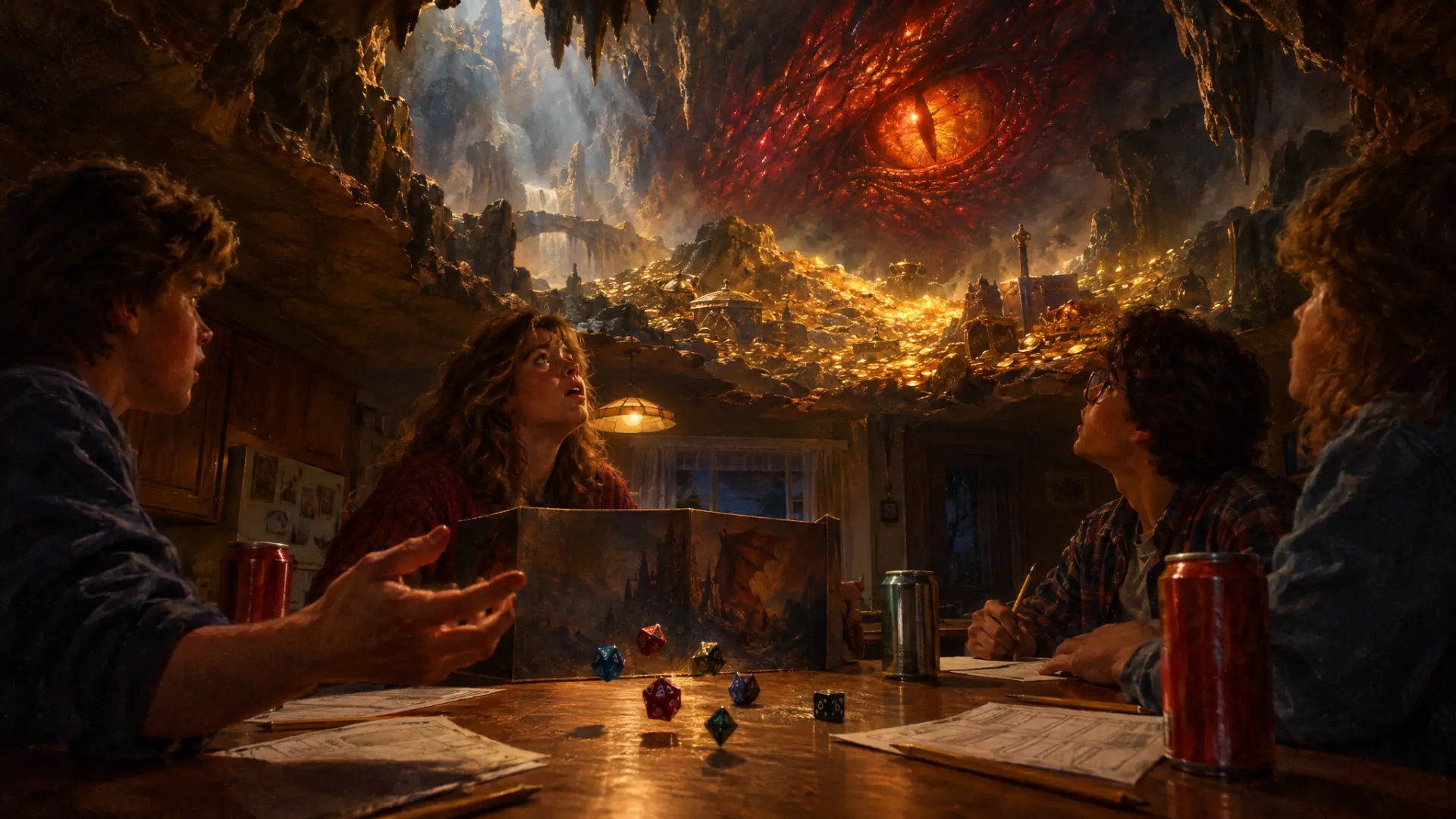
Lucas's attempt to do for sword-and-sorcery what Star Wars did for space opera, it gave Warwick Davis a rare leading role, pioneered ILM's digital morphing, and became a family-fantasy staple on home video.
Overview
Willow is George Lucas's fantasy epic, made with the same toolkit that built Star Wars: an archetypal quest, a farm boy with hidden potential, a rogue with a sword, a wicked queen and a castle to storm. Directed by Ron Howard from a screenplay by Bob Dolman and released in the United States on May 20, 1988, it stars Warwick Davis as Willow Ufgood, a small farmer and would-be sorcerer of the Nelwyn people who must protect a baby prophesied to bring down the tyrant Queen Bavmorda.
Made for $35 million, it earned $137.6 million worldwide, respectable but short of the blockbuster Lucas and MGM had hoped for. Its technical achievement, the first digital morph in a feature film, outlasted its reviews, and it became one of the defining family fantasies of the home-video era.
Origins
Lucas said he conceived the idea in 1972, part of the same fascination with myth and folklore that shaped Star Wars. The project took shape when he met Warwick Davis during the 1982 filming of Return of the Jedi, in which Davis played the Ewok Wicket, and approached him about the part that became Willow. In 1985 he brought the story to Ron Howard, who was then finishing Cocoon.
Lucasfilm produced with Howard's Imagine Entertainment and MGM, with Nigel Wooll as producer and Lucas as executive producer. Principal photography ran from April to October 1987: interiors at Elstree Studios in England, extensive exteriors in Wales, including the Dinorwic slate quarry, and Tongariro National Park in New Zealand for Bavmorda's castle, thirteen years before Peter Jackson's trilogy brought Middle-earth to the same country. James Horner's score was performed by the London Symphony Orchestra.
The effects work went to Lucas's Industrial Light & Magic, which developed digital morphing for a sequence in which the sorceress Fin Raziel passes through a series of animal forms before regaining her human shape. The technique soon reappeared, more famously, in Terminator 2.
The story
The evil queen Bavmorda (Jean Marsh) learns of a prophecy that a child with a special birthmark will cause her downfall, and imprisons every pregnant woman in the land. When the infant Elora Danan is born, a midwife smuggles her out, and she drifts downriver to the Nelwyn village, where Willow and his family find her.
The village's High Aldwin (Billy Barty) sends Willow to return the baby to the world of the tall Daikini. At a crossroads he frees a caged mercenary swordsman, Madmartigan (Val Kilmer), and is joined by two squabbling brownies, Franjean and Rool (Kevin Pollak and Rick Overton). Their quest leads to the sorceress Fin Raziel (Patricia Hayes), trapped in the form of a possum, and through a series of battles with Bavmorda's daughter Sorsha (Joanne Whalley) and her general, Kael.
After a love potion misfires, Madmartigan falls for Sorsha, who changes sides. The allies find the castle of Tir Asleen cursed and overrun by trolls, face the two-headed dragon Eborsisk, and finally storm Bavmorda's fortress. Willow outwits the queen with a sleight-of-hand trick and her own ritual destroys her. With Elora safe with Madmartigan and Sorsha, Willow returns home with a gift of a book of magic.
Reception & impact
Reviews were mixed. Critics praised the effects and Davis's appealing performance while faulting the pacing and familiar plot; Roger Ebert gave it two and a half stars out of four. Lucas answered his critics with in-jokes: the dragon's name nods to Ebert and Gene Siskel, and General Kael to The New Yorker's Pauline Kael, who noted the "homage" in her review.
In a crowded summer that included Crocodile Dundee II, Big and Rambo III, the film grossed $57.3 million in the U.S. and $80.3 million abroad. It received Academy Award nominations for Sound Effects Editing and Visual Effects, won the Saturn Award for costume design, and drew Razzie nominations, including one for its screenplay. Strong home video and television sales made it profitable over time.
Legacy
Willow spun off into several media. Capcom released an arcade game and a Nintendo role-playing game in 1989, Tor Books published Greg Costikyan's The Willow Game in 1988, and Chris Claremont wrote a trilogy of sequel novels from Lucas's outline, Shadow Moon (1995), Shadow Dawn (1996) and Shadow Star (2000). In a decade that also produced Labyrinth and Conan the Barbarian, it stands as the big-studio, family-friendly face of 1980s Fantasy Film.
Decades later the story continued on streaming. Willow, a Disney+ series developed by Jonathan Kasdan and set more than twenty years after the film, premiered on November 30, 2022, with Warwick Davis returning as Willow and Joanne Whalley as Sorsha. It ran for eight episodes, was canceled in March 2023, and was removed from Disney+ on May 26, 2023.
Marginalia
- George Lucas first conceived the story in 1972 and brought it to Ron Howard in 1985, while Howard was finishing Cocoon.
- Lucas had met Warwick Davis, then playing Wicket the Ewok, on the set of Return of the Jedi.
- Industrial Light & Magic created digital morphing for the scene in which a sorceress changes through a series of animals, a technique later used in Terminator 2.
- The two-headed dragon is called an Eborsisk, a joke on critics Roger Ebert and Gene Siskel; the villain General Kael is named for Pauline Kael.
- It earned $137.6 million worldwide on a $35 million budget and received two Academy Award nominations.
- Tor Books published a board game adaptation, The Willow Game, designed by Greg Costikyan, in 1988.
Quick answers
- When was Willow first released?
- Willow was first released in 1988 (U.S., May 20).
- What kind of work is Willow?
- Willow is a film in the Fantasy Film and High / Epic Fantasy tradition.
- Why is Willow important?
- Lucas's attempt to do for sword-and-sorcery what Star Wars did for space opera, it gave Warwick Davis a rare leading role, pioneered ILM's digital morphing, and became a family-fantasy staple on home video.