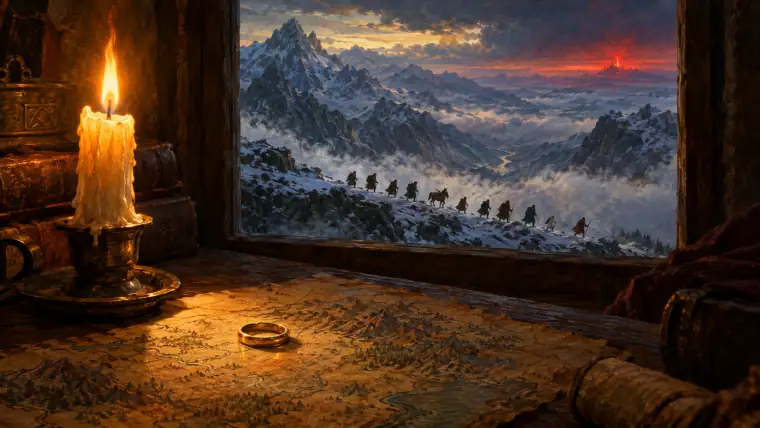
One of the first major commercial epic fantasies built around an antihero, Covenant bridged the Tolkien-inspired boom of 1977 and the morally fraught fantasy that followed, and it was finished, all ten volumes, 36 years after it began.
Overview
The year 1977 gave epic fantasy two very different futures. One was The Sword of Shannara, a cheerful quest that showed publishers how many readers wanted more Tolkien. The other was Lord Foul's Bane, the first volume of Stephen R. Donaldson's The Chronicles of Thomas Covenant, the Unbeliever, which offered those same readers a hero who was bitter, self-pitying, and guilty of a terrible crime in the book's opening chapters. Both came from Lester del Rey's new Del Rey Books imprint. Both became bestsellers. The difference between them anticipates much of the argument fantasy would have with itself over the next half-century.
Origins
Donaldson, born in Cleveland in 1947, spent part of his childhood in India, where his father was a medical missionary who worked with people suffering from leprosy. That experience gave him the disease at the center of the saga: its hero, Thomas Covenant, is a successful novelist whose leprosy has cost him his wife, his son and his place in society, and whose survival depends on a grim routine of self-inspection called the VSE — "visual surveillance of extremities."
The manuscript was, by widely repeated accounts, rejected by 47 publishers. Lester del Rey acquired it for Ballantine's new imprint, and the First Chronicles appeared as Lord Foul's Bane (1977), The Illearth War (1978) and The Power That Preserves (1979). Donaldson won the John W. Campbell Award for Best New Writer in 1979.
The story
Covenant is struck by a police car and wakes in "the Land," a luminous secondary world whose people, the Giants, the Ranyhyn horses and the Lords of Revelstone, greet him as the reincarnation of a legendary hero because he wears a white gold wedding ring — a metal that does not exist in the Land and carries "wild magic." Covenant's response is to refuse to believe any of it. He calls himself "the Unbeliever," insists the Land is a dream, and, overwhelmed by the sudden return of sensation to his numb body, commits an act of sexual violence against a young woman, Lena, whose consequences echo through the rest of the series.
That act made the books notorious and remains the most debated element of the saga. Donaldson's point was that Covenant must carry the damage he does; the Land's forgiveness and his own refusal of it drive the moral plot. His adversary, Lord Foul the Despiser, is less a conquering The Dark Lord than a personification of despair, and the question is not whether the hero can win but whether he can bring himself to act at all.
The Second Chronicles (1980–83) return Covenant, with the physician Linden Avery, to a Land poisoned by the "Sunbane." The Last Chronicles began after a two-decade pause with The Runes of the Earth (2004) and ended with The Last Dark in 2013, bringing the total to ten novels.
Reception & impact
Lord Foul's Bane was named the British Fantasy Society's best novel of the year, and the First Chronicles became a paperback phenomenon alongside Brooks. Readers either embraced Covenant's anguish as a serious answer to Tolkien's moral clarity or abandoned the books in disgust; very few were indifferent. Donaldson's dense, archaic vocabulary became a running joke among some fans and a badge of seriousness for others.
For all its Portal Fantasy bones, Covenant is a darker book than anything else on the late-1970s fantasy shelf. Its self-loathing protagonist and its insistence that heroism can coexist with atrocity point directly toward the Dark Fantasy and, later, the Grimdark fiction of writers such as Joe Abercrombie, who inherited the question of what a fantasy hero owes to the people he hurts.
Legacy
Unlike many of its peers, Covenant never became a game, a film or a television series; its interior drama resists the translation that turned Dragonlance or the Witcher into playable worlds. Its influence is literary rather than commercial. Tom Shippey predicted in 2013 that the series would be "seen as one of the self-defining works of the third millennium," and it is still read as the great counter-argument within the 1977 boom — the moment High / Epic Fantasy first asked whether its chosen hero deserved the role. Its appearance in the same year as Shannara, as the Paperback Boom & the Counterculture reached full speed, made clear that the audience Tolkien had built was large enough to support both the comforting and the harrowing.
Marginalia
- Lord Foul's Bane was reportedly rejected by 47 publishers before Lester del Rey accepted the trilogy for Del Rey Books.
- Donaldson spent part of his youth in India, where his father was a medical missionary working with leprosy patients; Covenant is a leper.
- Donaldson won the John W. Campbell Award for Best New Writer in 1979.
- Lord Foul's Bane was named the British Fantasy Society's best novel of the year.
- The ten-book cycle ended with The Last Dark in 2013, completing a story begun in 1977.
Quick answers
- When was The Chronicles of Thomas Covenant first published?
- The Chronicles of Thomas Covenant was first published in 1977–2013.
- Who created The Chronicles of Thomas Covenant?
- The Chronicles of Thomas Covenant was made by Stephen R. Donaldson (author).
- Who published or developed The Chronicles of Thomas Covenant?
- Del Rey Books and Ballantine Books.
- What kind of work is The Chronicles of Thomas Covenant?
- The Chronicles of Thomas Covenant is a book series in the High / Epic Fantasy, Dark Fantasy and Portal Fantasy tradition.
- Why is The Chronicles of Thomas Covenant important?
- One of the first major commercial epic fantasies built around an antihero, Covenant bridged the Tolkien-inspired boom of 1977 and the morally fraught fantasy that followed, and it was finished, all ten volumes, 36 years after it began.