Pratchett turned comic fantasy into a vehicle for sharp moral satire, and his Discworld became one of the most adapted fantasy worlds in games, from a GURPS rulebook he co-wrote to adventure games, a long-running MUD and his own work on Oblivion mods.
Life
Terence David John Pratchett was born on April 28, 1948, in Beaconsfield, Buckinghamshire, the only child of a mechanic and a secretary. Bullied at primary school over a speech impediment, he credited his real education to the Beaconsfield Public Library. He wanted to be an astronomer but lacked the mathematics, went to science fiction conventions as a teenager, and sold his first story, "The Hades Business," to Science Fantasy at fifteen. He left school at seventeen in 1965 to apprentice as a journalist on the Bucks Free Press.
While on the paper he interviewed a director of the small publisher Colin Smythe Ltd, mentioned a manuscript, and saw The Carpet People published in 1971 with his own illustrations. In 1979 he became press officer for the South West Region of the Central Electricity Generating Board, a post covering three nuclear power stations, and joked about his timing so soon after Three Mile Island. He went full-time as a novelist only in 1987, after finishing Mort.
In December 2007 he announced that he had been diagnosed with a rare form of early-onset Alzheimer's disease, posterior cortical atrophy. He donated £494,000 to the Alzheimer's Research Trust, made BBC documentaries about living with the disease, and gave the 2010 Richard Dimbleby Lecture. He was appointed OBE in 1998 and knighted in the 2009 New Year Honours, and in 2010 made his own sword from iron ore dug from a field near his home. He died at home on March 12, 2015, at 66. His daughter, the game writer Rhianna Pratchett, is custodian of the Discworld franchise.
Work
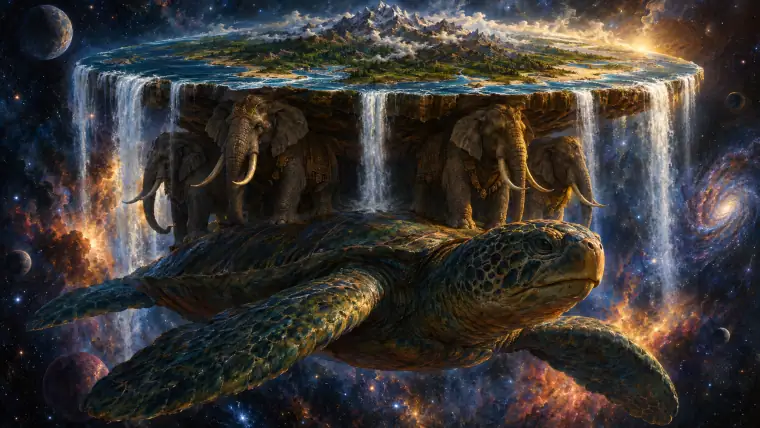
The Colour of Magic (1983) began as a parody of the Sword & Sorcery paperbacks of his youth. It opens with the thief-heroes Bravd and the Weasel, an affectionate nod to Fritz Leiber's Fafhrd and the Gray Mouser, introduces a barbarian cut from Robert E. Howard's cloth and a cowardly failed wizard named Rincewind, and sends everyone past dragons that exist only when imagined and a Lovecraftian horror lurking in a forgotten temple. The world itself, a disc carried by four elephants on the back of the star turtle Great A'Tuin, was a joke that proved infinitely roomy.
Across 41 novels, the last of which, The Shepherd's Crown, appeared in August 2015, five months after his death, Pratchett turned the parody into something closer to Swift or Dickens. The books settled into loose sub-series about the witches of Lancre, the wizards of Unseen University, Death and his granddaughter Susan, and the Ankh-Morpork City Watch, and increasingly they dramatized a medieval world colliding with modernity: police in Guards! Guards!, guns in Men at Arms, newspapers in The Truth, the postal service in Going Postal, banking in Making Money. Beneath the footnotes and puns ran a fierce concern with justice, class and what people owe one another. He also co-wrote Good Omens (1990) with Neil Gaiman, and wrote for younger readers in the Tiffany Aching books. Pratchett averaged two books a year; his works have sold more than 100 million copies in 43 languages (as of 2023).
Legacy
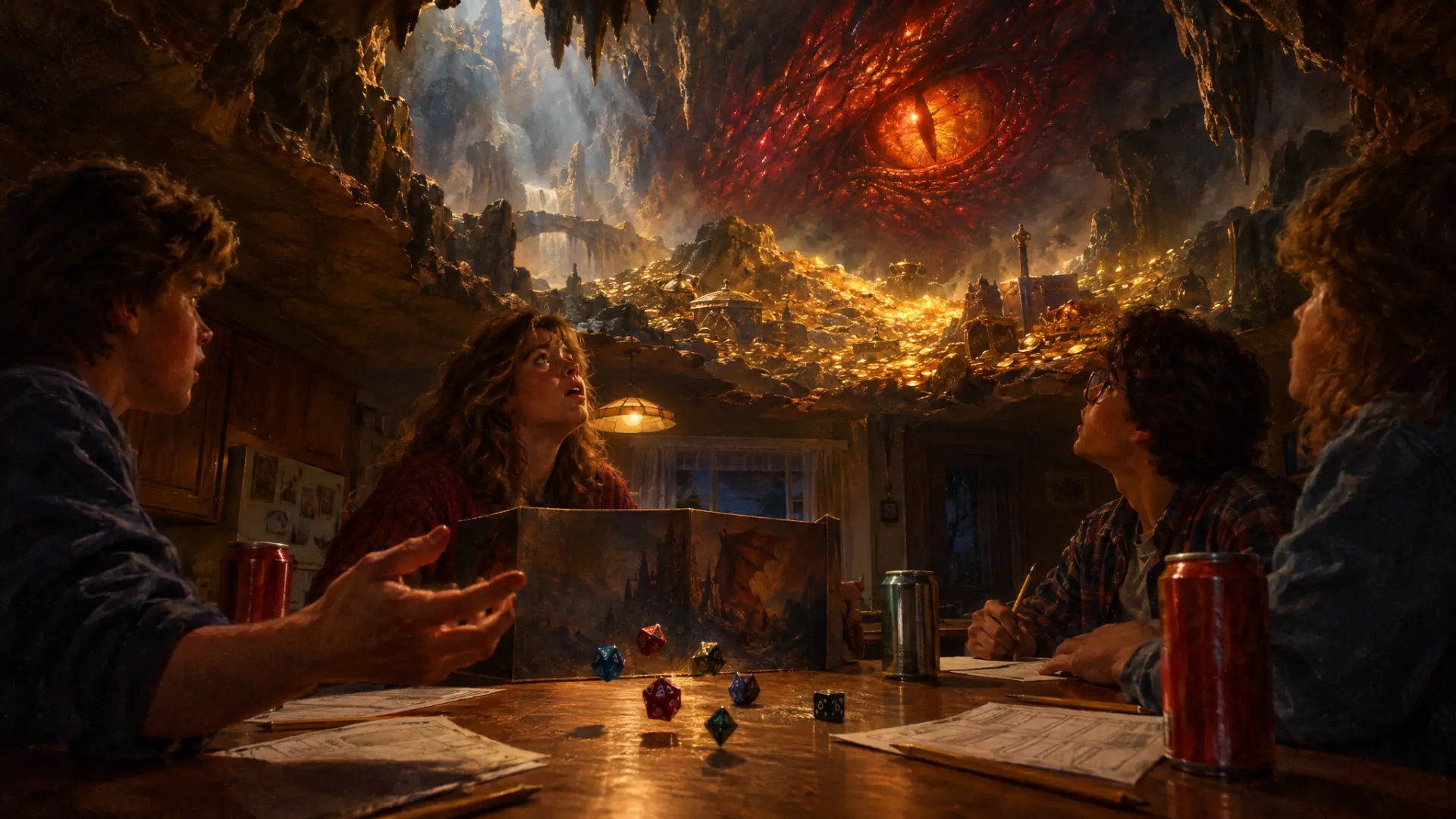
Pratchett was a devoted gamer, and games returned the favor. After a poorly received 1986 adaptation of The Colour of Magic, he initially refused game licenses, but was won over by designer Gregg Barnett. The resulting point-and-click Discworld (Psygnosis, 1995), with Eric Idle voicing Rincewind, was reviewed in Dragon and followed by Discworld II and the detective game Discworld Noir. On the tabletop, he co-wrote GURPS Discworld (1998) with Phil Masters for Steve Jackson Games, built on GURPS; later came board games such as Martin Wallace's Ankh-Morpork (2011). The fan-built Discworld MUD, founded in 1991 and open since 1992, has run for more than three decades. Pratchett called The Elder Scrolls IV: Oblivion his favorite game, wrote dialogue for the fan-made companion mod Vilja, and helped with its Skyrim successor.
On screen, Sky One produced three two-part films, Hogfather (2006), The Colour of Magic (2008) and Going Postal (2010); BBC America's loose adaptation The Watch followed in 2021. Good Omens ran on Amazon Prime Video from 2019, concluding with a feature-length finale released in May 2026. After his death, thousands of websites added the invisible header "GNU Terry Pratchett," echoing the clacks operators of Going Postal who keep the names of the dead moving along the line. He had asked that whatever he was working on at his death be destroyed by a steamroller, and in 2017 his hard drive duly was.
Marginalia
- He left school at 17 to become a journalist and later spent eight years as a press officer for the Central Electricity Generating Board, covering three nuclear power stations.
- The Colour of Magic (1983) opens with Bravd and the Weasel, a wink at Fritz Leiber's Fafhrd and the Gray Mouser.
- He co-wrote GURPS Discworld (Steve Jackson Games, 1998) with Phil Masters; it was the first book to include the GURPS Lite rules.
- He called The Elder Scrolls IV: Oblivion his favorite video game and wrote dialogue for the fan mod companion Vilja.
- He was the UK's best-selling author of the 1990s, was knighted in 2009, and won the Carnegie Medal for The Amazing Maurice and His Educated Rodents (2001).
- After his death, web administrators added the header "X-Clacks-Overhead: GNU Terry Pratchett" to their sites, borrowing a custom from Going Postal.
Quick answers
- Who was Terry Pratchett?
- The satirist who put a flat world on four elephants and a turtle, then used it for 41 Discworld novels that skewered sword and sorcery, then everything else, selling more than 100 million books.
- When was Terry Pratchett born?
- Terry Pratchett was born in 1948 in Beaconsfield, Buckinghamshire, England and died in 2015.
- What is Terry Pratchett known for?
- Terry Pratchett is best known for Discworld.
- Why does Terry Pratchett matter to fantasy and games?
- Pratchett turned comic fantasy into a vehicle for sharp moral satire, and his Discworld became one of the most adapted fantasy worlds in games, from a GURPS rulebook he co-wrote to adventure games, a long-running MUD and his own work on Oblivion mods.