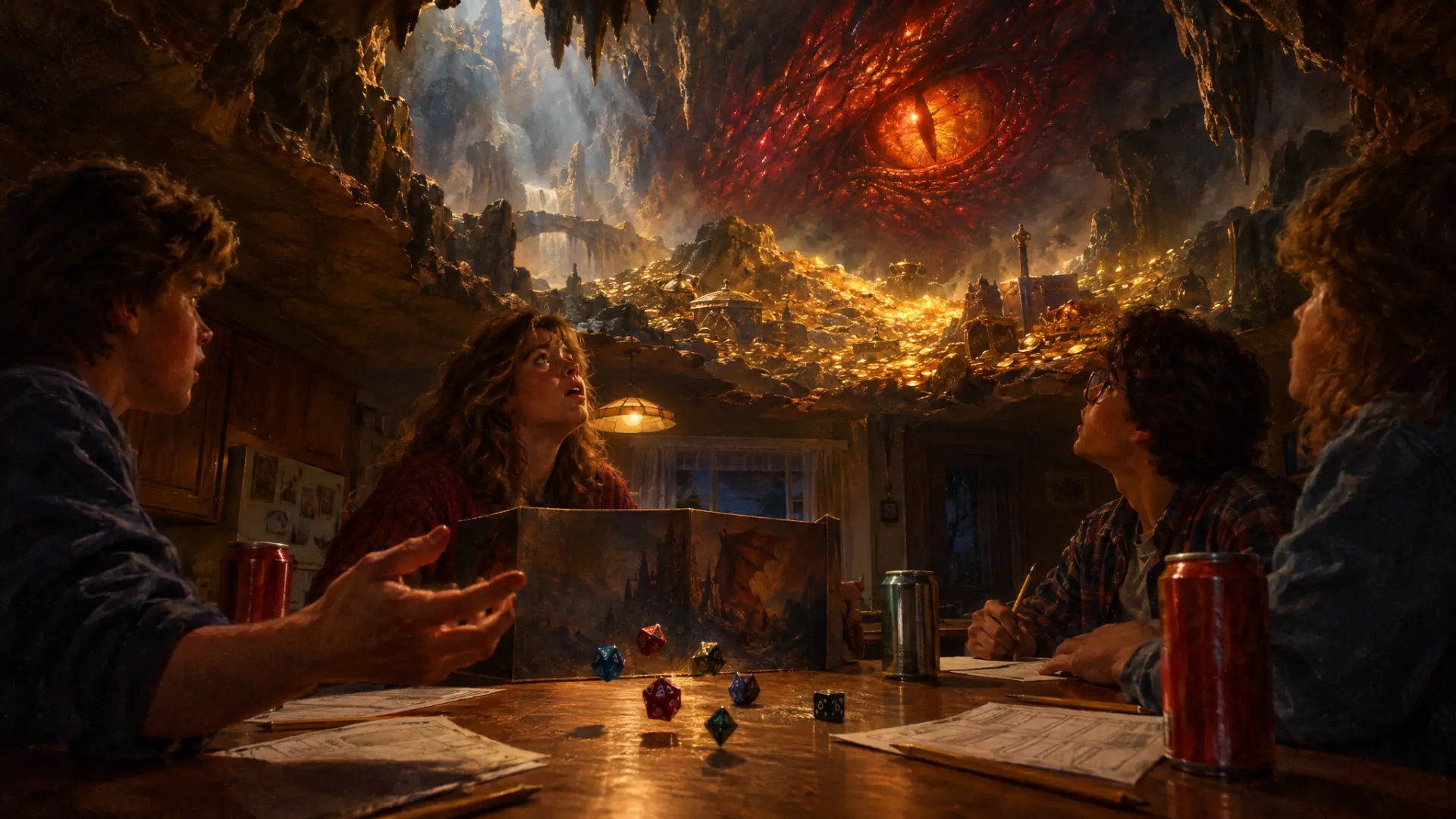
The panic was the first great culture-war battle over a fantasy game. It shaped how the public saw roleplayers for a decade, changed what TSR would print, and prefigured later scares over heavy metal and video games.
What happened
The panic over Dungeons & Dragons was one strand of a much larger fear. In 1980 a Canadian psychiatrist and his patient published Michelle Remembers, a memoir, since discredited, of childhood abuse by a Satanic cult, assembled through recovered-memory therapy. It became a template. Through the 1980s, talk shows, conferences and some therapists and investigators spread the belief that organized Satanists were abusing and murdering children across North America; the McMartin preschool case in California, charged in 1983, ended after years in court with no convictions. In 1994 The New York Times reported that of more than 12,000 documented accusations, police had been unable to substantiate any allegation of organized cult abuse.
Roleplaying games entered the story through a tragedy. In August 1979 James Dallas Egbert III, a 16-year-old prodigy at Michigan State University, disappeared from campus. He was struggling with serious personal difficulties and had attempted to take his own life. A private investigator hired by his family learned that he played D&D and speculated to reporters that he might have been lost in the university's steam tunnels during a live-action game. Much of the press reported the theory as fact, and D&D was described in some coverage as a "bizarre and secretive cult." Egbert was found alive in Louisiana several weeks later; the game had nothing to do with his disappearance. He died by suicide in August 1980. The investigator later rejected the D&D link in his own book. The "steam tunnel" myth nonetheless became the basis for Rona Jaffe's novel Mazes and Monsters (1981) and its 1982 television film.
In June 1982 Irving Pulling, a teenager in Richmond, Virginia, who played D&D, died by suicide. His grieving mother, Patricia Pulling, sued his high school principal, blaming a curse she said had been placed on her son's character in a game shortly before his death, and sued TSR; both suits were dismissed. She then founded Bothered About Dungeons & Dragons (BADD), which described the game as a catalog of "demonology, witchcraft, voodoo, murder" and worse, and worked with psychiatrist Thomas Radecki of the National Coalition on Television Violence, who on national television linked the game to 28 murders and suicides. Pulling obtained a private investigator's license and became a consultant to law enforcement, and BADD's materials circulated through conservative Christian media and the mainstream press, reaching as far as Australia. Jack Chick's 1984 comic tract Dark Dungeons showed a player led into witchcraft by her Dungeon Master.
In 1985 CBS's 60 Minutes put Gary Gygax opposite Pulling and Radecki. Gygax argued that the game was make-believe, comparing it to Monopoly, in which no one is really bankrupted. TSR received death threats; Gygax hired a bodyguard.
Why it mattered
The accusations did not survive scrutiny. Reporters and researchers found that BADD's lists of "gaming deaths" were mostly unsourced clippings, sometimes counting one case several times; given the number of players, gamers appeared to take their own lives at a lower rate than their peers. The game designer Michael A. Stackpole's Pulling Report (1990) dismantled BADD's statistics and exposed misrepresented credentials, and Pulling withdrew from the group. By 1991 the American Association of Suicidology, the U.S. Centers for Disease Control and Health and Welfare Canada had all concluded that there was no causal link between fantasy gaming and suicide. Studies of players found no special tendency to depression or instability.
The costs were nonetheless real. There were campaigns to ban the game, young players were ostracized, and the language of cult "recruitment" attached itself to a hobby built on friends around a table. The panic also changed the product. Ironically, publicity first boosted sales: TSR's revenue rose from about $2.3 million in 1979 to about $8.7 million in 1980. But when TSR published AD&D 2nd Edition in 1989 it quietly removed the words "demon" and "devil"; the fiends returned as "tanar'ri" and "baatezu."
Legacy
Media hostility faded in the early 1990s, as the wider Satanic ritual abuse scare collapsed and the FBI's child-abuse specialist Kenneth Lanning reported little or no evidence for organized Satanic conspiracies. With third edition (2000), Wizards of the Coast restored the old names and handled demonology openly. Parental anxieties moved on, above all to video games (see the Oblivion ESRB Re-rating).
Gamers have since made the panic part of their folklore. A 2014 short-film adaptation of Dark Dungeons, made with Chick's permission and read by most critics as satire, premiered at Gen Con. The fourth season of Stranger Things (2022) built its plot around a small town turning on a school D&D club in the mid-1980s. For those who lived through it, the episode remains a lesson in how a moral panic chooses its targets, and in the families on every side who were hurt by it.
Marginalia
- The wider Satanic panic grew from Michelle Remembers (1980), a later-discredited memoir built on recovered-memory therapy; a 1994 New York Times report found police could not substantiate any of more than 12,000 accusations of organized cult abuse.
- Newspaper coverage of the 1979 disappearance of Michigan State student James Dallas Egbert III wrongly tied it to D&D; the game's sales rose sharply in the months that followed.
- Patricia Pulling founded Bothered About Dungeons & Dragons (BADD) after her son Irving died by suicide in June 1982; her lawsuits against his school principal and against TSR were dismissed.
- Jack Chick's 1984 comic tract Dark Dungeons depicted D&D as a recruitment tool for witchcraft.
- On a 1985 60 Minutes segment Gary Gygax compared the game to Monopoly, asking who is bankrupted by play money; TSR received death threats, and Gygax hired a bodyguard.
- By 1991 the American Association of Suicidology, the U.S. Centers for Disease Control and Health and Welfare Canada had all concluded there was no causal link between fantasy games and suicide.
- AD&D 2nd Edition (1989) dropped the words "demon" and "devil"; the creatures later returned as tanar'ri and baatezu.
Quick answers
- What was The Satanic Panic & D&D?
- In the 1980s a moral panic over imagined Satanic cults swept up Dungeons & Dragons, casting a game of dice and imagination as a gateway to the occult, suicide and murder. Every serious investigation found nothing.
- When did The Satanic Panic & D&D happen?
- 1979 – mid-1990s.
- Why did The Satanic Panic & D&D matter?
- The panic was the first great culture-war battle over a fantasy game. It shaped how the public saw roleplayers for a decade, changed what TSR would print, and prefigured later scares over heavy metal and video games.