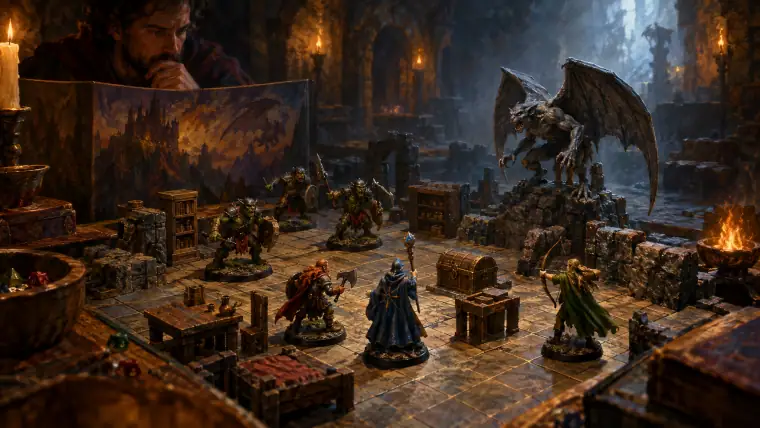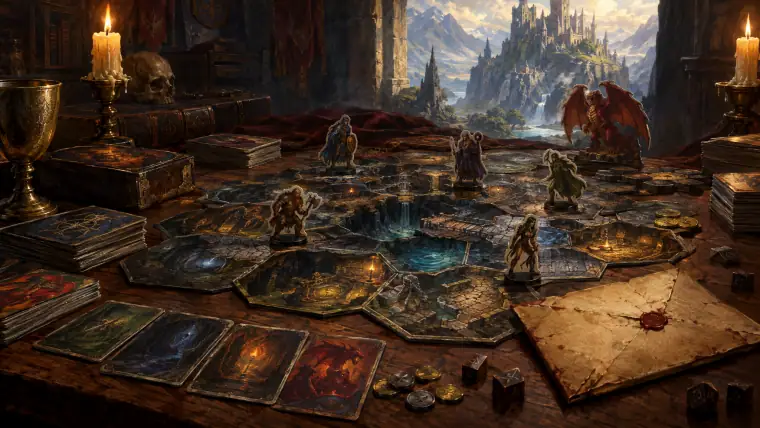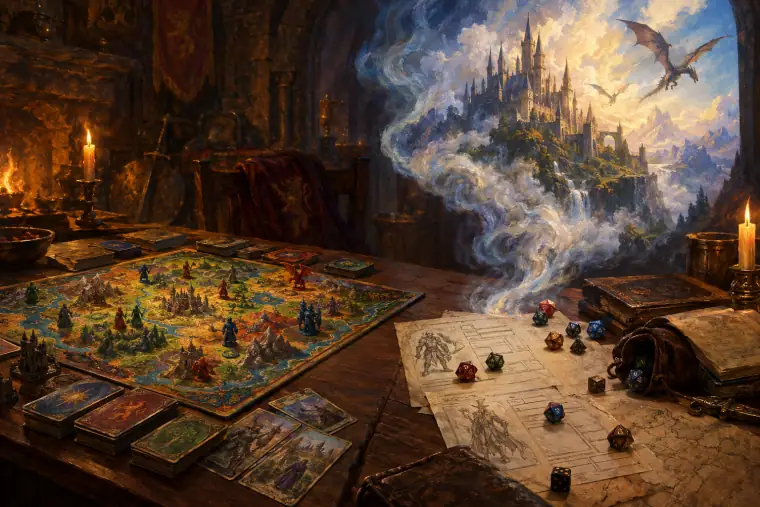
Warhammer Quest took the HeroQuest formula and removed the evil overlord, making the dungeon itself the opponent and prefiguring the cooperative campaign crawlers of the 2010s.
Overview
Warhammer Quest is a dungeon crawl that plays against you. Released by Games Workshop in 1995 and designed by Andy Jones, it put four heroes — a Barbarian, a Dwarf, an Elf and a Wizard — into the tunnels beneath the Old World of Warhammer and let a deck of cards generate the dungeon as they went. There was no evil overlord at the table. One to six players cooperated against the game itself, a design that anticipated much of the modern Dungeon-Crawler Board Games.
Origins
Games Workshop had helped create the fantasy adventure board game. With Milton Bradley it produced HeroQuest (1989), Stephen Baker's mass-market dungeon crawl in which one player acted as the evil wizard Zargon, and it followed with the deeper Advanced HeroQuest in 1989. Warhammer Quest was the next step: a game that kept HeroQuest's tactile plastic miniatures and modular corridors but replaced the villain player with systems.
The box was lavish even by Games Workshop standards: 32 board sections, 108 cards, 91 plastic miniatures and 18 dice. The Old World setting gave it an existing bestiary of orcs, goblins, skaven and undead, painted in the grim, baroque style of John Blanche and Games Workshop's house artists.
How it plays
Each turn begins with the Power Phase, when the Wizard rolls a die to see how much magical power he has to spend. On a roll of 1, something unexpected happens instead: the players draw an Event card, which might spring a trap, bring a wandering band of monsters or offer a strange encounter. The Wizard's power and the dungeon's menace are tied to the same roll — a simple and elegant way to keep tension rising without a human opponent.
The dungeon itself is a shuffled deck. When the heroes reach an unexplored doorway, they turn over a Dungeon card and place the matching room or corridor section, with the final objective room buried near the bottom of the deck. Monsters follow simple behavior rules for choosing targets, so everyone at the table plays heroes. Combat uses six-sided dice against weapon skill tables familiar from Warhammer's miniatures rules.
Between adventures the game expanded into something like a roleplaying game. Heroes collect gold from dungeon-room and objective-room treasure, then visit settlements to buy equipment and pay for training that advances them through ten battle levels. The included Roleplay Book added more locations, psychology rules and guidance for a game master who wanted to run looser, story-driven campaigns. Additional Warrior Packs offered further characters from the Warhammer world.
Reception & impact
Warhammer Quest earned a strong following for its cooperative play and campaign progression, and Games Workshop supported it with expansions, extra warriors and articles in White Dwarf. But the company's attention remained on its core miniatures wargames, and the original line ended in 1998.
Its structure — cooperating heroes, a card-driven dungeon, an automated enemy and persistent character growth — became a template. Fantasy Flight Games' Descent: Journeys in the Dark (2005) revived the big-box dungeon crawl, though with a villain player; later cooperative campaigns such as Gloomhaven made automated monsters and long-term progression central.
Legacy
The name returned in 2016 with Warhammer Quest: Silver Tower, set in Games Workshop's newer Age of Sigmar universe, followed by Shadows over Hammerhal (2017), Blackstone Fortress (2018) in the Warhammer 40,000 setting, Cursed City (2021), Lost Relics (2022) and Darkwater (2025). Rodeo Games adapted the original as a digital game, first released for iOS on May 30, 2013 and later ported to computers and consoles.
For many players, Warhammer Quest is the missing link between HeroQuest's family-friendly adventure and the heavyweight campaign board games of the 2010s — proof that a dungeon could be dangerous and surprising even with nobody playing the villain.
Marginalia
- The box held 32 board sections, 108 cards, 91 plastic miniatures and 18 six-sided dice.
- Unlike HeroQuest, no player runs the monsters; cards and dice decide what lurks around each corner.
- Heroes buy their way up ten battle levels with gold, training in towns between expeditions.
- A separate Roleplay Book added settlements, psychology rules and a path toward full roleplaying.
- Games Workshop revived the name in 2016 with Warhammer Quest: Silver Tower, followed by Blackstone Fortress (2018) and Cursed City (2021).
Quick answers
- When was Warhammer Quest first released?
- Warhammer Quest was first released in 1995.
- Who published or developed Warhammer Quest?
- Games Workshop.
- What kind of work is Warhammer Quest?
- Warhammer Quest is a board game in the Dungeon-Crawler Board Games and Fantasy Adventure Board Games tradition, released for Boxed board game and iOS, PC and consoles (2013 adaptation).
- Why is Warhammer Quest important?
- Warhammer Quest took the HeroQuest formula and removed the evil overlord, making the dungeon itself the opponent and prefiguring the cooperative campaign crawlers of the 2010s.