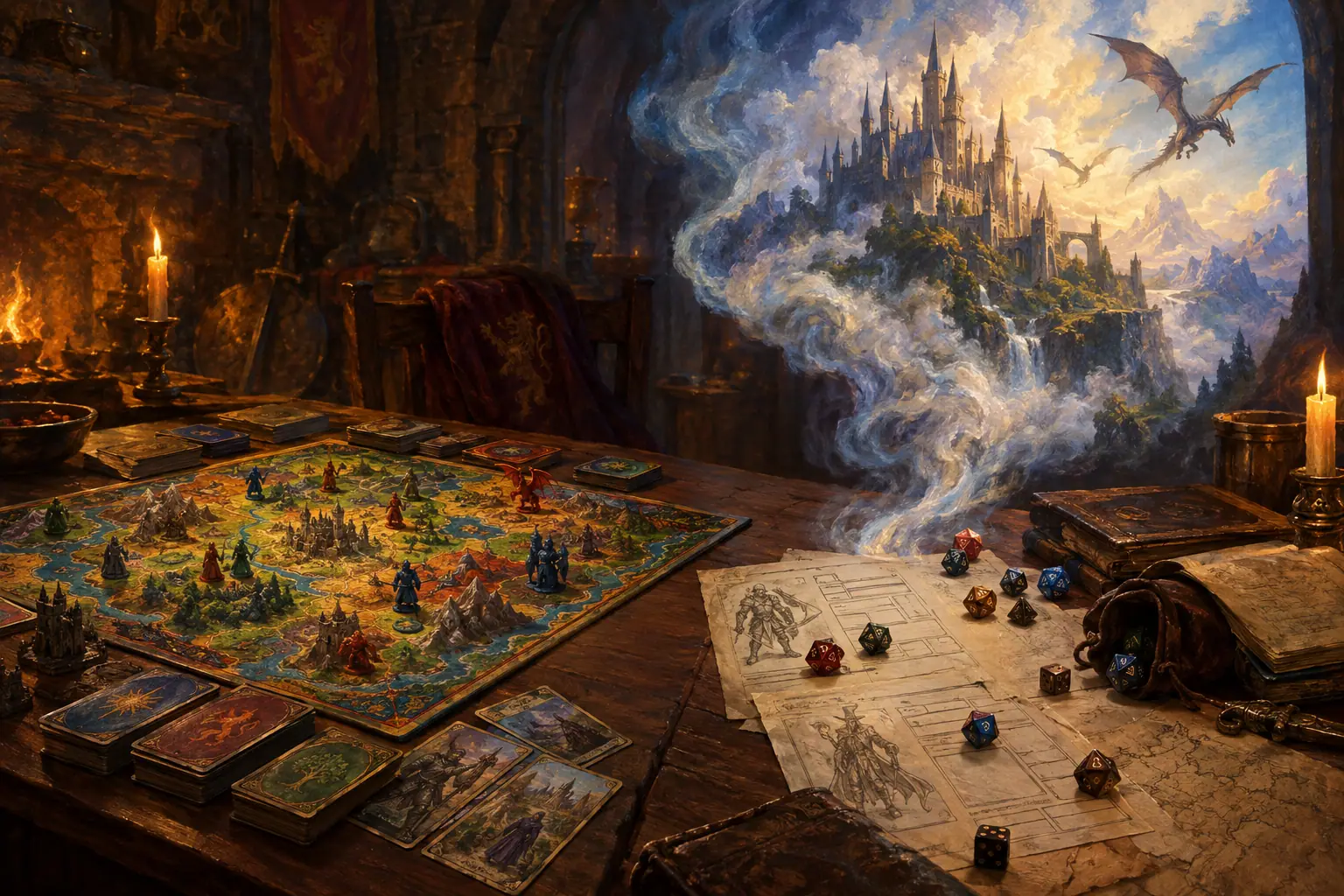
Board Game, Wargame, or Roleplaying Game?
A field guide to telling the fantasy game families apart
The dragons look the same. A red dragon might appear on a wargame counter, a board game card, a gamebook page, a D&D miniature and a computer screen. What differs is the structure around it, and structure is what this field guide teaches you to see.
Three questions will identify almost any specimen in the museum.
Who decides what happens? In a Miniatures & Board Wargames and a board game, the rules and the board decide. In a Gamebooks & Interactive Books, the author decided in advance. In a tabletop roleplaying game, a living referee decides, and can respond to anything a player tries. In a computer RPG, the program decides, within the limits its designers foresaw.
Is there a winner? Wargames and board games end, and someone wins. Roleplaying games generally have no winner. Play simply continues.
Does the game remember? A board game resets when it goes back in the box. An RPG remembers: the same characters return, carrying their scars, treasure and Experience points. An MMORPGs remembers for everyone at once, running a world that continues when you log off.
The stops that follow run roughly in historical order, from Chainmail to World of Warcraft. Each is a clear specimen of its family, and one, Gloomhaven, is a test case that sits on a border. Hybrids are common. HeroQuest gives one player a role like a Dungeon Master's, and Fighting Fantasy puts a character sheet inside a paperback. Part of the fun is arguing over where they belong.
At each stop, ask the three questions. By the end you should be able to sort any fantasy game you meet, and to see why the invention of the roleplaying game in 1974 was such a break with what came before.
- 1ChainmailWargame · 1971
Specimen: the miniatures wargame. Two sides, armies of figures, a table of terrain, fixed rules and a winner. Its fantasy supplement added dragons and wizards, but the player is still a general commanding units, not a person living a life.
- 2Dungeon!Board game · 1975
Specimen: the board game. Dungeon! (1975) has a printed board, legal moves along its corridors and a victory condition, a set amount of treasure carried out. No referee is needed, because every situation is already on the board or the cards.
- 3TalismanBoard game · 1983
Specimen: the adventure board game. Heroes gain strength, items and followers as they circle a board toward the Crown of Command, which feels like a roleplaying character's growth. But the game ends, someone wins, and the characters are put back in the box.
- 4HeroQuestBoard game · 1989
Specimen: the dungeon-crawler board game, a close cousin of the RPG. One player runs the monsters and hides the dungeon, much like a Dungeon Master, and heroes carry equipment between quests. The difference is that the quests, rooms and choices are printed in advance.
- 5Choose Your Own AdventureGamebook · 1979–1998
Specimen: the branching book. The reader is 'you' and chooses which page to turn to, but there are no dice, no statistics and no fighting rules. The author has already written every possible path.
- 6Fighting FantasyGamebook · 1982
Specimen: the gamebook. Numbered paragraphs branch like a Choose Your Own Adventure book, but the reader also rolls dice and tracks SKILL, STAMINA and LUCK on a character sheet. The book acts as a referee that can only offer choices its author foresaw.
- 7Dungeons & DragonsTabletop RPG · 1974
Specimen: the tabletop roleplaying game. A referee holds a secret world and adjudicates anything the players attempt, not just the options on a list. There is no board and no winner, and characters persist from session to session as a campaign. That combination defines the RPG.
- 8GloomhavenBoard game · 2017
A test case. Gloomhaven (2017) is a board game with a campaign: characters level up, retire and change a persistent world across dozens of sessions. It borrows the RPG's persistence but keeps the board game's fixed rules and needs no referee.
- 9Wizardry: Proving Grounds of the Mad OverlordDungeon crawler · 1981
Specimen: the computer RPG. The computer replaces the referee, running the rules, hiding the maze and rolling the dice. The player gains a patient, tireless game master that can respond only to what its programmers anticipated.
- 10RogueRoguelike · c. 1980
Specimen: the roguelike. The computer generates a new dungeon for every game, and death is permanent. Rogue restores some of the tabletop's surprise, because not even the designer knows what the next level holds.
- 11MUD1MUD · 1978–1999
Specimen: the MUD. In 1978 two Essex students let many players share one text world in real time. It was the first step from a game played at one table to one played by a crowd.
- 12World of WarcraftMMORPG · 2004
Specimen: the MMORPG. A persistent 3D world, run on servers, where thousands of players share the same space and the world continues after they log off. It is the largest descendant of all the forms on this tour, and its raids ask forty players, later twenty-five, to act as a single party.