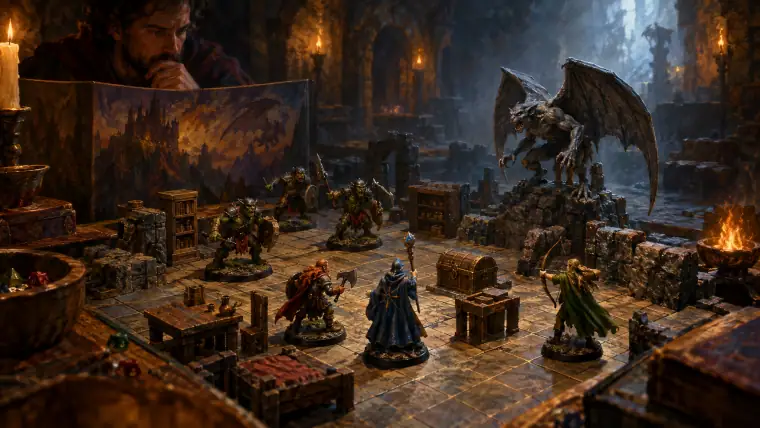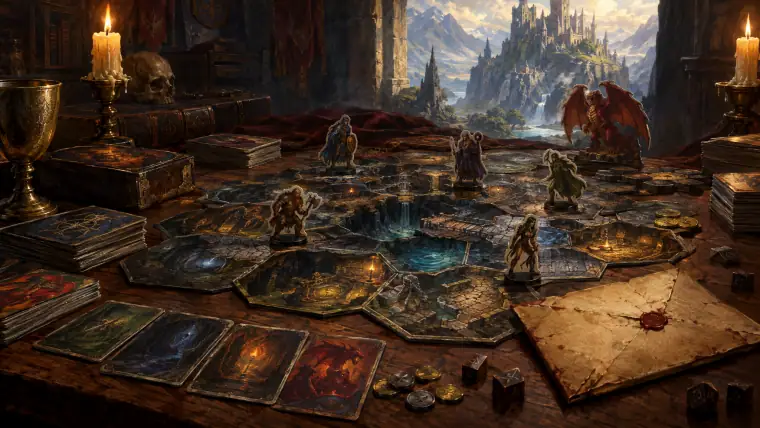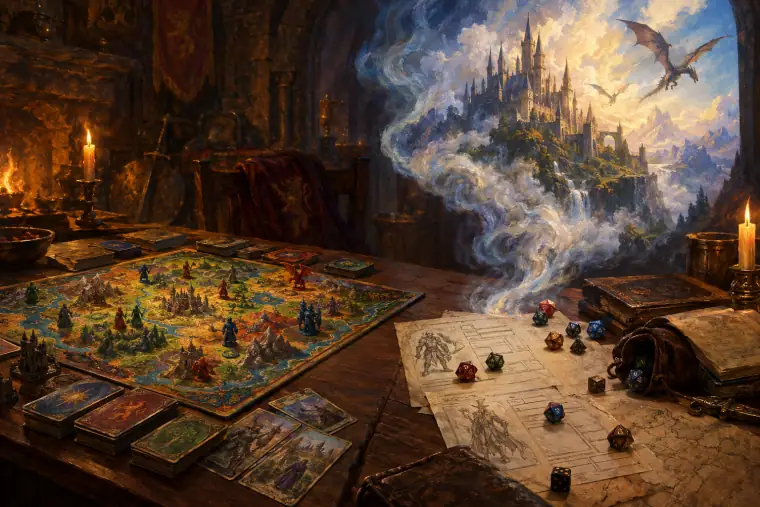
Adventure board games carried the fantasy RPG's core pleasure, a character who grows, to players who never met a Dungeon Master, and they remain the busiest crossroads between roleplaying and board gaming.
Hallmarks
- Each player is one hero who grows stronger through play
- RPG trappings in a box: stats, items, spells, followers, experience
- A fixed or modular board that structures exploration
- Encounter and adventure cards in place of a game master's invention
- A defined ending and usually a winner, or a shared victory in co-op designs
- Sessions of an evening, with no preparation and no referee
What it is
An adventure board game gives each player a single hero and lets that hero improve. You begin as a weak warrior, thief or wizard with a few numbers on a card; you move across a board, turn over encounter cards, fight monsters with dice, and collect gold, weapons, spells and companions until you are strong enough to win. The pleasures are those of a Tabletop Roleplaying Games, the party of adventurers and the climb in Experience points and Loot & loot tables, but they are delivered by a board, a deck and a rulebook rather than by a Game Master. The game has edges: it ends tonight, and usually somebody wins.
The genre splits into three families. Competitive races, like Talisman, pit heroes against each other on the way to a goal. Cooperative adventures set the players against the game itself. And overlord games, like HeroQuest and Descent: Journeys in the Dark, hand one player the monsters. When the action narrows to rooms, corridors and tactical fights, the result is its own sub-genre, the Dungeon-Crawler Board Games.
Origins
The first adventure board game grew up beside Dungeons & Dragons itself. David Megarry, a player in Dave Arneson's Blackmoor campaign, had a prototype of Dungeon! by 1972; he and Arneson brought it to Lake Geneva, and TSR, Inc. published it in 1975. It kept D&D's monsters, treasure and classes but put them on a fixed six-level board where each class raced to collect a set amount of gold.
The late 1970s and early 1980s supplied a remarkable range of experiments. Avalon Hill's Magic Realm (1979), designed by Richard Hamblen, built a different world from modular hex tiles each game and is often described as somewhat similar to a role-playing game, though notoriously hard to learn. Milton Bradley Company's Dark Tower (1981) put an electronic tower at the center of the board to run encounters and combat, a microchip Game Master for families. Then in 1983 Games Workshop published Robert Harris's Talisman, a race around concentric regions to the Crown of Command, in which heroes gained strength, craft, items and followers. Talisman proved so durable that it has passed through five editions, from 1983 to 2024, and had sold more than 800,000 copies by 2000. Its appeal was the arc of a whole RPG campaign compressed into an evening: a hero who starts out losing fights to wolves ends by duelling dragons, unless a card turns them into a toad first. Luck governs much of it, and critics complained from the start that games ran long, but the combination of a growing character and a shared, perilous map became the template for everything that followed.
Evolution
The genre broadened in the later 1980s. Chaosium's Arkham Horror (1987) made the adventure cooperative and Lovecraftian, and in 1989 Stephen Baker's HeroQuest for Milton Bradley and Games Workshop brought a game-master-led dungeon to toy shelves in the UK and Europe, reaching North America in 1990.
The 1990s were leaner: the collectible card game boom drew away much of the hobby's money and attention. The revival came from Fantasy Flight Games, which in the 2000s reissued Talisman and Arkham Horror, published Runebound (2004) and launched Descent: Journeys in the Dark (2005). The 2010s brought campaign play and legacy mechanisms: Wizards of the Coast' cooperative D&D Adventure System, starting with Castle Ravenloft (2010), let one to five players explore without a referee, and Isaac Childres's crowdfunded Gloomhaven (2017) turned the adventure into a months-long campaign with a changing world, riding the wave described in Crowdfunding & the Kickstarter Era. Many modern designs now link to companion apps that take over the role once played by Dark Tower's electronics.
How to tell it apart
Versus the roleplaying game. A Tabletop Roleplaying Games is open-ended: players can attempt anything and a referee rules on it. An adventure board game offers a menu of legal moves, content fixed on printed cards, and a finish. The RPG's campaign has no final square; Talisman has the Crown of Command.
Versus the wargame. A Miniatures & Board Wargames commands armies of expendable units; an adventure game follows one hero whose growth is the point.
Versus the dungeon crawler. Every dungeon-crawler board game is an adventure board game, but not every adventure game crawls. Talisman roams a whole world at a brisk, luck-driven pace; a crawler like Warhammer Quest or Gloomhaven zooms in on room-by-room tactics, line of sight and positioning.
Versus the card game. A Collectible & Trading Card Games builds its decks before play and sells cards at random; the adventure game ships complete, and its cards generate encounters rather than forming a player's arsenal.
Where to start
- Dungeon! — the 1975 original, still quick and fun with children.
- Talisman — the definitive competitive race, luck and all.
- HeroQuest — the gateway box that made families into adventuring parties.
- Descent: Journeys in the Dark — the lavish overlord game of the 2000s revival.
- Gloomhaven — the campaign epic that topped BoardGameGeek for years.
- Then take the tour Board Game, Wargame, or Roleplaying Game? to see where board game ends and roleplaying begins.
Marginalia
- Dungeon! (1975) is generally described as the first adventure board game; its designer played in Dave Arneson's Blackmoor campaign.
- Avalon Hill's Magic Realm (1979) could be played solo or by up to 16 players and was called more complex than many wargames.
- Milton Bradley's Dark Tower (1981) put a rotating electronic tower with sounds and lights at the center of the board.
- Talisman began as a school game about becoming prefect before Robert Harris rethemed it as fantasy.
- Talisman had sold more than 800,000 copies by 2000 and reached a fifth edition in 2024.
- Wizards of the Coast's cooperative D&D Adventure System began with Castle Ravenloft in 2010.
Quick answers
- What is Fantasy Adventure Board Games?
- The roleplaying game folded into a box: roll, move, draw an encounter card, gain a sword or a spell, and race your friends' heroes toward a crown, a tower or a dragon's hoard before the evening ends.
- What are the hallmarks of Fantasy Adventure Board Games?
- Each player is one hero who grows stronger through play; RPG trappings in a box: stats, items, spells, followers, experience; A fixed or modular board that structures exploration; Encounter and adventure cards in place of a game master's invention; A defined ending and usually a winner, or a shared victory in co-op designs; Sessions of an evening, with no preparation and no referee.
- When did Fantasy Adventure Board Games emerge?
- 1975 (Dungeon!); golden age 1980s; revival 2000s.
- What are the key works of Fantasy Adventure Board Games?
- Dungeon!, Talisman, HeroQuest, Descent: Journeys in the Dark and Gloomhaven.