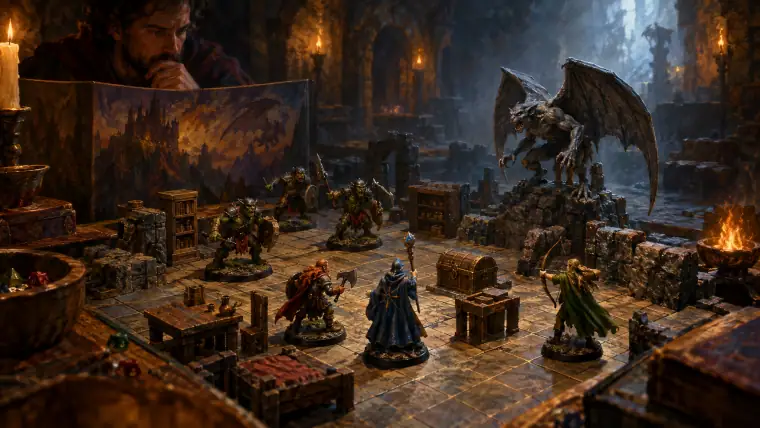
Harris's Talisman offered the excitement of a roleplaying adventure without a referee or preparation. It became one of the best-known fantasy adventure board games, has stayed in print through five editions, and sold more than 800,000 copies by 2000.
Life
Robert J. Harris, known as Bob, was born in Dundee, Scotland. As a boy he made comics and games and wrote stories. In his teens he read science fiction and the new "heroic fantasy": The Lord of the Rings and reprints of William Morris and Lord Dunsany, most of them with introductions by Lin Carter. He studied Latin and Greek at the University of St Andrews and took a first-class honours degree in Humanity (Latin). He then began, but did not finish, a doctorate on the early Church Fathers.
At St Andrews he met Debby Turner, an American Rotary Scholar working on her first novel. They married, and as Deborah Turner Harris she became a fantasy novelist too. The couple settled in Scotland, raised three sons, and became close friends of the American author Jane Yolen, who spent a good part of every year in St Andrews until her death in 2026.
Work
Talisman began, in Harris's telling, with a group purchase. In the early 1980s his future wife, who had played Dungeons & Dragons at home in Florida, persuaded a group of postgraduates in their St Andrews residence to pool their money for a set. Their first session, run by an Australian physicist, lasted a whole weekend. Characters died and were replaced one after another, and Harris was hooked. He also wanted something else: the excitement of a roleplaying adventure without the work of creating characters and drawing maps.
He had a template in a game he had designed at Morgan Academy in Dundee. In Rectocracy, each player took the part of a teacher and worked inward across the board to become Rector of the school. Harris gave it a fantasy setting. Each character had Strength for physical power and Craft for mental and spiritual power, two or three special abilities, and an alignment of good, evil or neutral. Players drew cards for encounters, gained gold, followers, objects and spells, and moved inward through increasingly dangerous regions, needing a magic talisman to reach the center. He called it Necromancer. His friends loved it, and in playtests the first player to reach the center rarely won, because rivals caught up and attacked. Whenever someone rolled to avoid being turned into a toad, the table chanted "Toad! Toad! Toad!"
He found a small company called Games Workshop through a magazine advertisement and posted them a full-color prototype he had drawn himself. Within weeks he was in London with Ian Livingstone and Steve Jackson, signing a contract for a royalty on every copy. They renamed the game Talisman. It launched at Games Day 1983, where Harris ran demonstration games and met Ken St. Andre, whose Tunnels & Trolls rules he had used for his own roleplaying games. The first edition had mostly black-and-white card art by Gary Chalk. A full-color second edition soon followed, along with expansions. Harris wrote two of them, including Talisman Dungeon, which added a second board.
The game spread to France, Germany, Scandinavia, Eastern Europe, Australia and the United States. After a glossier third edition in 1994, Games Workshop bought out Harris's interest. Later editions came from Games Workshop's Black Industries (2007), Fantasy Flight Games under license, Pegasus Spiele, and in 2024 a fifth edition published by Avalon Hill. Harris also designed a successor game, Mythgardia.
His second career was writing. With Jane Yolen he co-wrote historical novels such as Queen's Own Fool (2000) and the Young Heroes books about the youth of Odysseus, Hippolyta, Atalanta and Jason. On his own he wrote mysteries for young readers about a young Arthur Conan Doyle and, for adults, continuations of John Buchan's Richard Hannay and a series of Sherlock Holmes stories set during the Second World War.
Legacy
Talisman was an early and lasting success at combining the board game with the roleplaying adventure: characters with stats who grow in power, a world full of random encounters, and a quest toward a single goal, all without a game master. It sold more than 800,000 copies by 2000. It helped establish the Fantasy Adventure Board Games genre, which later produced HeroQuest and the big-box adventure games of the 2010s. More than forty years after its launch, the game Harris first drew in pencil for his friends is still in print.
Marginalia
- By his own account, he was the first St Andrews student in 20 years to write Latin poetry as part of his honours course.
- Talisman grew from Rectocracy, a board game he made at school in which players raced to become the Rector (headmaster).
- Its working title was Necromancer; Games Workshop renamed it Talisman.
- He signed a royalty deal in London with Games Workshop founders Ian Livingstone and Steve Jackson.
- He met Tunnels & Trolls creator Ken St. Andre at Games Day 1983, where Talisman launched.
- Games Workshop later bought out his interest in the game after its third edition.
Quick answers
- Who is Robert J. Harris?
- A St Andrews Latin scholar who, after his first weekend of D&D, turned a schoolboy game about becoming headmaster into Talisman, Games Workshop's 1983 magical quest game, and later became a children's novelist.
- What is Robert J. Harris known for?
- Robert J. Harris is best known for Talisman.
- Why does Robert J. Harris matter to fantasy and games?
- Harris's Talisman offered the excitement of a roleplaying adventure without a referee or preparation. It became one of the best-known fantasy adventure board games, has stayed in print through five editions, and sold more than 800,000 copies by 2000.