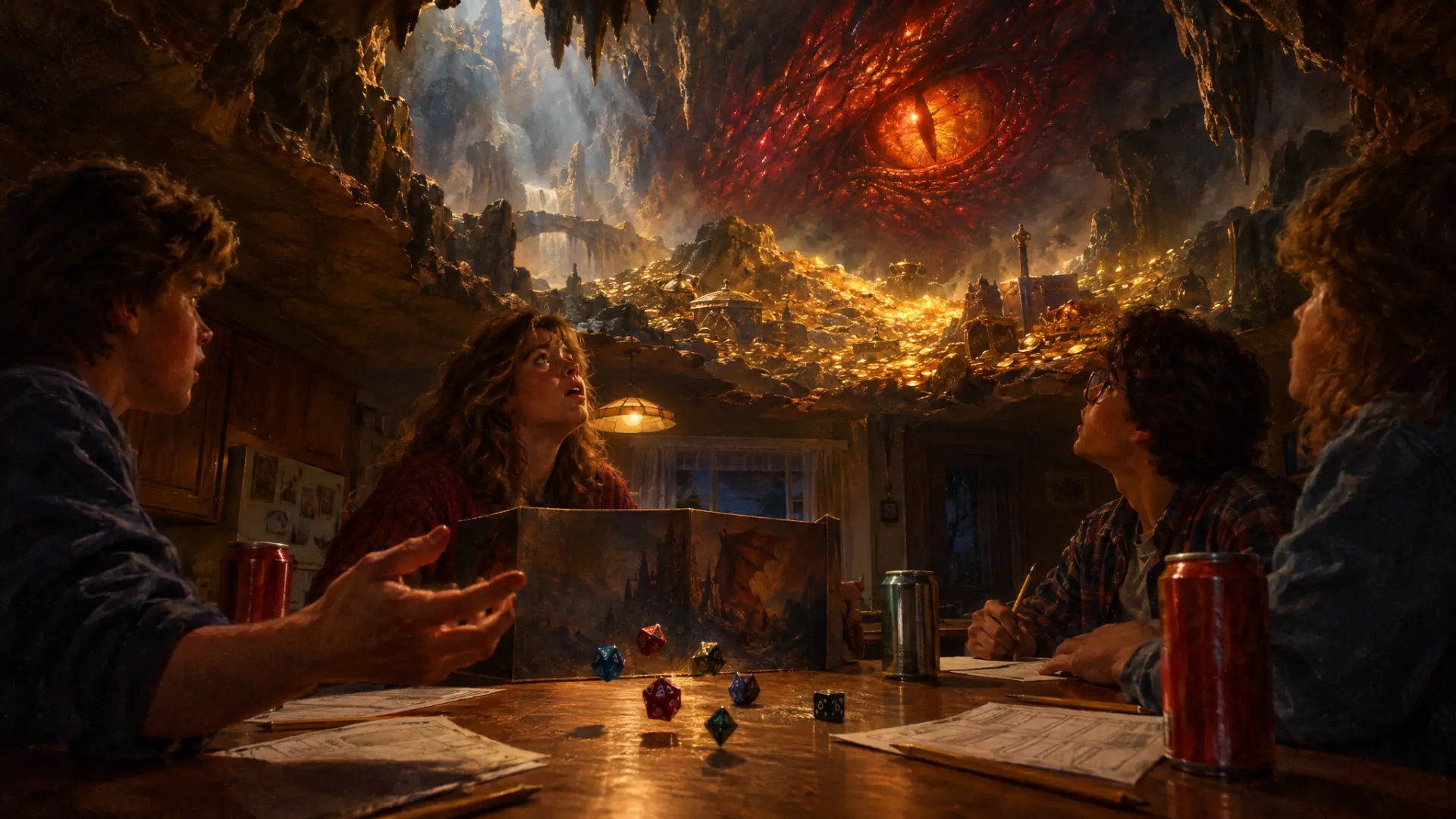
Jackson helped bring Dungeons & Dragons to Britain and then, with Fighting Fantasy, turned the roleplaying game into a paperback that a single child could play alone. The series introduced millions of readers to fantasy gaming and launched a generation of British game developers.
Life
Steve Jackson was born on May 20, 1951, in Altrincham, near Manchester, and studied at Keele University from 1968 to 1972. Ian Livingstone and John Peake were school friends with whom he would build a games business, and in 1974 began working as a games journalist for the magazine Games & Puzzles.
A note on names: there are two well-known game designers named Steve Jackson. This one is British, a co-founder of Games Workshop and co-creator of Fighting Fantasy. The other, the American Steve Jackson, designed The Fantasy Trip and GURPS and founded Steve Jackson Games in Texas. The American even wrote three Fighting Fantasy books, Scorpion Swamp, Demons of the Deep and Robot Commando, which appeared without any note that their author was not the series co-creator.
After Games Workshop he returned to journalism, including writing about games for the Daily Telegraph, and later moved into video games. He is an honorary professor at Brunel University London, where he teaches digital games theory and design.
Work
In early 1975 Jackson, Livingstone and Peake founded Games Workshop in London. They published a monthly newsletter, Owl and Weasel, largely written by Jackson, and through it came into contact with TSR, Inc., arranging with Brian Blume for exclusive rights to sell Dungeons & Dragons in Europe. The company sold games from their flat until their landlord evicted them in 1976, tired of visitors looking for a shop. By 1978 Games Workshop had opened its first retail store in London, and its magazine White Dwarf, launched in 1977, became the voice of British roleplaying.
At a Games Day convention in 1980, Jackson and Livingstone met Geraldine Cooke, an editor at Penguin Books, and proposed a book that would work like a roleplaying game for a single reader. The result, The Warlock of Firetop Mountain, published by Puffin Books in 1982, was a Gamebooks & Interactive Books with numbered paragraphs, a simple dice-and-pencil combat system and an adventure sheet for tracking Skill, Stamina and Luck. Jackson and Livingstone each wrote half of the adventure. It was a sensation, and Fighting Fantasy became a long-running series.
Jackson's own contributions were some of its most ambitious. The Citadel of Chaos (1983) cast the reader as a wizard; Starship Traveller (1984) moved the formula into science fiction; House of Hell (1984) was a horror story; Appointment with F.E.A.R. (1985) made the reader a superhero. Creature of Havoc (1986), in which the reader begins as a monster with no control over its own actions, is often regarded as the most difficult and inventive book in the series. The four-volume Sorcery! (1983–85), aimed at older readers, carried one character across a whole campaign and was accompanied by a spell book of its own.
With Games Workshop and Fighting Fantasy behind him, Jackson and Livingstone sold their interest in Games Workshop in 1991. He later co-founded the video game developer Lionhead Studios with Peter Molyneux, leaving when Microsoft bought the company in 2006. He has continued to write Fighting Fantasy, most recently Secrets of Salamonis (2022).
Legacy
Fighting Fantasy did for Britain in the 1980s what D&D did for the United States: it introduced a generation to fantasy gaming, and it did so through bookshops and school libraries rather than hobby stores. Combined with Games Workshop's shops and White Dwarf, it helped create the British fantasy-gaming culture that also produced Warhammer Fantasy Battle. The series has sold, by various counts, between 18 and 20 million copies, and was soon joined on bookshop shelves by rival series such as Lone Wolf, alongside the American Choose Your Own Adventure books.
The gamebooks also proved unusually adaptable to screens. From 2013 the studio inkle adapted Sorcery! as a series of acclaimed mobile and computer games, showing how naturally the branching, choice-driven structure of Jackson's books translated into digital form.
Marginalia
- This Steve Jackson, born on May 20, 1951, in Altrincham, is a different person from the American Steve Jackson of Steve Jackson Games.
- He co-founded Games Workshop in 1975 with Ian Livingstone and John Peake, running it at first from their shared flat.
- At a Games Day convention in 1980, he and Livingstone met Penguin editor Geraldine Cooke, who commissioned what became Fighting Fantasy.
- The Warlock of Firetop Mountain (1982), co-written with Ian Livingstone, was published by Puffin Books.
- His four-part Sorcery! (1983–85) was written for older readers and carried a single character through an entire campaign.
- inkle's digital adaptations of Sorcery!, released from 2013, brought his gamebooks to a new generation.
Quick answers
- Who is Steve Jackson?
- The British co-founder of Games Workshop who, with Ian Livingstone, created Fighting Fantasy and wrote The Citadel of Chaos, Creature of Havoc and the four-part Sorcery! epic.
- When was Steve Jackson born?
- Steve Jackson was born in 1951 in Altrincham, England.
- What is Steve Jackson known for?
- Steve Jackson is best known for Fighting Fantasy.
- Why does Steve Jackson matter to fantasy and games?
- Jackson helped bring Dungeons & Dragons to Britain and then, with Fighting Fantasy, turned the roleplaying game into a paperback that a single child could play alone. The series introduced millions of readers to fantasy gaming and launched a generation of British game developers.