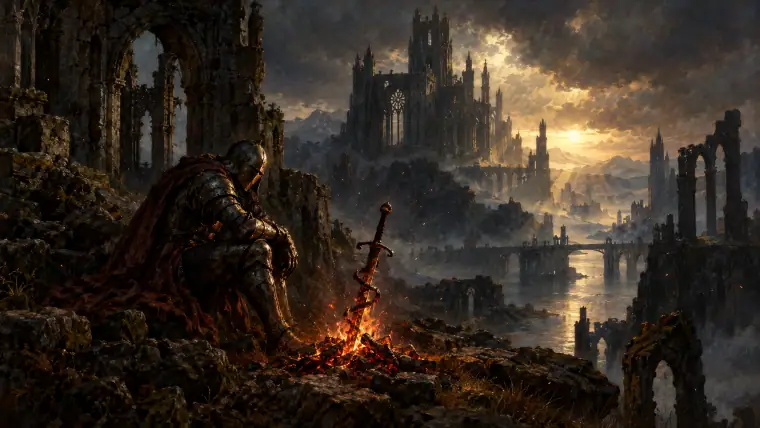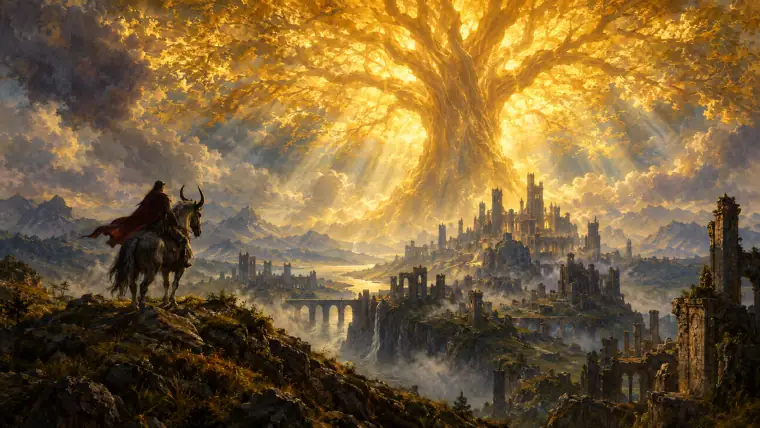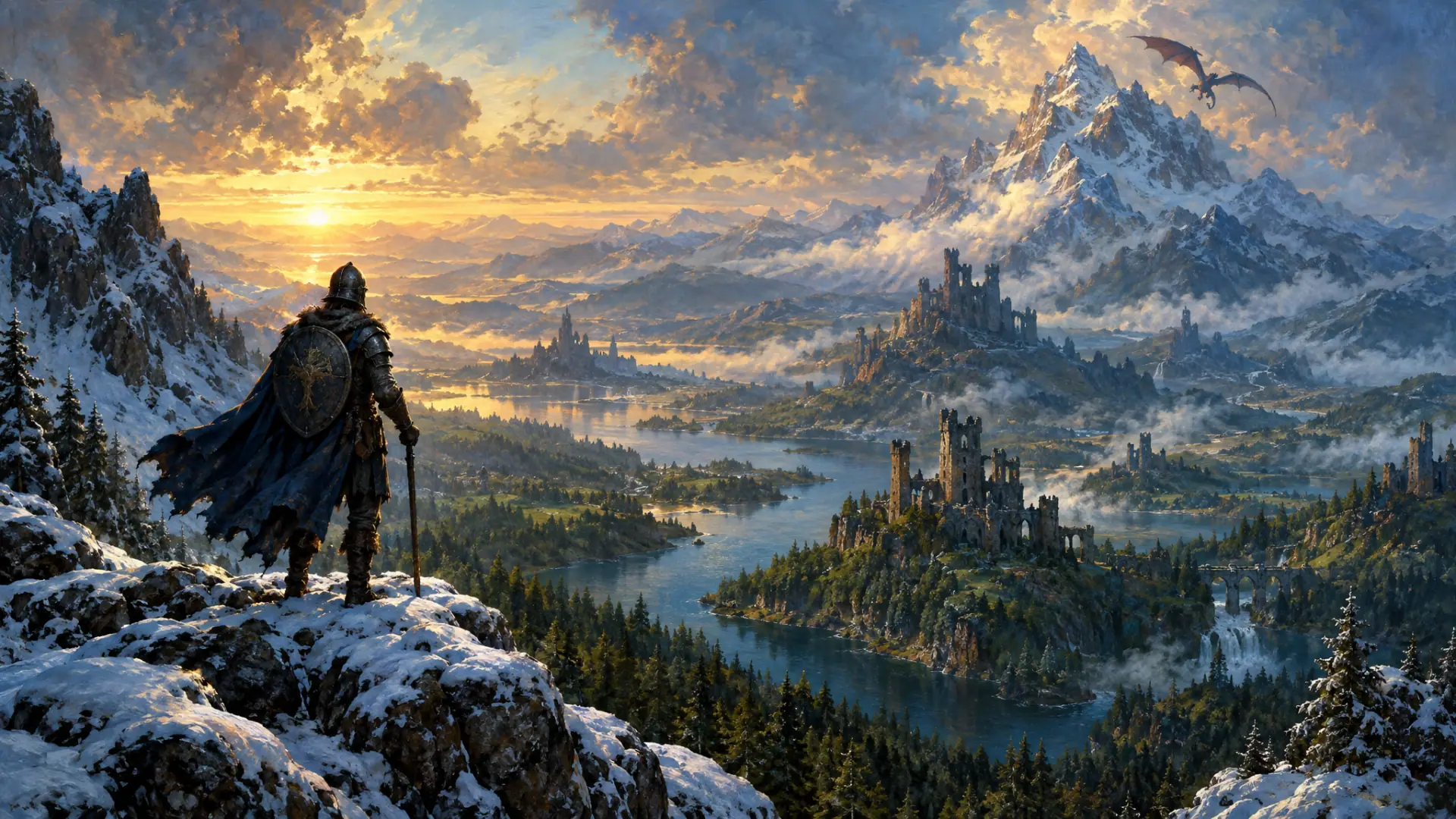
Miyazaki created the Souls series and directed Elden Ring, reviving punishing, cryptic dark fantasy as a mainstream form and giving rise to the soulslike, one of the most influential design traditions of the 21st century.
Life
Hidetaka Miyazaki was born on September 19, 1974, and grew up in Shizuoka, Japan. His family could not afford many books, so he borrowed from the local library, including English-language fantasy and science fiction that he could not fully understand. He filled in the gaps with his imagination, guided by the illustrations, and later cited that habit as a key to his design philosophy: stories glimpsed in fragments, completed by the reader.
His parents did not let him play video games until he was old enough for university, so his early play was on paper. He devoured gamebooks such as Steve Jackson's Sorcery! series, part of the Fighting Fantasy boom, and played tabletop games including Dungeons & Dragons and RuneQuest. He studied social science at Keio University and then worked as an account manager for the U.S. software company Oracle, partly to help pay for his sister's education.
On a friend's recommendation he played Ico (2001), Fumito Ueda's nearly wordless fable for the PlayStation 2, and it made him want to make games. At 29, with no industry experience, he found that few companies would consider him; one that did was FromSoftware, the Tokyo developer of the King's Field and Armored Core series.
Work
Miyazaki joined FromSoftware in 2004 as a planner on Armored Core: Last Raven, then directed Armored Core 4 (2006) and Armored Core: For Answer (2008). He learned of an internal fantasy action-RPG that the company regarded as a failure and asked to take it over; because it was already written off, he later explained, he had the freedom to pursue his own ideas. The result was Demon's Souls (2009) for the PlayStation 3: a grim, difficult game of deliberate combat and hard-won shortcuts, in which death was a teacher rather than a punishment. It was coolly received at the 2009 Tokyo Game Show and sold below expectations at first, but word of mouth built, and publishers took it overseas.
Its spiritual successor, Dark Souls (2011), expanded the formula into an interconnected world, the ruined kingdom of Lordran, whose history players pieced together from item descriptions, architecture and the few words of melancholy characters. Its asynchronous online systems, messages scrawled on the ground by other players, glimpses of their phantoms and bloodstains replaying their deaths, grew from a personal memory: stuck on a snowy hill, Miyazaki watched strangers push each other's cars up the slope and drive away before anyone could say thanks. After Dark Souls' success he became president of FromSoftware in May 2014, an extraordinarily quick rise in a Japanese company.
He then directed Bloodborne (2015), a Victorian-gothic, Lovecraft-inflected nightmare made with Sony, supervised Dark Souls II (2014), and returned to direct Dark Souls III (2016). Sekiro: Shadows Die Twice (2019), set in a mythic Sengoku-era Japan, won Game of the Year at The Game Awards. For Elden Ring (2022), he invited George R. R. Martin, author of A Song of Ice and Fire, to write the world's ancient mythology, while Miyazaki wrote the in-game narrative. Released on February 25, 2022, Elden Ring placed the Souls formula in a vast open world, the Lands Between, and sold tens of millions of copies; its Shadow of the Erdtree expansion followed in 2024.
Miyazaki typically writes most of the story, dialogue and text of the games he directs and has the final say on character, monster and level design. His influences span the early Dragon Quest games, The Legend of Zelda and King's Field; manga such as Berserk; the fiction of H. P. Lovecraft and Bram Stoker; and European architecture, which he uses as a storytelling medium.
Legacy
Few directors have created a genre. The Soulslikes, defined by exacting combat, checkpoint bonfires, recoverable losses and oblique storytelling, now names a whole family of games by other studios, and the Souls games' difficulty inspired communities devoted to challenge runs and speedruns. Miyazaki has always insisted that difficulty is not the point in itself but the route to a sense of accomplishment in "overcoming tremendous odds."
He is also the clearest heir in games to the tabletop and gamebook tradition this museum follows: a boy who learned fantasy from half-understood library books and Steve Jackson's gamebooks, and grew up to make worlds that ask players to do the same. Time named him one of its 100 most influential people in 2023.
Marginalia
- Born September 19, 1974, he grew up in Shizuoka and borrowed library books in English he could not fully read, imagining the gaps from the illustrations.
- His parents kept him from video games until university age, so he played gamebooks and tabletop RPGs such as RuneQuest and D&D.
- He joined FromSoftware in 2004 at 29, after playing Ico persuaded him to leave a job at Oracle Corporation.
- The online messages and phantoms of the Souls games were inspired by strangers pushing stalled cars up a snowy hill.
- He became president of FromSoftware in May 2014, about a decade after joining as a planner.
- In 2018 Ian Livingstone and Steve Jackson, whose gamebooks he loved, presented him a Golden Joystick Lifetime Achievement Award.
Quick answers
- Who is Hidetaka Miyazaki?
- The Oracle account manager who changed careers at 29 after playing Ico, rescued a failing project called Demon's Souls, and built the Souls games and Elden Ring into a genre of their own.
- When was Hidetaka Miyazaki born?
- Hidetaka Miyazaki was born in 1974.
- What is Hidetaka Miyazaki known for?
- Hidetaka Miyazaki is best known for Demon's Souls, Dark Souls and Elden Ring.
- Why does Hidetaka Miyazaki matter to fantasy and games?
- Miyazaki created the Souls series and directed Elden Ring, reviving punishing, cryptic dark fantasy as a mainstream form and giving rise to the soulslike, one of the most influential design traditions of the 21st century.