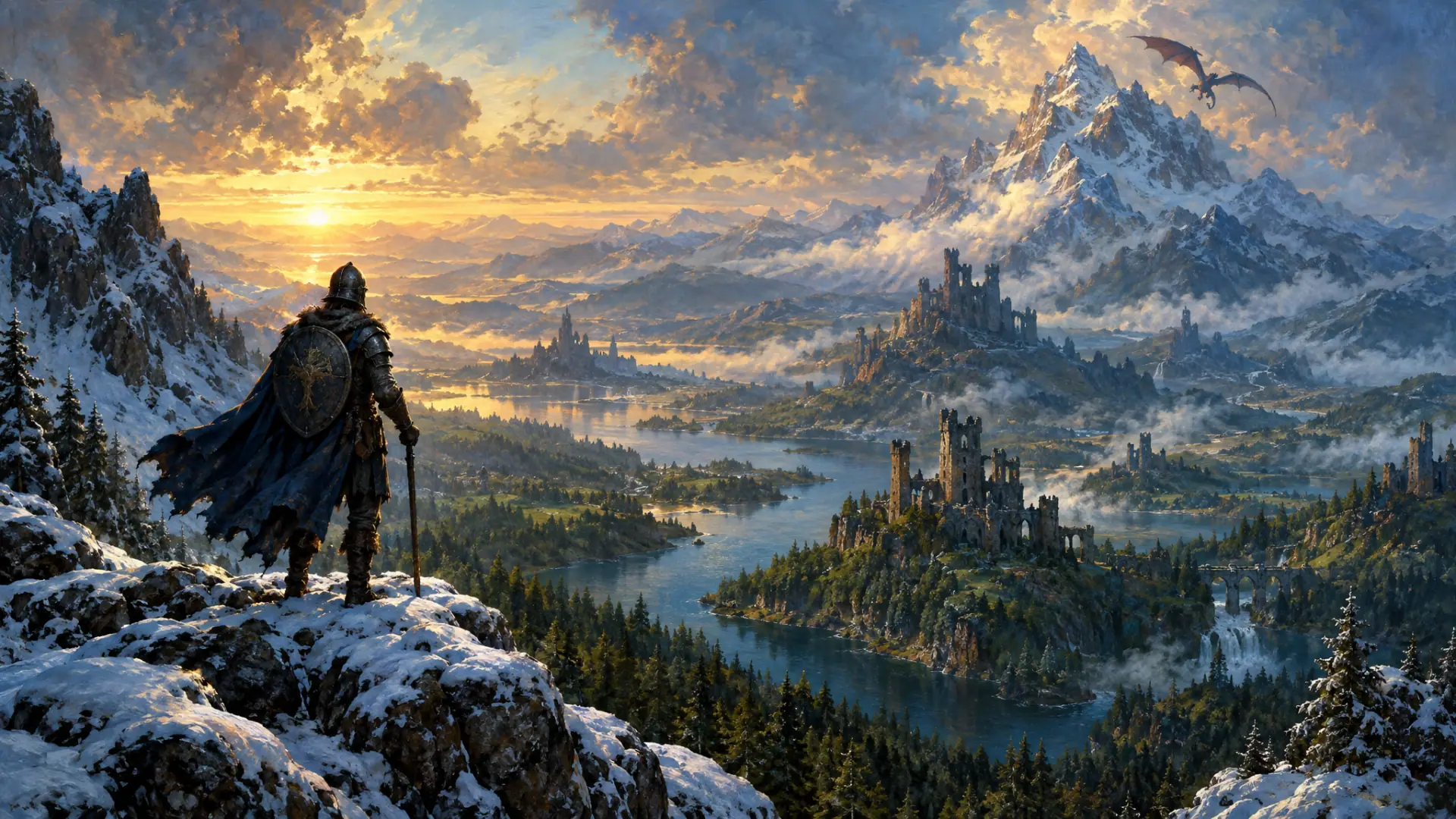
Jonathan Strange & Mr Norrell won the Hugo and World Fantasy awards and a place on the Booker longlist, proving that a fantasy novel could be embraced simultaneously by genre readers and the literary establishment.
Overview
"Some years ago there was in the city of York a society of magicians." So begins Jonathan Strange & Mr Norrell, in a voice borrowed from the English novel of manners, and for 782 pages Susanna Clarke never drops it. Her debut, published by Bloomsbury in September 2004, imagines that England once had real magic, ruled for three centuries by a human king raised in Faerie, and that in the early 19th century two very different men brought it back. The result is a comedy of manners, a war novel, a scholarly pastiche and a ghost story at once, and it arrived at a moment when Harry Potter and the Peter Jackson films had made fantasy the biggest thing in popular culture.
Origins
Clarke, an editor of cookery books in Cambridge, began writing the novel in 1992 after rereading Tolkien, and developed it over about a decade while publishing short stories set in the same world. Bloomsbury bought it with a reported £1 million advance, an extraordinary sum for a first novel, and gave it a handsome period presentation with illustrations by Portia Rosenberg.
The book's texture is its argument. Clarke wrote in the style of Jane Austen and Charles Dickens, with archaic spellings ("chuse," "surprize") and 185 footnotes that cite imaginary treatises, anecdotes and scholarly controversies. Together they build what Clarke calls an invented history of English magic — a Worldbuilding project hidden in the apparatus of a Regency novel.
The story
Gilbert Norrell, a fussy, secretive scholar from Yorkshire, proves to the magicians of York that practical magic still exists by making the statues of York Minster speak. He goes to London to offer his services against Napoleon, and to impress a cabinet minister he summons a fairy — "the gentleman with the thistle-down hair" — to raise the minister's fiancée from the dead, at the price of half her life. The bargain curses her to spend her nights dancing in the fairy's ruined halls of Lost-hope.
Norrell takes a pupil, the charming and impulsive Jonathan Strange, who serves with Wellington in the Peninsula and at Waterloo, moving roads and raising the dead. Pupil and master quarrel over the most dangerous figure in English history: John Uskglass, the Raven King, a human child stolen into Faerie who once ruled the north of England. Norrell wants him forgotten; Strange wants to follow him.
Reception & impact
The novel debuted at No. 9 on the New York Times bestseller list and rose to No. 3 within two weeks. It was longlisted for the Man Booker Prize and won the 2005 Hugo Award for Best Novel, the World Fantasy Award for Best Novel, the Locus Award for Best First Novel and the Mythopoeic Award — a rare sweep across literary and genre honors. Neil Gaiman praised it as the finest English novel of the fantastic in seventy years.
Its fairy is the old, dangerous kind: capricious, beautiful, and alien, closer to Lord Dunsany's Elfland and to folklore than to the benign elves of games and later Tolkien imitations. That deliberate return to older sources helped revive a strand of English Historical Fantasy and Fairy-Tale Fantasy rooted in folklore rather than in the quest.
Legacy
The novel has not been adapted as a game, but it reached television in a seven-part BBC One series in May 2015, directed by Toby Haynes, with Bertie Carvel as Strange and Eddie Marsan as Norrell. Clarke followed with The Ladies of Grace Adieu and Other Stories (2006). Her long-awaited second novel, Piranesi (2020), written while she lived with chronic fatigue syndrome, won the Women's Prize for Fiction.
A sequel to Jonathan Strange, which Clarke has discussed over the years, remains unfinished; her chronic illness has limited how much she can write. The original stands on its own as one of the most celebrated single-volume fantasies of the 21st century.
Marginalia
- Clarke spent about ten years writing the novel, beginning in 1992.
- Bloomsbury paid a reported £1 million advance for the debut.
- The 782-page novel carries 185 footnotes forming an invented history of English magic.
- It won the 2005 Hugo Award for Best Novel and the World Fantasy Award, and was longlisted for the 2004 Man Booker Prize.
- It debuted at No. 9 on the New York Times bestseller list and rose to No. 3 within two weeks.
- The BBC One adaptation, starring Bertie Carvel and Eddie Marsan, aired in May 2015.
Quick answers
- When was Jonathan Strange & Mr Norrell first published?
- Jonathan Strange & Mr Norrell was first published in 2004.
- Who created Jonathan Strange & Mr Norrell?
- Jonathan Strange & Mr Norrell was made by Susanna Clarke (author).
- What kind of work is Jonathan Strange & Mr Norrell?
- Jonathan Strange & Mr Norrell is a novel in the Historical Fantasy and Fairy-Tale Fantasy tradition.
- Why is Jonathan Strange & Mr Norrell important?
- Jonathan Strange & Mr Norrell won the Hugo and World Fantasy awards and a place on the Booker longlist, proving that a fantasy novel could be embraced simultaneously by genre readers and the literary establishment.