The foundational work of modern high fantasy: its paperback explosion in 1965 created the fantasy market, and its elves, dwarves, halflings, orcs and rangers became the default furniture of Dungeons & Dragons and nearly every RPG that followed.
Overview
The Lord of the Rings is the book that turned fantasy from a scattering of eccentric classics into a genre with shelves of its own. J. R. R. Tolkien spent twelve years writing it and never thought of it as a trilogy: it was a single novel in six "books," divided into three volumes by George Allen & Unwin because paper was expensive and the risk was large. The Fellowship of the Ring appeared on 29 July 1954, The Two Towers on 11 November 1954, and The Return of the King, delayed by work on the appendices, on 20 October 1955.
Its reach is hard to overstate. The book's estimated sales exceed 150 million copies. Its 1965 American paperback boom made fantasy a commercial category and helped create a counterculture phenomenon. And its peoples — elves, dwarves, hobbits, orcs, trolls, wizards, ents and a Balrog / Balor — became the stock population of Dungeons & Dragons and, through it, of the computer RPG. When a player in 2023 rolls a halfling rogue or a half-elf ranger in Baldur's Gate 3, they are making choices first laid out in Oxford in the 1940s.
Origins
After The Hobbit sold out in 1937, Stanley Unwin asked for more about hobbits. Tolkien offered the mythology that would later become The Silmarillion; Unwin declined it, and in December 1937 Tolkien started "a new story about Hobbits." It was meant to be a sequel for children. Instead, as Tolkien put it in his later foreword, "the tale grew in the telling." Bilbo's magic ring became the One Ring of Sauron, the Dark Lord; the story reached back into the ancient history of the First and Second Ages; and a dozen false starts gave way to the long march toward Mordor. Tolkien wrote through the Second World War, sending chapters in letters to his son Christopher, who was training with the RAF in South Africa, and reading drafts aloud to the Inklings. The story was essentially done by 1948 and revised in 1949; the surviving manuscripts, some 9,250 pages, are held at Marquette University in Milwaukee.
Publication was nearly as long a road. Tolkien wanted The Lord of the Rings issued together with The Silmarillion, and from 1949 to 1952 he negotiated with Collins, whose editor Milton Waldman was sympathetic; the scheme collapsed over sheer length. Tolkien returned to Allen & Unwin, where Rayner Unwin — the boy who had reviewed The Hobbit, now grown — advised his father that the book was a work of genius that might lose the firm £1,000. Rather than pay an advance or royalties, Allen & Unwin offered a profit-sharing agreement: Tolkien would receive nothing until the books broke even, and then a large share of the profits. It proved one of publishing's better bargains for an author. Christopher Tolkien drew the fold-out maps.
The story
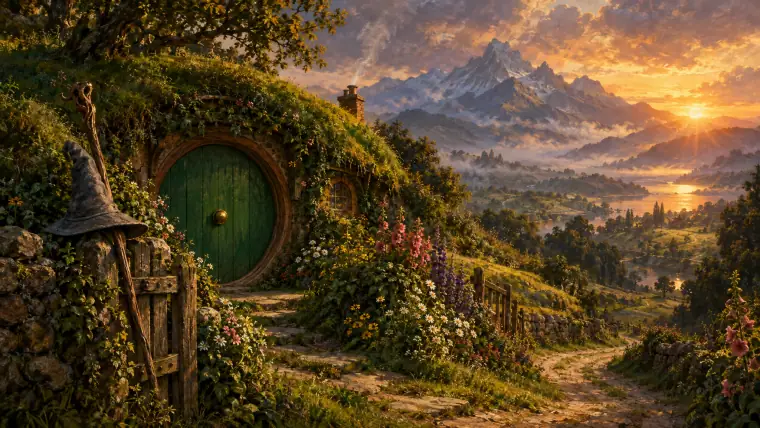
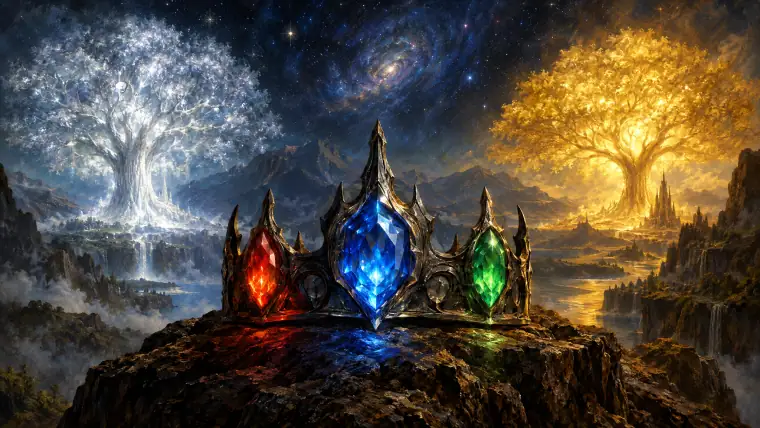
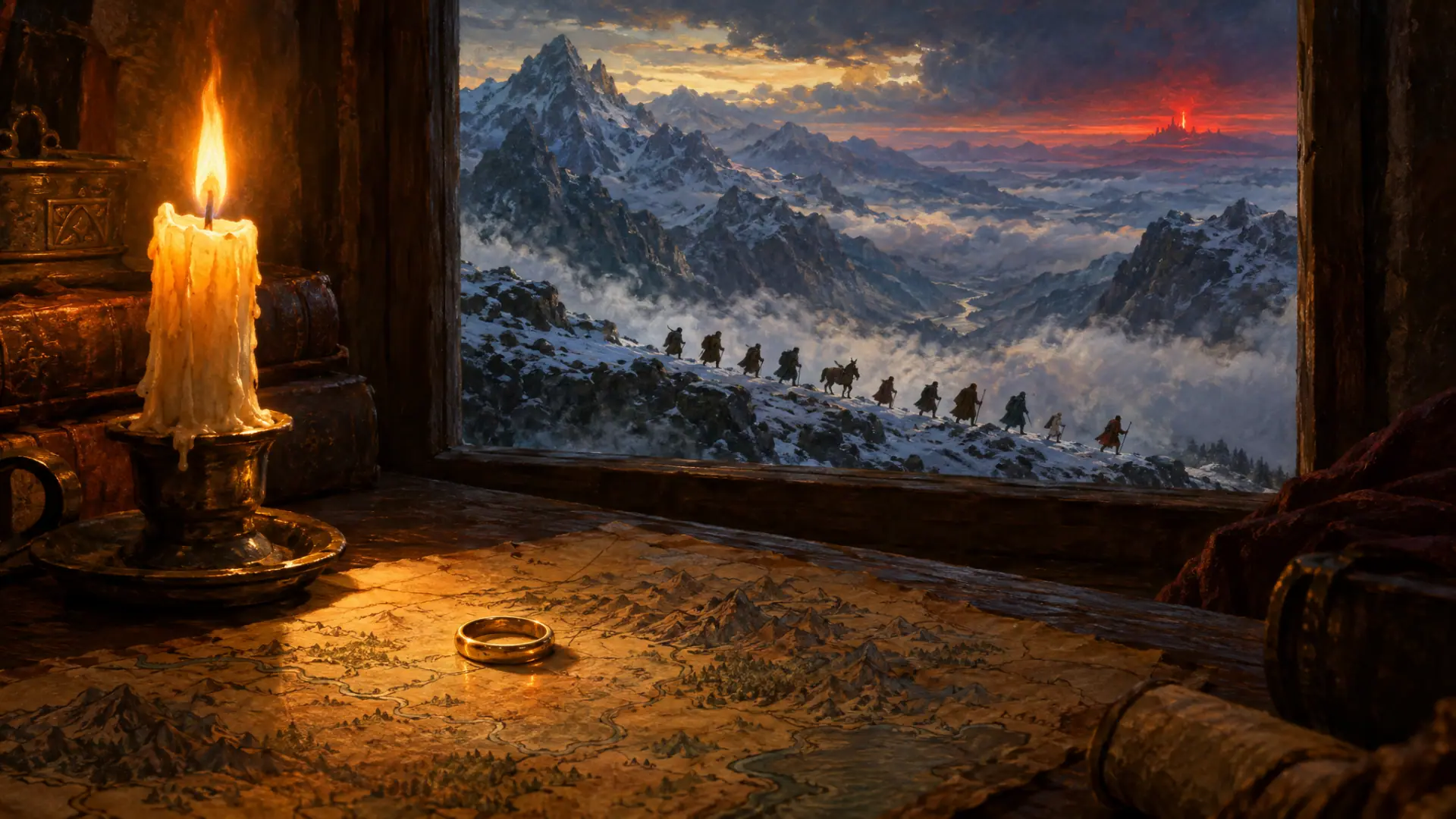
Sixty years after The Hobbit, Bilbo leaves the Shire and his ring passes to his nephew Frodo Baggins. Gandalf discovers that it is the One Ring, forged by Sauron to rule the other Rings of Power, and that the Dark Lord is hunting for it. Frodo flees with his gardener Sam Gamgee and his cousins Merry and Pippin, pursued by the Ringwraiths. At Rivendell, the Council of Elrond resolves that the ring must be destroyed in the fires of Mount Doom, and a Fellowship of nine sets out: four hobbits; Gandalf; Aragorn, the ranger who is heir to the throne of Gondor; Boromir of Gondor; Legolas the elf; and Gimli the dwarf.
The Fellowship breaks apart after Gandalf falls fighting a balrog in the Mines of Moria and Boromir is killed. The narrative then divides. One thread follows the war against the wizard Saruman and against Mordor — the ents' assault on Isengard, the battle of Helm's Deep, the siege of Minas Tirith, the charge of the Rohirrim, Aragorn's return as king. The other follows Frodo and Sam, guided by the treacherous Gollum, on their desperate walk into Mordor. At the Cracks of Doom, Frodo cannot let the ring go; it is destroyed only when Gollum bites it from his finger and falls into the fire — the kind of sudden, unlooked-for rescue Tolkien called Eucatastrophe. The hobbits come home to find the Shire itself despoiled and must scour it clean, and Frodo, wounded beyond healing, sails into the West.
Reception & impact
Early reviews were divided — W. H. Auden championed it, Edmund Wilson dismissed it — but the book sold steadily and won the International Fantasy Award in 1957. The explosion came in America in 1965. Donald A. Wollheim of Ace Books, believing a technicality had left the American copyright unprotected, issued an unauthorized paperback edition between May and July 1965 at 75 cents a volume. Tolkien, who had resisted paperbacks, hurried revisions into a new second edition, and Ballantine Books released the authorized version in October at 95 cents, carrying his note that it was the only paperback edition "published with my consent." Tolkien answered American fan letters by explaining the situation; fans and fellow writers took up his cause. By early 1966 Ace had agreed to pay royalties and let its edition go out of print. The whole affair was, paradoxically, a triumph: Ace's edition had sold more than 100,000 copies, Ballantine's sold roughly a quarter of a million in ten months, and the competition made the book a campus sensation. "Frodo Lives!" badges and graffiti followed; the Tolkien Society was founded in Britain in 1969, and Ballantine went on to build the Ballantine Adult Fantasy line to feed the new appetite. In 1969 Tolkien sold the film and merchandising rights to United Artists, the start of a long rights saga.
The honors have never stopped. In 1997 a Waterstones poll named it the greatest book of the century; in 2003 the BBC's Big Read voted it the United Kingdom's best-loved novel. Imitators arrived too, most famously Terry Brooks's The Sword of Shannara (1977), whose success helped establish the new Del Rey Books imprint.
Legacy
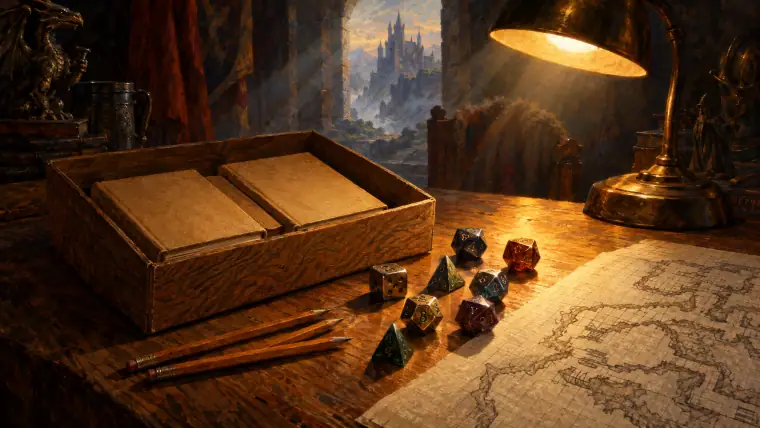
No single source shaped Dungeons & Dragons more visibly. Chainmail's 1971 fantasy supplement included hobbits, ents, balrogs and wraiths; the 1974 D&D boxed set had hobbits, ents, balrogs and orcs. After Saul Zaentz's Tolkien Enterprises objected in 1977, TSR renamed hobbits halflings and ents treants and dropped the balrog. The ranger class, introduced in The Strategic Review in 1975, was modeled chiefly on Aragorn and the Rangers of the North. Gary Gygax for years played down Tolkien's influence, listing the "Ring trilogy" in Appendix N alongside dozens of other books, but in a 2000 interview acknowledged its strong impact. The deepest inheritance is the idea of the fellowship itself: a mixed The party of races and talents on a quest.
Licensed tabletop games followed: Iron Crown Enterprises' Middle-earth Role Playing (1984) and Cubicle 7's The One Ring (2011, later published by Free League). On computers, Robert Alan Koeneke's roguelike Moria (1983) sent players down to face the Balrog, and its descendant Angband (1990) to Morgoth's fortress; Turbine's MMORPG The Lord of the Rings Online opened on 24 April 2007 and was still running nearly two decades later.
On screen, Ralph Bakshi's rotoscoped The Lord of the Rings (1978), co-written by Peter S. Beagle, covered only the first half; Rankin/Bass's The Return of the King (1980) finished the story for television; the BBC's 26-part radio serial (1981) became a classic. Then came Peter Jackson's film trilogy (2001–03), with conceptual art by Alan Lee and John Howe: nearly $3 billion at the box office and 17 Academy Awards, including all 11 for which The Return of the King was nominated. Amazon's The Rings of Power (2022– ) mines the Second Age history sketched in the book's appendices. Seventy years on, the Fellowship is still on the road.
Marginalia
- Tolkien began the 'new Hobbit' in December 1937 and did not finish it until 1949; he called it one novel, split into three volumes for cost.
- Allen & Unwin paid no advance; Tolkien took a profit-sharing deal that paid nothing until the books broke even — and then paid handsomely.
- Ace Books' unauthorized 75-cent paperbacks of 1965 sold over 100,000 copies; Ballantine's authorized edition cost 95 cents.
- Ballantine's authorized paperbacks sold about a quarter of a million copies within ten months.
- D&D's ranger class, introduced in The Strategic Review in 1975, was modeled chiefly on Aragorn and the Rangers of the North.
- Voted the United Kingdom's best-loved novel in the BBC's Big Read in 2003.
- The Return of the King (2003) won all 11 Academy Awards for which it was nominated, including Best Picture.
Quick answers
- When was The Lord of the Rings first published?
- The Lord of the Rings was first published in 1954–55.
- Who created The Lord of the Rings?
- The Lord of the Rings was made by J. R. R. Tolkien (author) and Christopher Tolkien (maps (first edition)).
- Who published or developed The Lord of the Rings?
- George Allen & Unwin, Ace Books and Ballantine Books.
- What kind of work is The Lord of the Rings?
- The Lord of the Rings is a novel in the High / Epic Fantasy tradition.
- Why is The Lord of the Rings important?
- The foundational work of modern high fantasy: its paperback explosion in 1965 created the fantasy market, and its elves, dwarves, halflings, orcs and rangers became the default furniture of Dungeons & Dragons and nearly every RPG that followed.