Tolkien's bedtime story became the doorway to Middle-earth, the seed of The Lord of the Rings, and — through hobbits, dragons' hoards and hired adventurers — a direct ancestor of Dungeons & Dragons and the computer RPG.
Overview
"In a hole in the ground there lived a hobbit." With that sentence, scribbled by an Oxford professor of Anglo-Saxon on a blank page of an examination script, J. R. R. Tolkien opened a door that fantasy has been walking through ever since. The Hobbit, or There and Back Again was published by George Allen & Unwin in London on 21 September 1937 as a book for children: a fireside tale, told by a chatty narrator who pauses to address "you" directly, about a respectable, unadventurous gentleman who is talked into burgling a dragon.
It is also something much larger than a children's book. The Hobbit is the first published glimpse of Middle-earth, the invented secondary world that Tolkien had been building privately since the First World War. Its success led directly to The Lord of the Rings, and its shape — a hired band of adventurers, a map with a lonely mountain marked on it, goblin tunnels, a riddle-contest in the dark, and a dragon asleep on a hoard — became the template for an entire genre of games. Few books have a clearer claim to be an ancestor of Dungeons & Dragons.
Origins
Tolkien's own memory of the date shifted over the years; he recalled the famous first line coming to him while marking School Certificate papers in the early 1930s, around 1930. The story grew from tales he told his children, and by late 1932 he had a typescript that ran nearly to the end. In early drafts, as John D. Rateliff documented in The History of the Hobbit (2007), the wizard was called Bladorthin, the chief dwarf was Gandalf, and the dragon was Pryftan. The final names — Gandalf for the wizard, Thorin Oakenshield and his companions for the dwarves — were lifted almost wholesale from the list of dwarf names in the Old Norse Völuspá, part of the Poetic Edda. The theft of a cup from a sleeping dragon, which rouses the beast to fury, echoes the final section of Beowulf, a poem Tolkien knew as well as any scholar alive.
The manuscript circulated among friends, including C. S. Lewis and Tolkien's former student Elaine Griffiths. In 1936 Susan Dagnall of Allen & Unwin learned of it through Griffiths and borrowed it. Stanley Unwin handed it to his ten-year-old son Rayner, who was paid a shilling for reader's reports, and Rayner's favorable verdict settled the matter. Tolkien, a talented amateur artist, supplied the maps, ten black-and-white illustrations and the dust-jacket design. The American edition from Houghton Mifflin in 1938 added four of his watercolors as color plates, and Allen & Unwin adopted them in its second printing.
The story
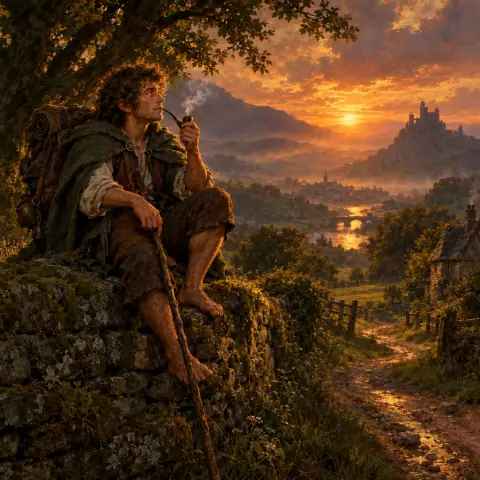
Bilbo Baggins lives a comfortable life in Bag End until the wizard Gandalf marks his door and thirteen dwarves arrive for tea. They are led by Thorin Oakenshield, heir to the dwarf-kingdom under the Lonely Mountain, which was seized long ago by the Dragon Smaug. They need a fourteenth member and a "burglar," and Gandalf has chosen Bilbo.
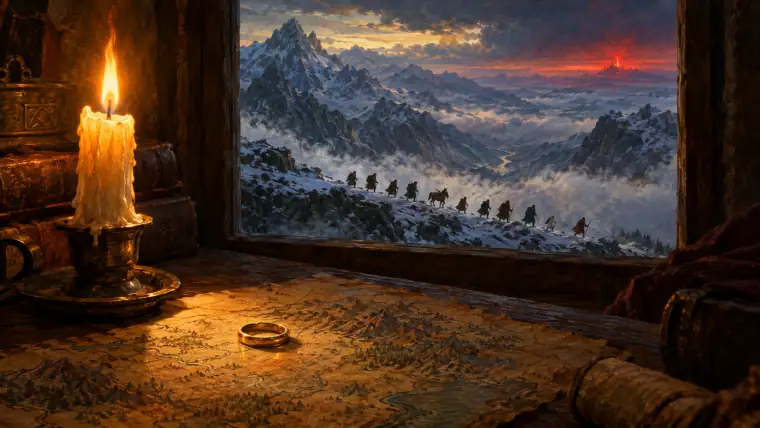
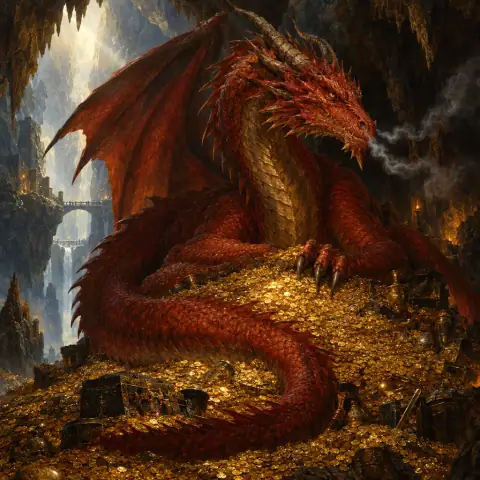
The journey east is a chain of episodes that reads, to modern eyes, almost like a series of encounters on a game map: three trolls who turn to stone at dawn; the Last Homely House at Rivendell; the goblins of the Misty Mountains; and, deep underground, Bilbo's riddle-game with the slimy creature Gollum, during which he pockets a magic ring that makes him invisible. There are wolves and eagles, the shape-changing Beorn, giant spiders in the forest of Mirkwood, and imprisonment by the Wood-elves, from which Bilbo rescues the dwarves in barrels. At the Mountain he converses with Smaug and spots a gap in the dragon's armor; the enraged dragon attacks Lake-town and is shot down by Bard the Bowman. The story ends not with the dragon's death but with the far harder problem of what to do with his gold — a standoff among dwarves, elves and men resolved only by the Battle of Five Armies, and by Bilbo's decision to give away the Arkenstone. He returns home, "there and back again," changed.
Reception & impact
The first printing of 1,500 copies sold out by December 1937. Reviewers were warm — C. S. Lewis praised it, unsigned, in The Times Literary Supplement — and the book was nominated for the Carnegie Medal. Houghton Mifflin's American edition won the New York Herald Tribune prize for the best juvenile fiction of 1938. Stanley Unwin immediately asked for a sequel; Tolkien offered his mythology instead, which Allen & Unwin declined, and in December 1937 he began "a new Hobbit" that would become The Lord of the Rings.
That sequel forced a change to the original. In the 1937 text, Gollum wagers the ring as a present and, having lost, apologizes and leads Bilbo to the exit. Once the ring had become the One Ring, that genial Gollum no longer fit. Tolkien drafted a revised "Riddles in the Dark" in which Gollum is aggressive and desolate at the ring's loss, and sent it to Unwin as a sample of what might be done; he heard nothing for years, and was surprised to find it set in galley proofs for the second edition of 1951. The Lord of the Rings explains the discrepancy ingeniously: the first version was a lie Bilbo told under the ring's influence. A third edition in 1966 aligned further details and helped secure a fresh American copyright in the wake of the Ace paperback affair. Estimates of the book's lifetime sales range from 35 million to more than 100 million copies, in dozens of languages.
Legacy
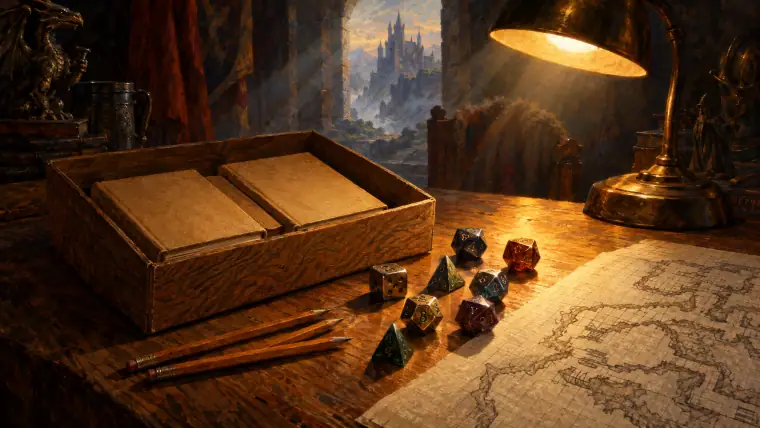
The line from Bag End to the gaming table is unusually direct. Chainmail's 1971 fantasy supplement fielded hobbits alongside ents and balrogs, and the 1974 Men & Magic booklet of original D&D listed hobbits as a playable race. When TSR also published Battle of the Five Armies, a board game named for the book's climax, Saul Zaentz's Tolkien Enterprises — holder of the film and merchandising rights since 1976 — objected. Accounts differ on the exact sequence and date, but by 1977 TSR had pulled the board game and rewritten its rules: hobbits became halflings, ents became treants, and the Balrog / Balor was quietly dropped, its fiery niche later filled by the demonic balor. Gary Gygax later listed The Hobbit in Appendix N of the 1979 Dungeon Master's Guide. The deeper inheritance is structural: a The party of mismatched specialists, a burglar who scouts and picks locks, a map, a dungeon, and a dragon's hoard waiting to be divided.
Computer games followed the same road. Beam Software's text adventure The Hobbit, written by Veronika Megler and Philip Mitchell and published by Melbourne House in December 1982, had characters who moved and acted on their own — Thorin famously "sits down and starts singing about gold" — and a parser that understood full sentences. It won the 1983 Golden Joystick for best strategy game, came bundled with a copy of the novel, and sold in the hundreds of thousands; the Digital Antiquarian judges it probably the best-selling single text adventure ever made.
On screen, Rankin/Bass's animated The Hobbit premiered on NBC on 27 November 1977, with John Huston as Gandalf and animation by Topcraft of Tokyo. Peter Jackson returned to the book after his Lord of the Rings films, stretching it into three features (2012–14) that grossed about $2.94 billion worldwide. Through it all, the novel remains the gentlest entry point to Middle-earth — and the first stop on the Tolkien Road through this museum.
Did you know?
Hobbits were not strictly Tolkien's own coinage in every sense — scholars later found the word "hobbit" in a long list of supernatural creatures in the nineteenth-century Denham Tracts — but nothing suggests Tolkien knew of it, and the creature he described is entirely his invention.
Marginalia
- The first printing of 1,500 copies, published on 21 September 1937, had sold out by December.
- Ten-year-old Rayner Unwin wrote the reader's report that persuaded his father, publisher Stanley Unwin, to take the book.
- Tolkien drew the maps, the dust jacket and ten black-and-white illustrations for the first edition himself.
- In the 1937 text Gollum stakes the ring as a prize and, on losing, cheerfully shows Bilbo the way out; the 1951 revision made him menacing.
- Original D&D (1974) offered 'hobbits' as a player race; after Tolkien Enterprises objected in 1977, TSR renamed them halflings.
- Melbourne House's 1982 text-adventure version won the 1983 Golden Joystick Award for best strategy game.
- The dwarves' names — Thorin, Fili, Kili, Bombur, even Gandalf — come from the dwarf-list in the Old Norse Völuspá.
Quick answers
- When was The Hobbit first published?
- The Hobbit was first published in 1937 (revised 1951, 1966).
- Who created The Hobbit?
- The Hobbit was made by J. R. R. Tolkien (author, illustrator & cartographer).
- Who published or developed The Hobbit?
- George Allen & Unwin.
- What kind of work is The Hobbit?
- The Hobbit is a novel in the Children's & YA Fantasy and High / Epic Fantasy tradition.
- Why is The Hobbit important?
- Tolkien's bedtime story became the doorway to Middle-earth, the seed of The Lord of the Rings, and — through hobbits, dragons' hoards and hired adventurers — a direct ancestor of Dungeons & Dragons and the computer RPG.