Chainmail was the rules engine D&D was built on: the original 1974 set assumed players owned it. Its Fantasy Supplement put fireballs, lightning bolts and Law-versus-Chaos alignment on the tabletop three years before the first roleplaying game.
Overview
Chainmail is a set of rules for fighting medieval battles with miniature figures, written by Gary Gygax and Jeff Perren of the Lake Geneva Tactical Studies Association in Wisconsin and published by Guidon Games in 1971. On its own terms it is a solid period Miniatures & Board Wargames: rules for massed troops, for single combat, and for jousting. What made it historic was an appendix of fourteen pages called the Fantasy Supplement — and the fact that Dungeons & Dragons, three years later, told its buyers they would need Chainmail to play.
Origins
The trail starts at the first Gen Con in 1968, where Gygax played Henry Bodenstedt's medieval game Siege of Bodenburg. Perren, a hobby-shop owner in the LGTSA, wrote his own four-page rules for medieval figures after the club bought a large batch of Elastolin miniatures in early 1970. Gygax edited and expanded them, and versions appeared in the wargaming magazine Panzerfaust and in The Domesday Book, the newsletter of the Castle & Crusade Society, which Gygax had co-founded in 1970 within the International Federation of Wargamers. Later issues added man-to-man and jousting rules.
When Don Lowry founded Guidon Games in Illinois and hired Gygax to develop a "Wargaming with Miniatures" series, the expanded medieval rules became its first title. Chainmail saw print in March 1971. It quickly became Guidon's best seller at around a hundred copies a month — a hit by the standards of the tiny miniatures market. A second edition followed in 1972; after Guidon closed, the rules passed to Gygax's new company, TSR, Inc., which kept them in print from 1975 to 1985.
How it plays
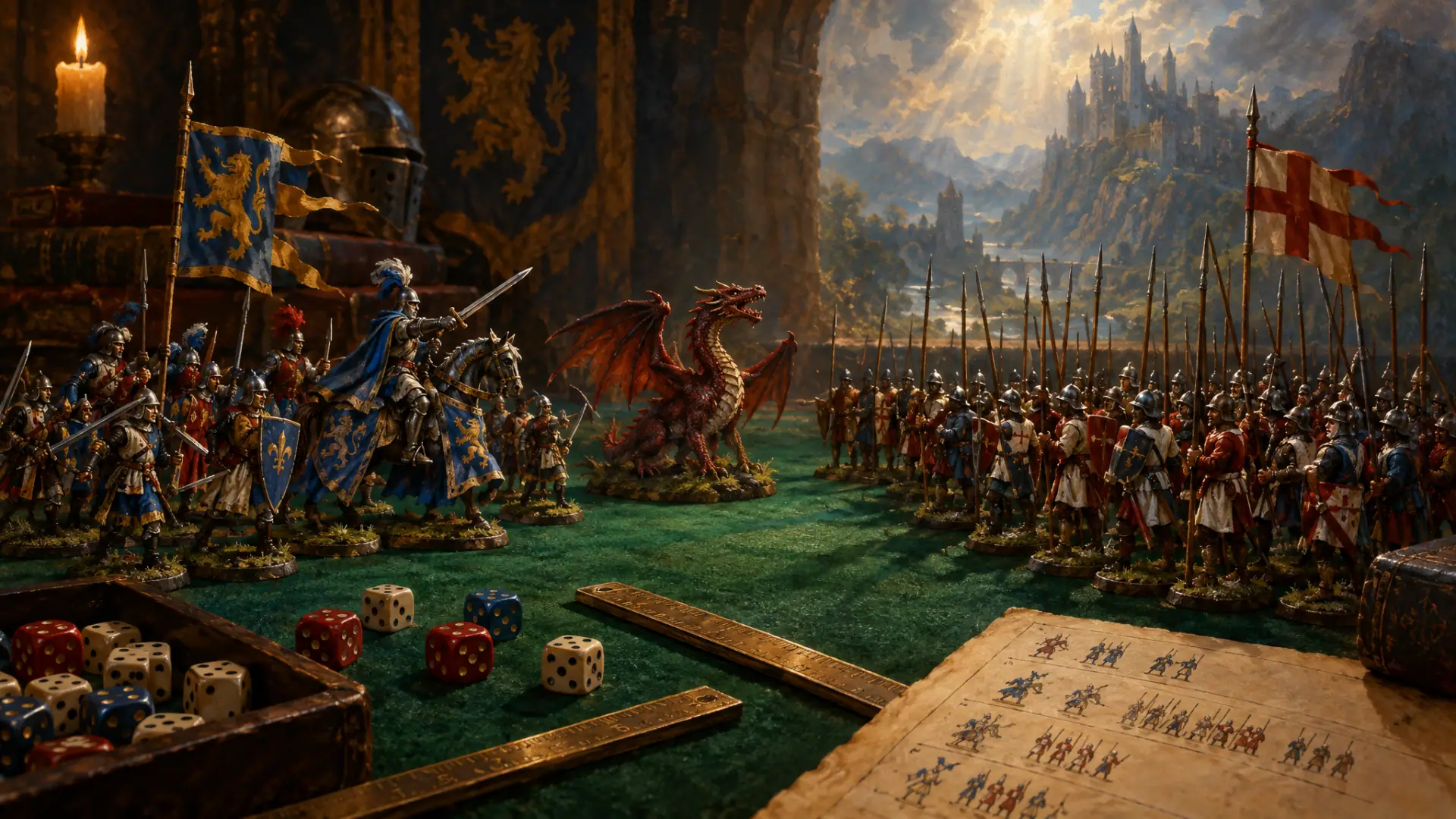
Chainmail is a wargame, not a roleplaying game: players command forces, not individuals, and the goal is to win the battle. In the mass-combat rules each figure stands for twenty men, troops fall into six types from light foot to heavy horse, and melee is resolved by rolling handfuls of six-sided dice. Heavy horse attacking light foot rolls four dice per figure, killing on a five or six; light foot attacking heavy horse gets only one die for every four figures and needs a six. Further rules govern missiles, terrain, charges, fatigue, morale and prisoners.
A separate man-to-man system, at one figure to one man, uses two six-sided dice and a chart cross-indexing weapon type against armor — the germ of the later Armor Class table. Then comes the Fantasy Supplement. It adds heroes and super-heroes, wizards who hurl fireballs and lightning bolts, elves, dwarves, hobbits, orcs, trolls, giants and dragons, magic swords and elementals. Some figures may make saving throws against spells, a stronger wizard can cancel a weaker one's spell on a roll of seven or better on two dice, and every creature is aligned with Law or Chaos. A chart gives the roll each fantastic type needs to defeat another.
Reception & impact
The Fantasy Supplement arrived just as the paperback boom had put The Lord of the Rings into wargamers' hands, and it let them field the armies of Middle-earth, Hyboria or Melniboné. Its art showed as much: the fantasy section's illustration of a knight charging a dragon was drawn by Lowry after a Pauline Baynes picture for Tolkien's Farmer Giles of Ham.
Its most important reader was in Minneapolis. Dave Arneson used the Fantasy Supplement when he started his Blackmoor campaign in 1971, though after a short, unsatisfying trial of its fantasy combat table he developed his own rules for tracking individual characters. When Arneson demonstrated Blackmoor to Gygax, the resulting collaboration grew from Chainmail's vocabulary. The 1974 D&D rules assumed players owned Chainmail for combat, offering an "alternative" system of their own — the one that eventually replaced it.
Legacy
Much of D&D's early DNA is visible here: fighting-men measured in heroes, wizards defined by spells like Fireball, the Law–Chaos axis that became Alignment, and movement in tabletop inches. Guidon itself did not last; it declined to publish Gygax's next idea, which is part of why Gygax and Don Kaye founded TSR, Inc. in 1973. TSR later produced Swords & Spells (1976), a mass-battle supplement its foreword called Chainmail's "grandson," and in 2001 Wizards of the Coast revived the name for a D&D skirmish miniatures game. Chainmail is the hinge between the two halves of this chronicle: the last great medieval wargame of the old hobby, and the first rulebook of the new one.
Marginalia
- It grew from four pages of medieval rules by hobby-shop owner Jeff Perren, which Gary Gygax expanded and printed in 1970 in Panzerfaust and the Castle & Crusade Society fanzine The Domesday Book.
- The Fantasy Supplement drew on Tolkien, Robert E. Howard, Poul Anderson and Michael Moorcock, and let players refight battles from fantasy fiction.
- It introduced "Fireball" and "Lightning Bolt" spells to wargaming, along with magic swords and elementals.
- A Hero counted as four heavy footmen and needed four simultaneous hits to kill; a Super-Hero was twice as tough.
- Creatures were aligned with Law or Chaos, a scheme borrowed from Poul Anderson via Michael Moorcock's Elric stories.
- D&D's 1976 mass-battle supplement Swords & Spells was described in its foreword as the "grandson" of Chainmail.
Quick answers
- When was Chainmail first released?
- Chainmail was first released in 1971 (Guidon Games); TSR editions 1975–85.
- Who created Chainmail?
- Chainmail was made by Gary Gygax (co-designer; editor and expander of the rules) and Jeff Perren (co-designer; author of the original medieval rules).
- Who published or developed Chainmail?
- TSR, Inc..
- What kind of work is Chainmail?
- Chainmail is a wargame in the Miniatures & Board Wargames tradition, released for Rulebook, Miniature figures and Six-sided dice.
- Why is Chainmail important?
- Chainmail was the rules engine D&D was built on: the original 1974 set assumed players owned it. Its Fantasy Supplement put fireballs, lightning bolts and Law-versus-Chaos alignment on the tabletop three years before the first roleplaying game.