Baldur's Gate 3 proved that a vast, reactive, turn-based computer RPG built on tabletop rules could be a blockbuster. It swept every major Game of the Year award, sold tens of millions of copies, and brought Dungeons & Dragons' own logic of choice and consequence to a mass audience.
Overview
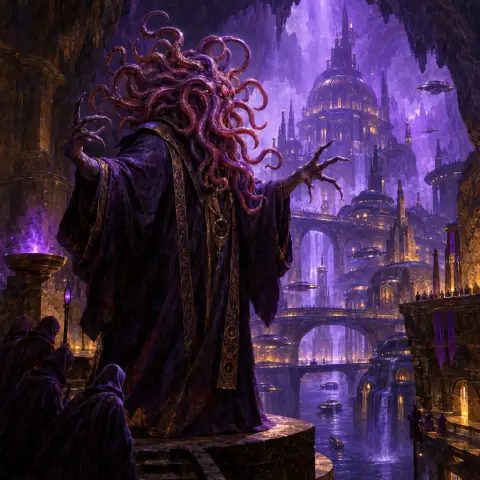
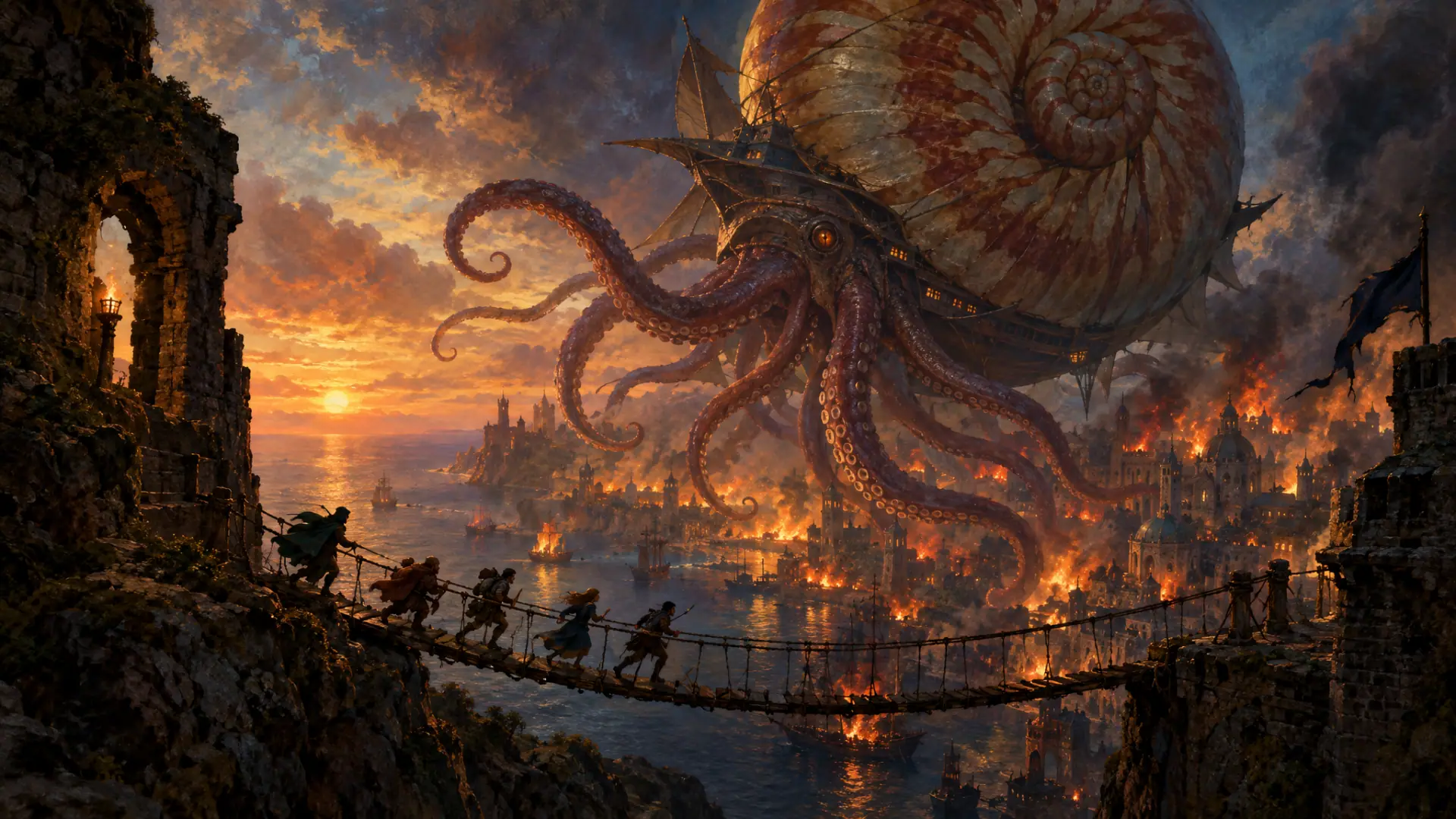
It begins in the belly of a nautiloid, a mind flayer ship tearing across the planes with a hold full of captives. Each of them has a tadpole in their skull, a parasite that should turn them into an illithid within days. The ship crashes on the Sword Coast. The transformation never comes. And the survivors, a vampire spawn, a disgraced wizard, a cleric of a goddess of loss, a githyanki warrior, a warlock and a tiefling fresh from the wars of Hell, have to work out why before it does.
Baldur's Gate 3, developed and published by Belgium's Larian Studios under license from Wizards of the Coast, is a party-based computer role-playing game built on the rules of fifth-edition Dungeons & Dragons and set in the Forgotten Realms. After almost three years in early access it was fully released for Windows on August 3, 2023, then for PlayStation 5, macOS and Xbox Series X/S. It became the first game to win Game of the Year at all five of the industry's major award ceremonies, sold more than 20 million copies by the end of 2025, and is widely counted among the greatest games ever made.
Origins
The series it continues was born at BioWare. Baldur's Gate (1998) and Baldur's Gate II: Shadows of Amn (2000), published by Interplay, revived the licensed D&D computer game. A third game, The Black Hound, was begun at Black Isle Studios and cancelled in 2003 when Interplay lost the relevant rights. For fifteen years the name lay dormant while studios including Obsidian and Beamdog, which made enhanced editions of the originals, hoped for the chance.
Swen Vincke, founder of Larian, first asked Wizards of the Coast while making Divinity: Original Sin (2014) and was turned down as too inexperienced. The success of Divinity: Original Sin II (2017) changed the answer: Wizards, impressed by prerelease footage, invited a pitch. Vincke drafted the design document in a hotel room with a handful of designers and writers, a first pitch was rejected, and a later one won the license. Wizards filled in the century of Forgotten Realms history since Baldur's Gate II, the two companies coordinated on a tabletop prequel adventure, Baldur's Gate: Descent into Avernus (2019), and D&D creative director Mike Mearls welcomed Larian's willingness to alter the rules where the computer demanded it.
Larian wanted blockbuster production values, and that meant fully voiced, motion-captured cinematic dialogue for nearly every conversation. The studio grew from about 140 people in 2017 to more than 450 by 2023. The game was revealed at a Google Stadia presentation in June 2019, and the first act entered early access in October 2020. Early reviews found it promising but rough; 2.5 million copies sold during early access, and player feedback reshaped companions, classes and interface. The COVID-19 pandemic disrupted motion capture, and Russia's invasion of Ukraine forced Larian to close its Saint Petersburg office and help most of that staff relocate. To avoid launching against Bethesda's Starfield, Vincke moved the Windows release up by four weeks.
How it plays
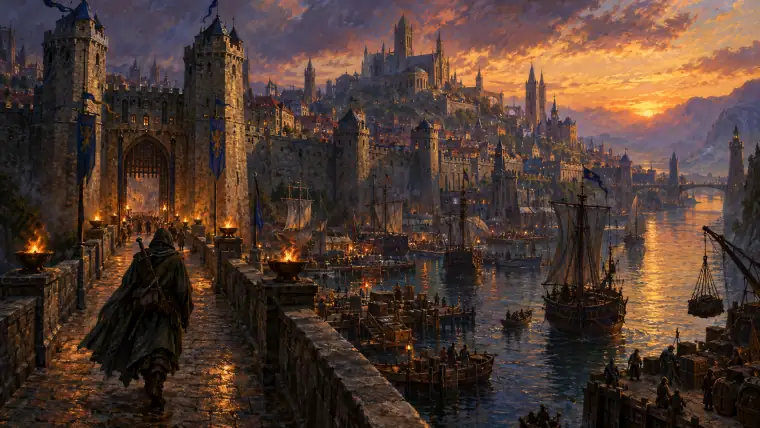
Players create a character, choosing among eleven species (including elves, dwarves, halflings, githyanki and tieflings) and twelve classes, or play as one of the "origin" companions with their own stories. Exploration happens in real time across three huge acts: the wilderness around the crashed ship, a druid grove and the Underdark; the shadow-cursed lands around Moonrise Towers; and the city of Baldur's Gate itself. Combat switches to turn-based rounds that follow fifth-edition rules closely, with actions, bonus actions, spell slots, armor class and the d20 die behind every attack. Larian's hallmarks carry over from Divinity: height advantage, shoving enemies off ledges, and surfaces of grease, water and fire that react to one another.
The d20 also rules conversations. Persuasion, deception and intimidation checks are rolled on screen, so failure is a real possibility and the story branches to accommodate it. Almost any character can die, including major ones, and the game keeps going. A narrator, voiced by Amelia Tyler, acts as the dungeon master. At camp the party talks, argues and falls in love; the companions, among them the vampire spawn Astarion, the cleric Shadowheart, the githyanki Lae'zel and the barbarian Karlach, have their own quests and opinions of the player, and can be romanced. Returning favorites from the earlier games include Jaheira and Minsc, voiced by Matthew Mercer. Larian estimated about 1.3 million lines of dialogue, more than 140 hours of cinematics and over 170 ending variations, most of which no single player will see.
Reception & impact
Critics compared Larian to a generous dungeon master who always says yes. Reviewers praised the writing, the companions, the performances and the freedom to solve problems creatively, and the game earned a Metacritic score of 96 on PC. The main criticisms were bugs and a third act that strained under the density of the city. It became one of 2023's biggest launches: Larian reported more than 10 million players by February 2024, the Irish Independent reported 15 million copies sold in November 2024, and Bloomberg reported more than 20 million by the end of 2025. Hasbro, Wizards' parent company, said the game had earned it about $90 million, and Larian's pre-tax profit for 2023 was reported at €249 million.
The awards were unprecedented. By April 2024 Baldur's Gate 3 had won Game of the Year at The Game Awards, the Golden Joystick Awards, the D.I.C.E. Awards, the Game Developers Choice Awards and the BAFTA Games Awards, the first game to take the top prize at all five. At The Game Awards 2023 it won six of its nine categories, including Best Performance for Neil Newbon as Astarion; at the Golden Joysticks it set a record with seven wins; at the BAFTAs it won five, including Performer in a Supporting Role for Andrew Wincott as the devil Raphael. In 2024 it won the first Hugo Award for Best Game or Interactive Work, and it received the GLAAD Media Award for Outstanding Video Game.
Legacy
Larian supported the game with free patches through April 2025, adding an epilogue, custom difficulty and a mode with Permadeath, cross-platform play and twelve new subclasses. In March 2024, however, Vincke announced that the studio would make no expansion and no sequel, and would turn to its own worlds instead; in December 2025 Larian announced a new Divinity game. The Forgotten Realms did not let go of Baldur's Gate: in February 2026 HBO announced a television series continuing the story, led by Craig Mazin of The Last of Us, and a prequel novel about Astarion by T. Kingfisher was scheduled for September 2026.
The game's larger legacy is an argument won. For decades, publishers had treated real-time or action combat as a requirement for mainstream success. Baldur's Gate 3, turn-based, slow, dense with text and dice, showed that the tabletop experience of Dungeons & Dragons, the sense that the world will respond to anything you try, could reach an audience in the tens of millions. It arrived during D&D's own boom, fueled by actual-play shows such as Critical Role and the film Honor Among Thieves, released the same year. Alongside Elden Ring, it defined the fantasy RPG of the 2020s.
Did you know?
At launch, a bug made companions far more eager to start romances than intended, which Vincke acknowledged a month after release. And the physical edition's disc did not hold the whole game; it contained a downloader, alongside a cloth map and a soundtrack spread across three discs.
Marginalia
- Wizards of the Coast turned down Larian's first pitch, made while Divinity: Original Sin was in development; the studio got the license only after Wizards saw footage of Original Sin II.
- Swen Vincke chose mind flayers as the villains after seeing an illustration in the D&D sourcebook Volo's Guide to Monsters.
- Larian's writers invented a seven-day timeline for 'ceremorphosis,' the transformation into a mind flayer, drawing on body horror and David Cronenberg's films.
- All 248 of the game's voice actors also performed motion capture for their characters.
- Matthew Mercer of Critical Role voices Minsc, the ranger with a miniature giant space hamster named Boo.
- It won the first Hugo Award for Best Game or Interactive Work, in 2024.
- Larian's 2023 pre-tax profit was reported at €249 million, roughly twenty times its previous year.
Quick answers
- When was Baldur's Gate 3 first released?
- Baldur's Gate 3 was first released in 2023 (Windows; early access 2020).
- Who created Baldur's Gate 3?
- Baldur's Gate 3 was made by Swen Vincke (director) and Matthew Mercer (voice of Minsc).
- Who published or developed Baldur's Gate 3?
- Larian Studios and Wizards of the Coast.
- What kind of work is Baldur's Gate 3?
- Baldur's Gate 3 is a computer RPG in the Western Computer RPGs (CRPG) and Tactical & Strategy RPGs tradition, released for Microsoft Windows, PlayStation 5, macOS, Xbox Series X/S and Linux (2025).
- Why is Baldur's Gate 3 important?
- Baldur's Gate 3 proved that a vast, reactive, turn-based computer RPG built on tabletop rules could be a blockbuster. It swept every major Game of the Year award, sold tens of millions of copies, and brought Dungeons & Dragons' own logic of choice and consequence to a mass audience.