The Bard's Tale brought the Wizardry-style party dungeon crawl to the Commodore 64 audience with color, animation and music, made Interplay a major studio, and launched a series revived nearly four decades later.
Overview
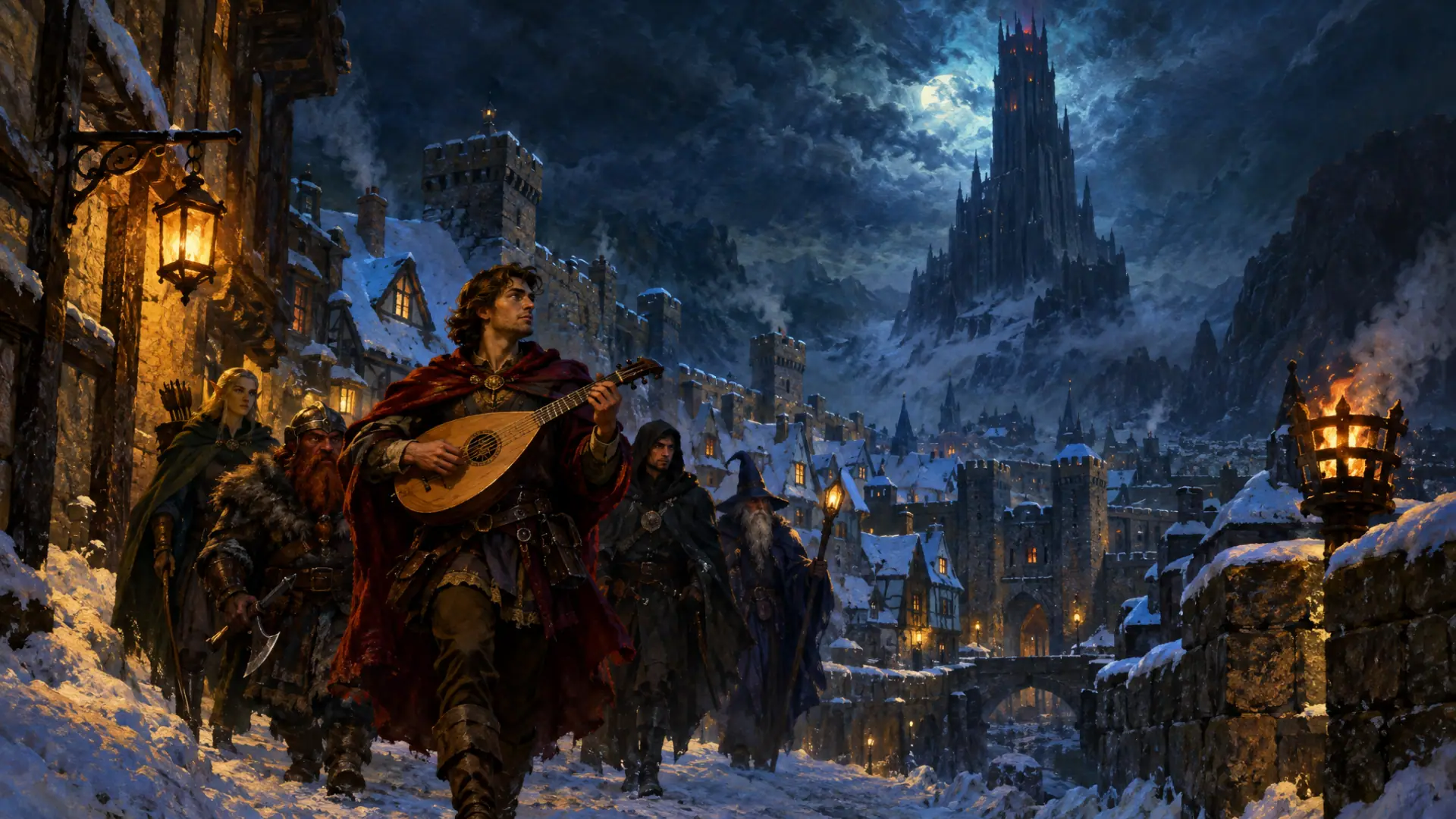
The premise, as printed on the box, is a winter's tale. Long ago, the evil wizard Mangar the Dark seized the small town of Skara Brae, froze the surrounding lands with a spell of Eternal Winter, and let his creatures ooze into the streets. The town militia has vanished. Who is left? "Only a handful of unproven young Warriors, junior Magic Users, a couple of Bards barely old enough to drink, and some out of work Rogues." You are their leader.
The Bard's Tale, designed and programmed by Michael Cranford at Brian Fargo's Interplay Productions and published by Electronic Arts in 1985 for the Apple II and Commodore 64, is a first-person dungeon crawl in the tradition of Wizardry. What it added was presentation: a full-color window onto streets and corridors, animated portraits of every monster, and music that played whenever the bard sang. For a generation of Commodore 64 owners who could not buy Wizardry on their machine (a Commodore version did not appear until 1987), it was the definitive fantasy role-playing game, and by Electronic Arts' own figures it became the best-selling computer RPG of the decade.
Origins
Cranford had already written a dungeon game, Maze Master (1983), for Human Engineered Software, and ported Donkey Kong to the Apple II. Interplay, founded in Irvine, California, in October 1983 by Fargo, Jay Patel, Troy Worrell and Rebecca Heineman with investor Chris Wells, was then a small contract studio. The new game was announced under the working title Shadow Snare. Cranford said most of the design grew out of the Dungeons & Dragons sessions he and Fargo had played, and that he set out to beat Wizardry's Apple II presentation, which he felt fell short.
The credits show a small team. Cranford did the concept, design and programming; Fargo and Roe R. Adams III contributed design; David Lowery drew the graphics; Lawrence Holland, later of X-Wing fame, composed the music; and Joe Ybarra produced for EA. Heineman is credited in the manual for the data-compression routines that let Cranford pack in so much animation, and says she also wrote tools and the ports. The name Skara Brae, borrowed from a Neolithic settlement in Orkney, came from an outside contact: Cranford has recalled a consultant who was also working on Ultima IV, which is why a Skara Brae turned up in both games in 1985, and he has also credited an EA agent with suggesting the title itself (the earlier idea was Tale of the Scarlet Bard). EA packaged the game as Tales of the Unknown, Volume I; that series banner quietly disappeared as The Bard's Tale became a brand in its own right.
Cranford, a devout Christian, placed references to Jesus in the game. The project also ended in a dispute over contract terms, with Cranford withholding the finished game until Fargo signed. Accounts from Cranford, Fargo and Heineman differ in tone, but all three have since said they bear no grudges over something that happened in their early twenties.
How it plays
You begin at the Adventurer's Guild and build a The party of up to six from eight classes: warrior, paladin, rogue, bard, hunter, monk, conjurer and magician. Magic users can later switch permanently to become sorcerers and wizards; a character who masters all four spell schools is called an archmage. Characters could also be imported from Wizardry or Ultima III on some platforms.
The bard is the innovation that named the game. Instead of spells, a bard sings, and each tune is a lasting party-wide effect, from faster attacks to stronger armor, accompanied by an actual melody from the computer's sound chip. Some of the game's puzzles hinge on knowing which song to play. The mages, meanwhile, work from 85 spells cast by typing four-letter codes printed only in the manual, so the rulebook doubled as a key. Combat is turn-based and resolved in text beside the monster's animated portrait, and experience only turns into levels at the Review Board, a building the player first has to find.
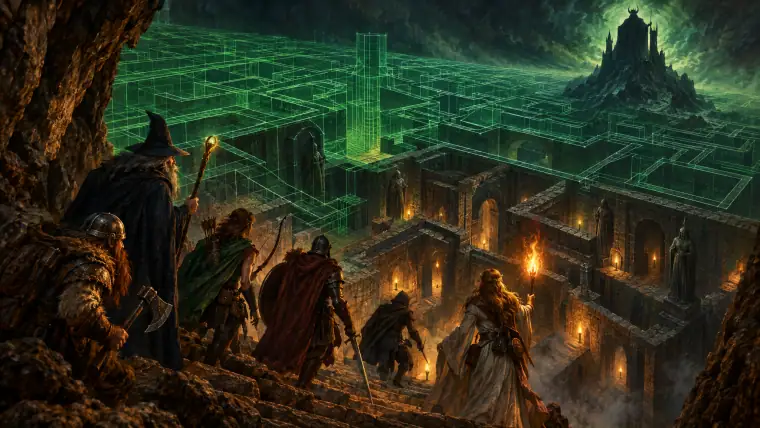
Skara Brae itself is a 30-by-30 grid of streets, shops (Garth's Equipment Shoppe), taverns and temples, guarded by statues that come to life. Beneath and around it lie sixteen dungeon levels to be mapped on graph paper: the wine cellar of the only tavern that serves wine, the sewers, the catacombs beneath the Mad God's temple (entered only if you know his name), Harkyn's Castle, the tower of the archmage Kylearan, and finally the five levels of Mangar's Tower. Spinners, teleporters, anti-magic zones and riddles made it a game of notebooks and patience, a textbook Blobber.
Reception & impact
Computer Gaming World's Scorpia called it "not to be missed!" in late 1985. Zzap!64 awarded the Commodore version 94 percent and a Sizzler, calling it the best RPG on the machine; Compute!'s Gazette praised "its depth of concept and brilliance of execution"; Dragon's reviewers later gave it five stars. In 1988 it was among the first games in Computer Gaming World's Hall of Fame. Commercially it was a phenomenon. An official EA figure reported in Questbusters in 1991 put sales at 407,000 copies, and it became the first non-Wizardry CRPG to challenge Ultima at the register. By 1993 the series had sold over a million.
Legacy
The sequels. The Bard's Tale II: The Destiny Knight (December 1986, Commodore 64 first) was Cranford's last; it opened a wilderness with six cities, banks and casinos, added the archmage class and timed puzzle "Snares of Death," and won the Origins Award for best fantasy or science fiction computer game of 1986. Cranford then left games to study philosophy and theology, later becoming an ethics professor. The Bard's Tale III: Thief of Fate (1988), designed by Heineman, Bruce Schlickbernd and novelist Michael A. Stackpole under Fargo's direction, burned Skara Brae to the ground, sent the party across time and dimensions against the Mad God Tarjan, and added an automapping system for its 84 dungeon levels. A Bard's Tale Construction Set followed in 1991, EA collected the three games as The Bard's Tale Trilogy for DOS in 1990, and Baen Books published eight tie-in novels beginning with Mercedes Lackey and Josepha Sherman's Castle of Deception (1992). A planned fourth game became the unrelated Dragon Wars (1989) after Interplay parted from EA.
Interplay's rise. The series made Interplay a publisher-grade studio; it went on to Wasteland, Fallout and publishing Baldur's Gate. Rivals such as Might and Magic (1986) and the real-time Dungeon Master (1987) arrived in its wake.
The revival. Fargo's inXile Entertainment used the name for a comic action RPG in 2004, but EA still held the original characters and places. In June 2015 inXile launched a Kickstarter for a true sequel with a $1.25 million goal and passed it within about two weeks. The Bard's Tale IV: Barrows Deep, set two centuries later in a Skara Brae rebuilt over its own ruins, released on Windows on September 18, 2018, with a Scottish-inflected score featuring Gaelic singer Julie Fowlis; Cranford was invited to consult. A Director's Cut followed on consoles and PC on August 27, 2019.
The remasters. Backers were promised modern versions of the original trilogy. After Heineman's studio Olde Sküül began the work, the project passed to Australia's Krome Studios, which rebuilt the games with automaps, female portraits and an optional Legacy Mode for purists. The first game returned on August 14, 2018; The Destiny Knight on October 23, 2018; Thief of Fate on February 26, 2019; and the complete Bard's Tale Trilogy reached Xbox One on August 13, 2019, after Microsoft's acquisition of inXile.
Marginalia
- Early boxes billed it as 'Tales of the Unknown, Volume I'; that series title was dropped once The Bard's Tale name took off.
- Its working title was Shadow Snare, announced as a follow-up to Michael Cranford's 1983 game Maze Master.
- Mage spells were cast by typing four-letter codes printed only in the manual, which made the manual part of the game.
- Some versions let you import characters from Wizardry and Ultima III, a startling courtesy in 1985.
- Electronic Arts reported 407,000 copies sold, which made it the best-selling computer RPG of the 1980s by that count.
- Skara Brae is named for a Neolithic village in Orkney; the name also appears in Ultima IV, released the same year.
- The 2018 Bard's Tale IV, crowdfunded on Kickstarter in 2015, reached its $1.25 million goal in under two weeks.
Quick answers
- When was The Bard's Tale first released?
- The Bard's Tale was first released in 1985 (Apple II, Commodore 64).
- Who created The Bard's Tale?
- The Bard's Tale was made by Michael Cranford (designer & programmer), Brian Fargo (additional design; Interplay founder) and Rebecca Heineman (data-compression routines, tools & ports).
- Who published or developed The Bard's Tale?
- Interplay Productions and Electronic Arts.
- What kind of work is The Bard's Tale?
- The Bard's Tale is a computer RPG in the First-Person Dungeon Crawlers ('Blobbers') and Western Computer RPGs (CRPG) tradition, released for Apple II, Commodore 64, Apple IIGS, ZX Spectrum, Amstrad CPC, Amiga, Atari ST, MS-DOS, Macintosh, NES, PC-98, Windows (2018 remaster) and Xbox One (2019).
- Why is The Bard's Tale important?
- The Bard's Tale brought the Wizardry-style party dungeon crawl to the Commodore 64 audience with color, animation and music, made Interplay a major studio, and launched a series revived nearly four decades later.