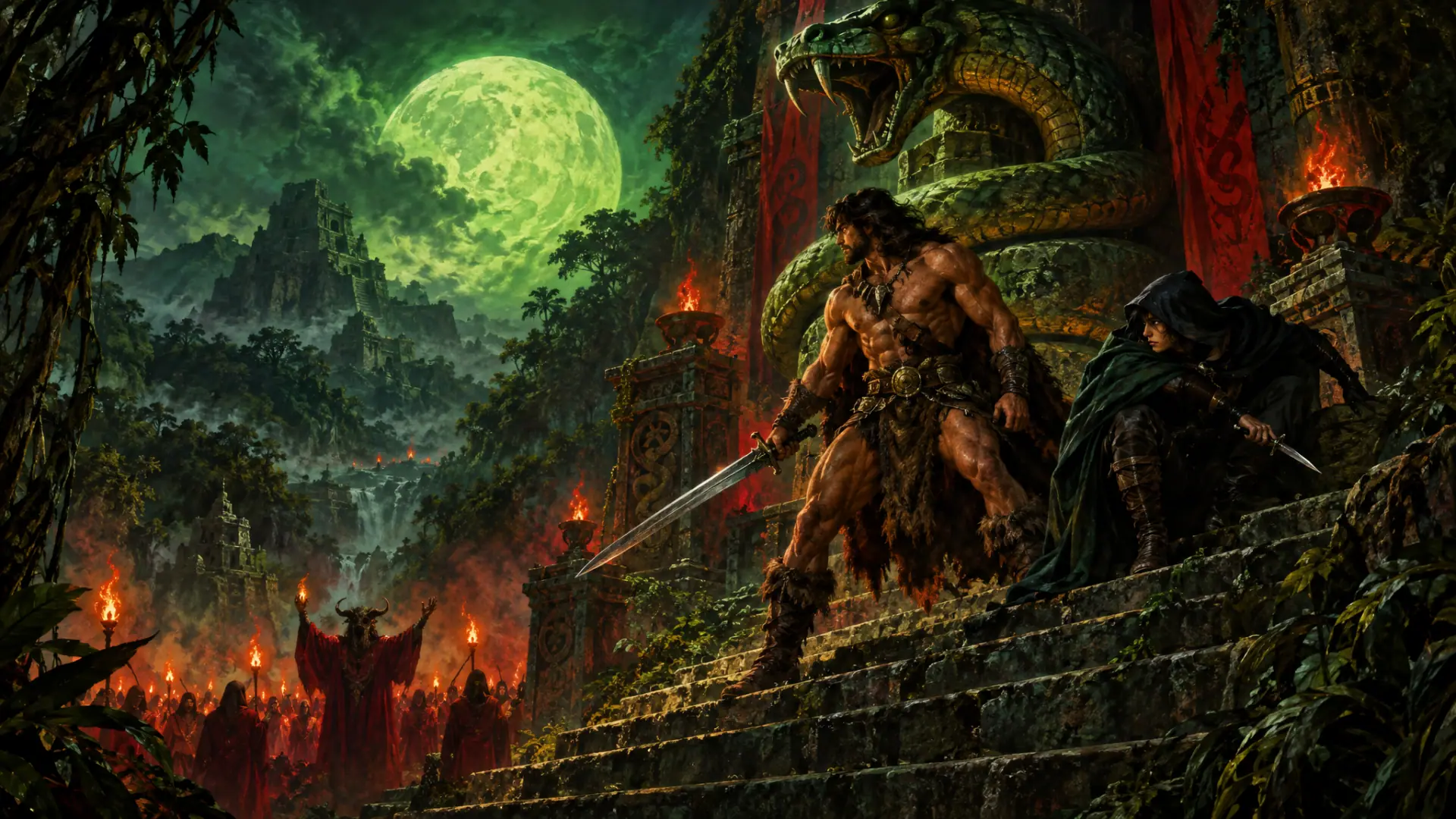
With Lovecraft and Howard, Smith was one of the three great writers of Weird Tales. His last-continent Zothique anticipated the Dying Earth, and his Averoigne stories were officially adapted by TSR.
Life
Clark Ashton Smith was born on 13 January 1893 in Long Valley, California, and spent nearly his whole life in a small cabin his parents built on the outskirts of Auburn, in the foothills of the Sierra Nevada. Crippled by agoraphobia and poor health, he left formal schooling after grammar school and educated himself with ferocious thoroughness — reading the Encyclopaedia Britannica and, by his own account, an unabridged dictionary word by word, which helps explain the exotic vocabulary of everything he wrote.
He began as a poet. The Star-Treader and Other Poems (1912), published when he was nineteen, won him a brief celebrity in San Francisco and the mentorship of the poet George Sterling. For years he earned little, doing odd jobs — fruit picking, wood chopping, well digging — while caring for his aging parents. In 1922 he began a fifteen-year correspondence with H. P. Lovecraft, who urged him toward fiction; in the Depression, prose paid where poetry did not. Between 1929 and the mid-1930s he wrote most of his hundred-odd stories. Then, in quick succession, his mother died (1935), Robert E. Howard killed himself (1936), Lovecraft died (1937) and his father died (1937). Smith virtually stopped writing fiction, turning to sculpture — small, strange figures carved from local stone — painting and poetry. In 1954 he married Carol Jones Dorman and moved to Pacific Grove on the coast, where he died on 14 August 1961.
Work
Smith's stories are fantasies of decadence, sorcery and doom told in a baroque, sensuous, darkly ironic prose. He built them in cycles. Hyperborea is a polar continent of the prehistoric past, where the toad-god Tsathoggua sleeps in a cavern beneath Mount Voormithadreth — a deity Lovecraft promptly borrowed. Poseidonis is the last isle of sinking Atlantis. Averoigne is a province of medieval France thick with witches, lamias, gargoyles and sorcerers, in stories such as "The Colossus of Ylourgne" and "The Holiness of Azédarac."
The greatest cycle is Zothique, the last continent of a far-future Earth under a dimming sun, where science is forgotten and necromancers rule. "The Empire of the Necromancers," "Xeethra" and "The Dark Eidolon" are among the most perfectly realized tales of the pulp era, and critics often trace Jack Vance's The Dying Earth (1950) and the whole Dying Earth genre back to them.
Legacy
Smith, Lovecraft and Howard are remembered as the "three musketeers" of Weird Tales, and Smith was the most purely literary of them. August Derleth's Arkham House collected him in hardcover from 1942, and Lin Carter brought four volumes of his stories — Zothique, Hyperborea, Xiccarph and Poseidonis — into the Ballantine Adult Fantasy Series series between 1970 and 1973, just as the first fantasy roleplayers were reading.
Smith is absent from Gygax's Appendix N, a gap often noted by later fans, but his fingerprints are on the hobby. The clearest case is TSR's module X2 Castle Amber (1981), written by Tom Moldvay for the Basic and Expert D&D line. Its credits thank Smith and his literary estate "for use of the Averoigne stories as inspirational material," and the adventure's later stages send the characters out of the mad d'Amberville family's mansion and into Averoigne itself. Tsathoggua and other Smith creations entered Chaosium's Call of Cthulhu as part of the wider Mythos. And the necromancers, liches and decaying empires that are staples of Weird Fiction and of D&D's darker settings owe much of their lush, rotten atmosphere to the poet of Auburn.
Marginalia
- Smith left school after grammar school and educated himself, reportedly reading an unabridged dictionary word by word.
- His first book, The Star-Treader and Other Poems (1912), was published when he was nineteen and drew comparisons to Keats.
- Most of his roughly one hundred stories were written in a burst between 1929 and the mid-1930s, largely for Weird Tales.
- He created the toad-like god Tsathoggua, whom Lovecraft then borrowed for his own stories.
- TSR's module X2 Castle Amber (1981) by Tom Moldvay credits Smith's Averoigne stories as inspirational material.
- Unlike Lovecraft and Howard, Smith does not appear on Gygax's Appendix N.
Quick answers
- Who was Clark Ashton Smith?
- The self-taught poet of Auburn, California, whose jeweled tales of Zothique, Hyperborea and Averoigne gave the pulps their most decadent sorcerers — and gave D&D the setting of Castle Amber.
- When was Clark Ashton Smith born?
- Clark Ashton Smith was born in 1893 in Long Valley, California and died in 1961.
- Why does Clark Ashton Smith matter to fantasy and games?
- With Lovecraft and Howard, Smith was one of the three great writers of Weird Tales. His last-continent Zothique anticipated the Dying Earth, and his Averoigne stories were officially adapted by TSR.