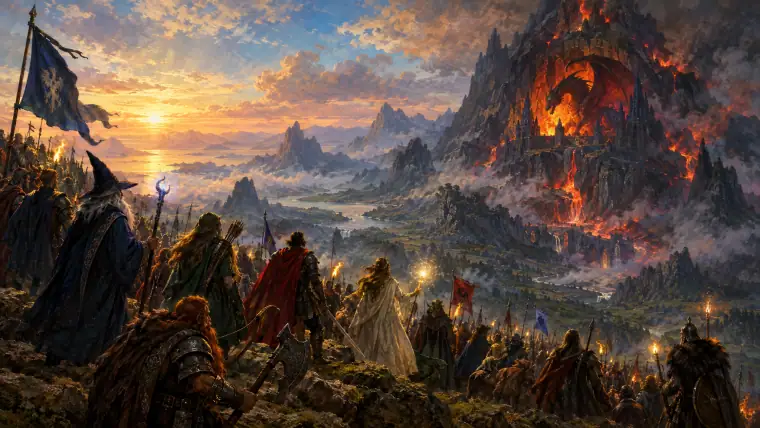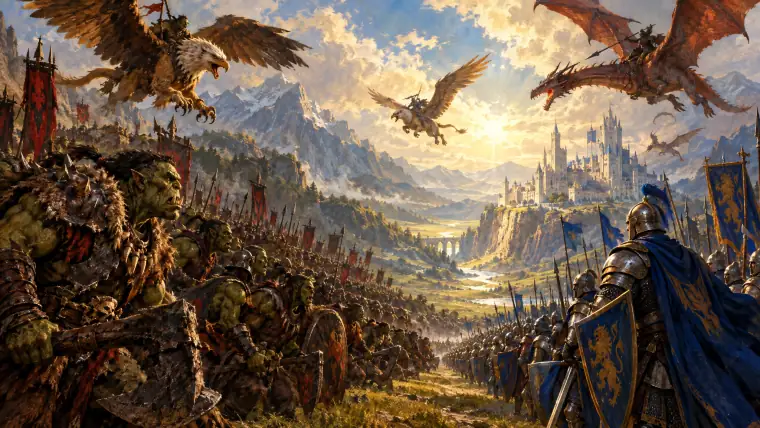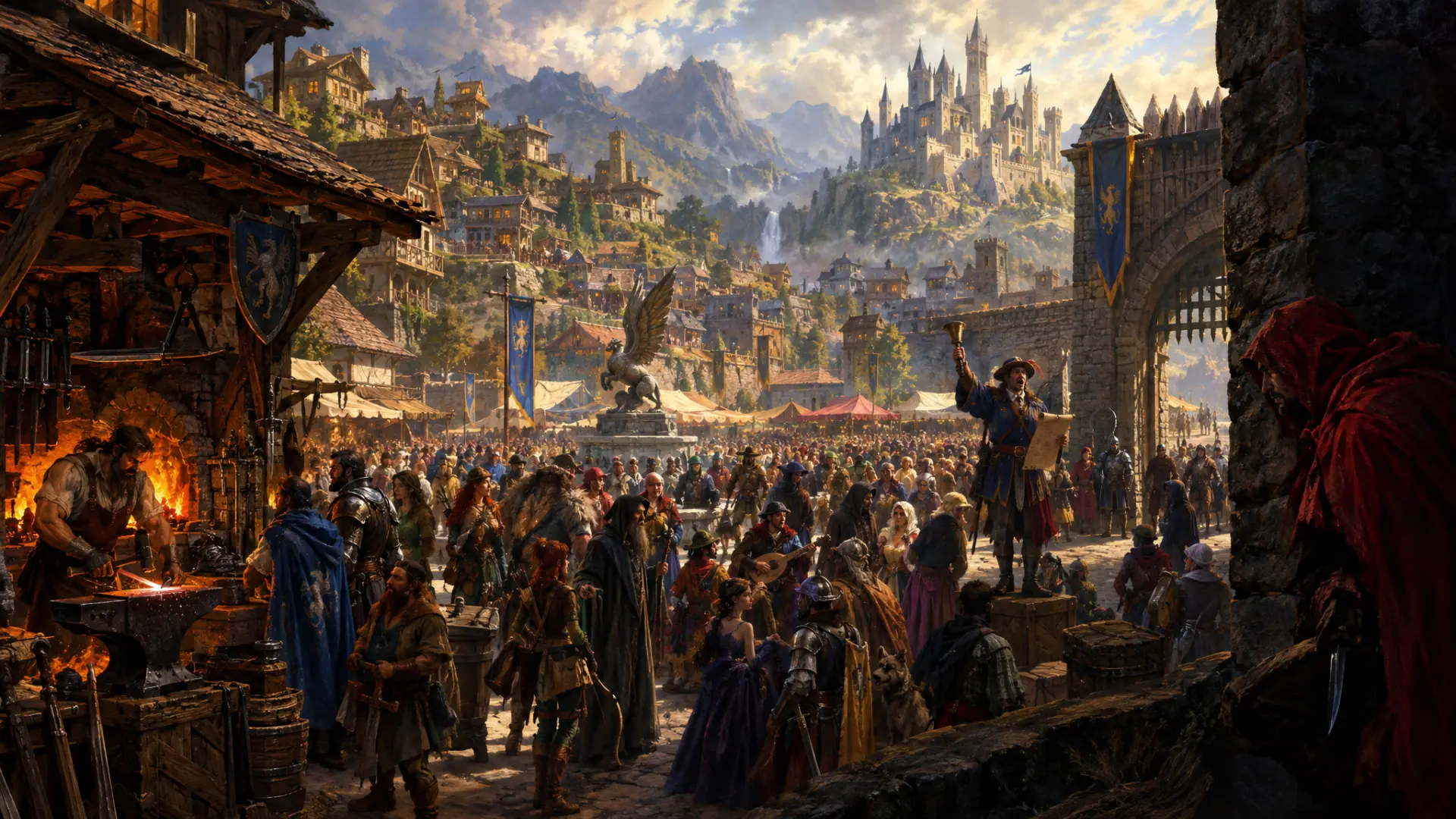
Ultima Online was the first online world to reach 100,000 paying subscribers and the game most often credited with popularizing the MMORPG. Its player-built economy, housing, and bitter arguments over player killing wrote the rulebook every later online world inherited.
Overview
For fifteen years the Ultima series had been a one-player pilgrimage: a single Avatar walking the moongates of Britannia, learning the Virtues and saving the realm from whatever threat Richard Garriott had dreamed up. Ultima Online handed the same world to everyone at once. Launched by Origin Systems and Electronic Arts on September 24, 1997, it offered no chosen hero and no ending, only a persistent Britannia split into parallel copies called shards, where thousands of players could fish, forge swords, tame dragons, run shops, build houses, form guilds, and murder one another. It was chaotic, laggy, often cruel, and a phenomenon. It was the first online world to pass 100,000 paying subscribers, and Garriott is credited with coining the term "MMORPG" to describe it. Almost every massively multiplayer game since has been, in part, a reaction to what happened in Britannia.
Origins
Online role-playing already existed, in the text MUDs descended from MUD1 and in pay-by-the-hour graphical games on America Online such as Neverwinter Nights. Garriott wanted something larger: a fantasy game, as he put it, involving several thousand people who could all play in one shared world. Origin, by then owned by Electronic Arts, started the project in 1995 on an initial budget of about $2.5 million. The core team was small and young. Starr Long, who had joined Origin in 1992 as a game tester, was the director; Raph Koster, a poet with an MFA who had been an implementor of the role-playing MUD LegendMUD, joined a little later, in 1995, as lead designer and wrote public "designer letters" to the community under the name Designer Dragon, drawing on MUDs such as DartMUD. Programmers Rick Delashmit and Scott Phillips built much of the technology.
The ambition was a simulation, not a theme park. Garriott promised "the very first ever completely virtual world for the mass public to go live out alternate lives in," and the team built an artificial-life engine in which ecological events would shape how animals behaved. It did not survive the players. As Garriott later put it, "all the players went in and just killed everything," faster than the game could spawn creatures for the simulation to begin, and the system was quietly ripped out before launch. Origin showed the game at E3 in May 1996 as Ultima Online: Shattered Legacy and ran a public alpha with more than 3,000 testers, then a large public beta through the summer of 1997.
The beta produced the most famous moment in the game's history. On August 9, 1997, Garriott appeared as Lord British to address the testers. A server crash earlier had reset his character's invulnerability flag, and a thief named Rainz cast a fire field spell and killed the king where he stood. Rainz was banned for exploiting rather than reporting bugs, which angered many testers. The beta ended on September 23, 1997, with an end-of-the-world event; the live game opened the next day.
How it plays
Ultima Online had no levels and no classes. Characters improved individual skills, dozens of them from swordsmanship and magery to blacksmithing, tailoring, lumberjacking, fishing, animal taming, and begging, by using them, with a total cap that forced every player to choose what kind of person to be. A character could be a mage, a miner, a bard, or a merchant, and many of the most respected players never fought at all. Everything was made by someone. Ore was mined and smelted, logs chopped and turned into bows and boards, cloth sewn into clothing, and the results sold from player-owned shops staffed by hired vendor NPCs.
That economy was the heart of the game, and it was a real economy with real problems. Balancing the flow of gold and goods proved endlessly difficult, and the designers spent years adjusting it. Items and gold were traded for cash almost from the start. By early 1999 players were auctioning whole accounts, one reportedly for $2,025, and a Wonder Bread deliveryman named John Dugger made headlines by paying $750 for a three-story house. These sales, alongside those of EverQuest, helped create the field of virtual economics.
Housing was the other great novelty. Players bought a deed and placed a home, from a small wooden or stone cottage up to a tower, a keep, or a castle, directly on the open map, where it became a permanent part of the shared landscape. Houses could be locked, decorated, filled with secure chests, and turned into storefronts. Space was finite, and on popular shards buildable ground grew scarce; much of the appeal of later expansions was the fresh land they opened. The 2003 Age of Shadows expansion doubled the housing space again with the floating islands of Malas, room for some 1,500 new homes, and introduced custom housing, letting owners design their buildings tile by tile.
And there was player killing. Britannia's original rules let anyone attack anyone outside guarded towns and loot the corpse. Over time the game developed a reputation system that tracked murders: under the rules that settled in, a player with five long-term murder counts turned red, a mark that made him fair game for all, and players who enjoyed hunting the player killers formed their own anti-PK guilds. The result was the most vivid Sandbox the medium had yet produced, but for many newcomers it was misery: gankers waited outside town gates, and a first trip into the woods could end with a naked ghost walking back to a healer. A rift formed between those who hunted players, those who hunted the hunters, and those who just wanted to be left alone.
Reception & impact
Critics were unimpressed by what they saw at launch. The servers were overwhelmed, lag was chronic, bugs were rampant, and reviewers scored it low: 4.9 out of 10 at GameSpot and 55 percent in PC Gamer, though Next Generation gave it four stars and called Britannia "what you make of it." The game's rough state started an industry argument about shipping unfinished products and patching them live; Koster's own timeline of online worlds records a class-action suit filed over the game in 1998, later settled. None of it slowed sales, which astonished its own publisher: by one Origin employee's account, the team had expected at most 15,000 subscribers. Between September 25 and November 13, 1997, the $65 box sold 65,000 copies, and Electronic Arts called it its fastest-selling computer game ever. There were 70,000 subscribers worldwide by early December 1997, and the service passed 100,000 paying subscribers within about six months, at $9.95 a month, a scale no online game had reached. Servers opened in Japan, Europe and South Korea in 1999. Subscriptions reached 150,000 by February 2000 and about 250,000 by October 2000, and hovered near that level until a peak of around 250,000 in July 2003. Japan was a stronghold, accounting for 64,000 of 240,000 subscribers in July 2001.
The pressure to fix player killing came to a head with Ultima Online: Renaissance, released May 4, 2000. It duplicated the entire map into two facets: Felucca kept the old, dangerous rules, while Trammel, a mirror world, allowed combat between players only by consent. Trammel doubled the land available for housing and resource gathering, and it drew the crowds: the developers noted that most players never ventured into Felucca, while many veteran player killers mourned the old, dangerous Britannia. The split became the defining lesson of the genre: open player-versus-player combat attracts a passionate minority and drives away a larger majority. EverQuest made most of its servers consensual from the start, Asheron's Call quarantined its killers on one server, and Dark Age of Camelot channeled the urge into warring realms.
Legacy
Expansions arrived for almost two decades: The Second Age (October 1998), Renaissance (2000), Third Dawn (2001, with a 3D client), Lord Blackthorn's Revenge (2002), Age of Shadows (2003), Samurai Empire (2004), Mondain's Legacy (2005), Stygian Abyss (2009), the High Seas booster (2010), and Time of Legends (2015). The company that built it did not last as long. Garriott resigned from Origin in 2000, taking Lord British with him, and players spun theories about the king's disappearance. A planned sequel, Ultima Worlds Online: Origin, with character designs by Todd McFarlane, was cancelled in 2001, partly for fear it would cannibalize the original; Origin itself was closed in 2004, and UO development moved to Fairfax, Virginia, then to Mythic Entertainment in 2006 and to the independent Broadsword in 2014. After World of Warcraft arrived in 2004, subscriptions fell, to roughly 100,000 by 2008. Alongside the standard shards, "Siege" shards preserve a harsher game of open player combat. In 2018 the game added Endless Journey, a free tier with limits on housing and storage.
The people scattered and built the genre. Koster went to Verant as creative director of Star Wars Galaxies and wrote A Theory of Fun for Game Design; his "Laws of Online World Design," first shown at GDC in 1999, became a design touchstone. Long and Garriott co-founded Destination Games, and years later reunited for the crowdfunded Shroud of the Avatar (2018). Fans reverse-engineered the server and ran their own shards, a scene that has outlived many commercial games. Guinness World Records gave it several records in its 2008 Gamer's Edition, including first MMORPG to reach 100,000 players. It was the first inductee into the Game Developers Choice Online Awards Hall of Fame in 2010, and Time named it one of the 100 greatest video games in 2012.
Did you know?
The guild Shadowclan became notorious in 1997 for role-playing as orcs, living as monsters in a world built for heroes. And after Origin's volunteer "Counselors," who helped players in-game, sued, arguing they should have been paid, a case settled in 2004 without admission of wrongdoing, Microsoft wound down the volunteer program of its own Asheron's Call.
Marginalia
- Lord British himself was assassinated in the beta on August 9, 1997: a server crash had cleared Garriott's invulnerability, and a player called Rainz killed him with a fire field spell.
- Origin began the project in 1995 on an initial budget of about $2.5 million and showed it at E3 in May 1996 as Ultima Online: Shattered Legacy.
- Japan's first 5,000-copy shipment reportedly sold out within 15 minutes.
- The designers built an artificial-life ecology of predators and prey, then abandoned it in beta: players simply killed everything.
- The 2000 Renaissance expansion split the world into Felucca, open to player killing, and Trammel, where no one could attack you without consent.
- In early 1999 players were already auctioning whole accounts; one reportedly sold for $2,025.
- An Origin employee recalled that the game was expected to top out at 15,000 subscribers; it passed 100,000 within about six months.
Quick answers
- When was Ultima Online first released?
- Ultima Online was first released in 1997 (Windows).
- Who created Ultima Online?
- Ultima Online was made by Richard Garriott (creator & producer ("Lord British")), Starr Long (director ("Lord Blackthorn")) and Raph Koster (lead designer ("Designer Dragon")).
- Who published or developed Ultima Online?
- Origin Systems, Electronic Arts and Mythic Entertainment.
- What kind of work is Ultima Online?
- Ultima Online is a MMORPG in the MMORPGs and Western Computer RPGs (CRPG) tradition, released for Microsoft Windows.
- Why is Ultima Online important?
- Ultima Online was the first online world to reach 100,000 paying subscribers and the game most often credited with popularizing the MMORPG. Its player-built economy, housing, and bitter arguments over player killing wrote the rulebook every later online world inherited.