MUD1 was the first multi-user dungeon and the first virtual world of its kind to go online internationally; its design and descendants led through AberMUD, DikuMUD and others to the graphical MMORPGs.
Overview
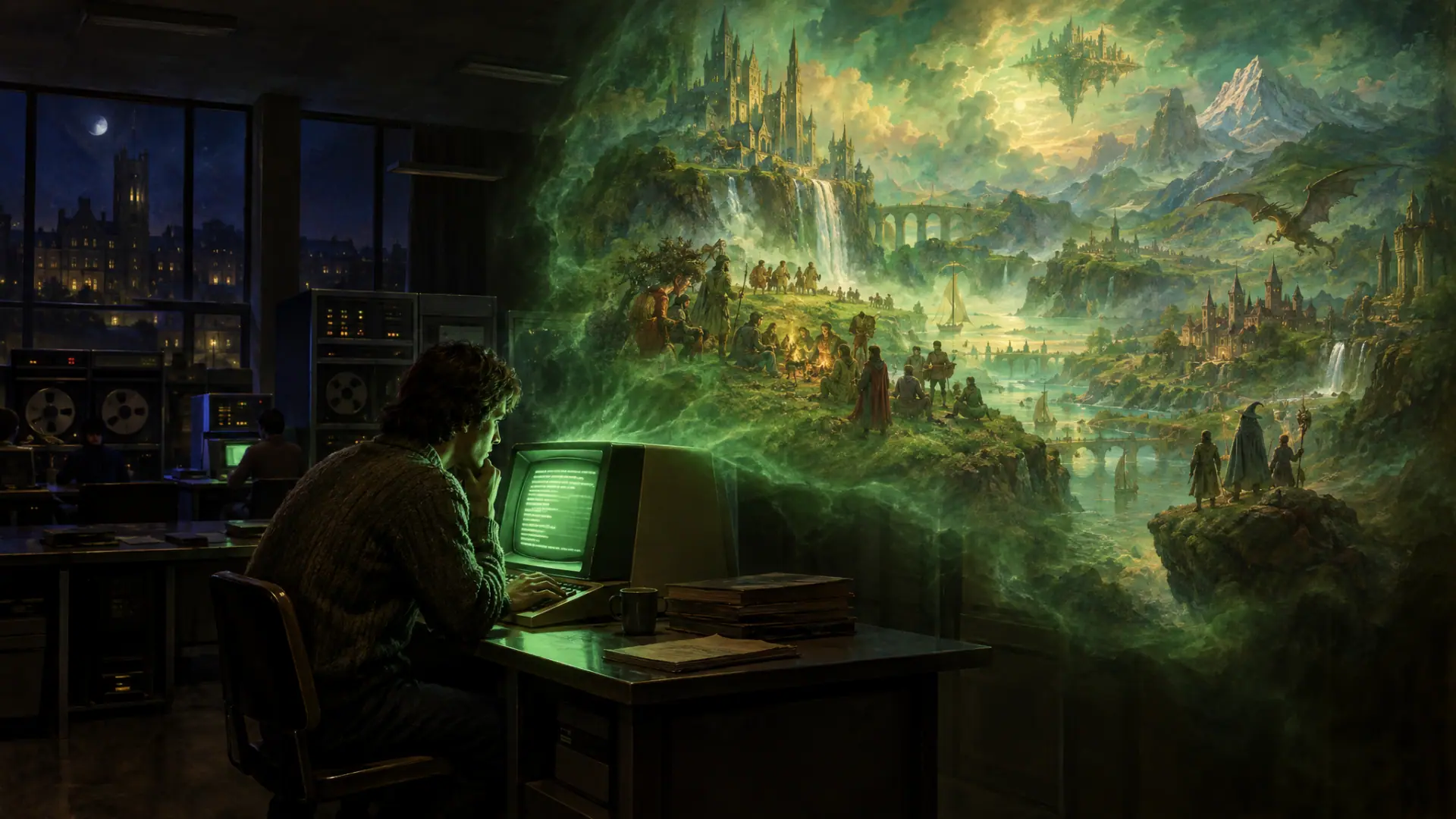
Colossal Cave and Zork were solitary worlds: one player, one parser, one story. In the autumn of 1978, at the University of Essex in England, an undergraduate named Roy Trubshaw began asking what would happen if many people could share the same text world at once, see one another arrive, talk, trade, cooperate and fight. The answer was MUD, the Multi-User Dungeon, later called MUD1 to distinguish it from its successor and from the genre it named. With his fellow student Richard Bartle, who built much of its world and ran it for years, Trubshaw created the first virtual world of the online age.
Origins
Trubshaw had played the Fortran version of Zork, then circulating under the title Dungeon, and named his game in its honor. He wrote the first version in MACRO-10 assembly language on the university's DECsystem-10 in autumn 1978. A second version followed, but assembly code was becoming unmanageable, and from late 1979 to about Easter 1980 he rewrote the whole system in BCPL; this "version 3," with its world defined in a special-purpose language called MUDDL, is what most people remember as the original MUD.
Bartle contributed more and more of the game's world: many of the locations and puzzles in "the Land" are his. When Trubshaw graduated in 1980, Bartle took over full control. That spring the first external players logged in, and Essex's connection to the ARPANET that year let people outside Britain reach the game, making MUD the first internationally networked multiplayer role-playing world. A reference to it appeared in an article on Zork in the December 1980 issue of Byte.
How it plays
MUD looks like a text adventure: rooms described in prose, typed commands, objects to take and use. The difference is that other people are there, typing too, in real time. The goal was to accumulate points, scored by killing things or by dropping treasure into a swamp, until you reached the rank of Wizard (or Witch). At that point the character became immortal and gained powers over mortal players, and in effect joined the ranks of those who kept the game running.
Because players shared one world, they could help or harm one another. Combat between players was possible, so reputations, alliances and grudges formed, and the player killer was born alongside the helpful veteran. Bartle has described the invention of multiplayer games as, for the two of them, a political gesture: a world where people were judged by what they did rather than who they were born.
Reception & impact
Demand quickly outran the hardware. Essex opened the game to outsiders only when the university's computer was otherwise idle, in the small hours of weekday mornings and longer at weekends, and even then it was always full. From 1983 players reached it over British Telecom's packet-switched network; from 1984 to 1987 the British service Compunet licensed and ran a copy for its Commodore 64 users; and the Dundee College of Technology hosted it for a time. Trubshaw, Bartle and Simon Dally formed a company, Multi-User Entertainment, which developed MUD2 (1985).
In 1987 CompuServe licensed MUD1, and Bartle closed the Essex original on September 30, 1987, when he left the university to work on MUD full time. On CompuServe it ran as British Legends until late 1999, when it was retired in the service's Y2K cleanup. A C++ reimplementation by Viktor Toth reopened it online in 2000; it was deposited in Stanford University's archives in 2014, and in 2020 the original PDP-10 source code was published on GitHub.
Legacy
MUD1 is the ancestor of a sprawling family tree. Players who had tasted it built their own: MIST at Essex, Shades on British Telecom's Prestel, and in 1987 Alan Cox's AberMUD at Aberystwyth, the first widely distributed MUD codebase, whose descendants TinyMUD, LPMud and DikuMUD carried the form across university networks worldwide. Designers of the first graphical online worlds, from Meridian 59 and Ultima Online to EverQuest, came out of that culture, which is why the MMORPG can be traced back to one PDP-10 at Essex.
Richard Bartle became the field's leading theorist. His 1996 paper "Hearts, Clubs, Diamonds, Spades: Players Who Suit MUDs" proposed four player types, achievers, explorers, socializers and killers, which remain the most cited taxonomy in game design, and his 2003 book Designing Virtual Worlds is a standard text. MUDs also sat alongside the BBS door games as the online playgrounds of the 1980s and 1990s, in a history this museum traces through the Online Worlds: From MUD1 to World of Warcraft chapter.
Marginalia
- Roy Trubshaw began MUD in autumn 1978 in MACRO-10 assembly on the University of Essex's DECsystem-10.
- The 'D' stands for Dungeon: Bartle explains that the version of Zork Trubshaw played was a Fortran port called DUNGEN.
- Outside players could connect only at weekends and in the small hours of weekdays, roughly 2 a.m. to 8 a.m., yet the game was reportedly always full.
- Points came from killing things or dropping treasure in a swamp; reaching Wizard rank made a player immortal, with powers over mortals.
- Bartle closed the Essex original on September 30, 1987, when he left the university to work on MUD full time.
- Its full PDP-10 source code, as of 1986, was released on GitHub with the authors' permission in 2020.
Quick answers
- When was MUD1 first released?
- MUD1 was first released in 1978 (University of Essex).
- Who created MUD1?
- MUD1 was made by Roy Trubshaw (creator; original programmer (1978–80)) and Richard Bartle (co-creator; world designer and later lead (1980– )).
- What kind of work is MUD1?
- MUD1 is a MUD in the MUDs (Multi-User Dungeons) tradition, released for DEC PDP-10 (DECsystem-10), Compunet and CompuServe.
- Why is MUD1 important?
- MUD1 was the first multi-user dungeon and the first virtual world of its kind to go online internationally; its design and descendants led through AberMUD, DikuMUD and others to the graphical MMORPGs.