The Basic Set took D&D out of hobby shops and into toy and department stores, teaching the game to readers with no wargaming background. It created a separate, simpler D&D line that ran alongside AD&D for two decades.
Overview
The Dungeons & Dragons Basic Set is not one product but a lineage of boxed introductions to D&D published by TSR, Inc. from 1977 to 1994. Three versions defined it. The 1977 set, edited by J. Eric Holmes, rewrote Dungeons & Dragons for newcomers. The 1981 revision by Tom Moldvay split "Basic" D&D into its own game, distinct from Advanced Dungeons & Dragons. And the 1983 set by Frank Mentzer — the "Red Box," with Larry Elmore's painting of a warrior facing a dragon — became for many people the image of D&D itself.
Together they were the front door of the tabletop boom. The original rules assumed you already knew miniatures wargaming; the Basic Set assumed you knew nothing at all.
Origins
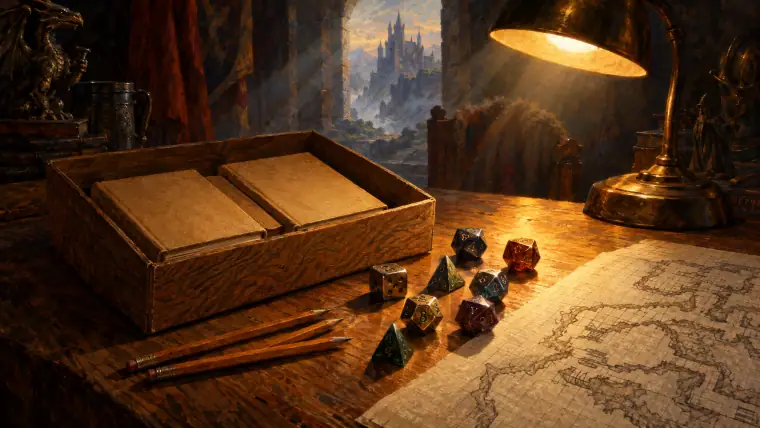
By 1977 the original box was selling well among wargamers and college students but was notoriously hard to learn from. John Eric Holmes, a professor of neurology at the University of Southern California and an enthusiastic player and fantasy writer, offered TSR an introductory version aimed at younger players and a mass-market audience. His 48-page rulebook, released in July 1977, reorganized the original rules and the Greyhawk supplement into a clear explanation of how to play characters from first to third level, with a sample dungeon. It was sold on its own or in a larger, more attractive box — built for toy-store shelves — with polyhedral dice and dungeon aids. Later printings swapped those aids for an adventure module: Mike Carr's B1 In Search of the Unknown from 1978, then Gygax's The Keep on the Borderlands from late 1979.
Holmes preferred a lighter game with room for improvisation; Gygax, meanwhile, was writing AD&D as an exhaustive rulebook for tournaments. The two lines diverged. Moldvay's 1981 revision, a 64-page book with a red border and an Erol Otus cover, was paired with an Expert Set by David Cook and Steve Marsh covering levels four to fourteen. Mentzer's 1983 rewrite presented the same rules as a step-by-step tutorial, and his five color-coded boxes — Basic, Expert, Companion, Master and Immortals (1983–86), known as BECMI — let characters rise from novice to godhood.
How it plays
Open the Red Box and you find a Players Manual, a Dungeon Masters Rulebook and six dice. The Players Manual begins with a solo adventure: you are a fighter exploring a cave, you meet a cleric named Aleena, and — when the magic-user Bargle strikes — you learn how quickly a character can die. Within a few pages you have learned to roll a twenty-sided die to hit and a smaller die for damage.
Character creation takes minutes. Roll three six-sided dice for each of six abilities; choose one of seven classes. Four are human — Fighter, Cleric, Magic-User, Thief — and three are "race-as-class" options: the Dwarf, the Elf and the Halfling. Choose Lawful, Neutral or Chaotic. Then the Dungeon Master describes the dungeon entrance, and the table falls into the rhythm of dungeon exploration: map the corridors, check for traps, fight or parley with monsters, divide the Loot & loot tables, and return to town to heal and gain Experience points. Basic covered levels one to three; the Expert rules added wilderness journeys, castles and higher levels.
Compared with AD&D, Basic was lean: fewer classes, simpler combat and saving throws, and rules short enough for a twelve-year-old to absorb over a weekend. That economy was the point.
Reception & impact
Reviewers welcomed the clarity. Jon Freeman praised Holmes's version as the work of "someone outside the TSR establishment who knew a noun from a verb." Doug Cowie, in Imagine, applauded Mentzer's set for finally explaining to newcomers how to get started, and judged Basic "a lot closer to the spirit of the original game" than AD&D. Games magazine listed the Basic Set among its top 100 games of 1981 and 1982.
Sales rose sharply at the end of the 1970s. Peterson has estimated that the set was selling perhaps 5,000 copies a month before the disappearance of Michigan State student James Dallas Egbert III in 1979, and over 30,000 a month by the year's end, as lurid press coverage — which wrongly tied the case to the game — spread D&D's name. That notoriety became part of the Satanic Panic & D&D of the following decade.
Legacy
The Basic line continued with Troy Denning's 1991 "black box," the Rules Cyclopedia compilation of the same year, and a final 1994 "Classic" set. D&D's third edition in 2000 ended the split, but the Basic rules were never forgotten. Games Workshop, which distributed early D&D in Britain, published its own edition of the Holmes rulebook in 1977. The 1981 Basic and Expert rules became a favorite foundation of the Old-School Renaissance (OSR); Old-School Essentials (2019) is a careful restatement of them. And Elmore's Red Box painting, reused and homaged ever since, remains one of the most recognizable images in the hobby.
Marginalia
- TSR hired neurologist J. Eric Holmes to write an introductory version for players aged twelve and up; his rulebook appeared in July 1977.
- The larger box was designed to sit on retail shelves and be sold through toy stores to the general public.
- During a 1979 dice shortage, some sets shipped with numbered cardboard chits and a coupon for real dice.
- Jon Peterson estimates Basic Set sales rose from perhaps 5,000 a month to over 30,000 a month by the end of 1979, amid press coverage of the Egbert case.
- The 1981 set included a crayon for inking the numbers on its unpainted dice.
- Mentzer's five boxes took characters from first level to immortality: Basic, Expert, Companion, Master and Immortals.
Quick answers
- When was Dungeons & Dragons Basic Set first released?
- Dungeons & Dragons Basic Set was first released in 1977 (Holmes); 1981 (Moldvay); 1983 (Mentzer); later versions 1991, 1994.
- Who created Dungeons & Dragons Basic Set?
- Dungeons & Dragons Basic Set was made by J. Eric Holmes (editor/writer, 1977 Basic Set), Tom Moldvay (editor/writer, 1981 revision), Frank Mentzer (writer, 1983 revision and the BECMI line), Larry Elmore (cover artist, 1983 Red Box), Gary Gygax (co-creator of the original game) and Dave Arneson (co-creator of the original game).
- Who published or developed Dungeons & Dragons Basic Set?
- TSR, Inc. and Games Workshop.
- What kind of work is Dungeons & Dragons Basic Set?
- Dungeons & Dragons Basic Set is a tabletop RPG in the Tabletop Roleplaying Games tradition, released for Boxed set with rulebook, dice and adventure module.
- Why is Dungeons & Dragons Basic Set important?
- The Basic Set took D&D out of hobby shops and into toy and department stores, teaching the game to readers with no wargaming background. It created a separate, simpler D&D line that ran alongside AD&D for two decades.