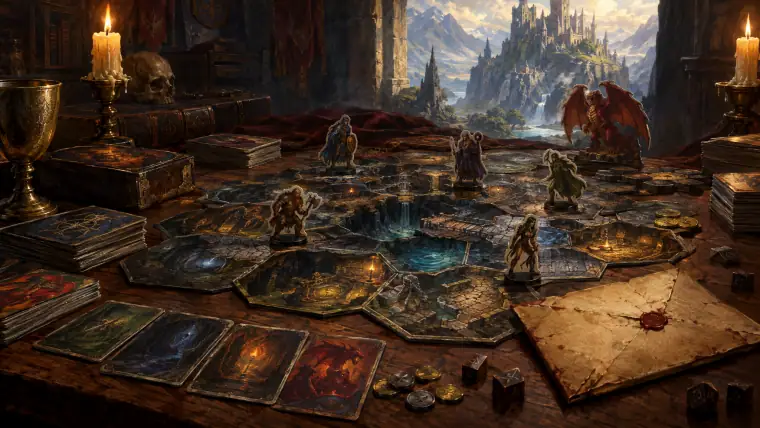
HeroQuest was many families' first taste of a game-master-led dungeon crawl, bridging mass-market board games and roleplaying, and it founded the dungeon-crawler board game as a mainstream genre.
Overview
HeroQuest is a fantasy board game designed by Stephen Baker and released by Milton Bradley in partnership with Games Workshop — in Britain, Europe and Australia in 1989, and in North America in 1990. Up to four players take the roles of heroes: the Barbarian, the Dwarf, the Elf and the Wizard. One more player takes the role of the evil wizard, called Morcar in the UK and Zargon in North America, who controls the monsters and reveals the dungeon as the heroes explore it.
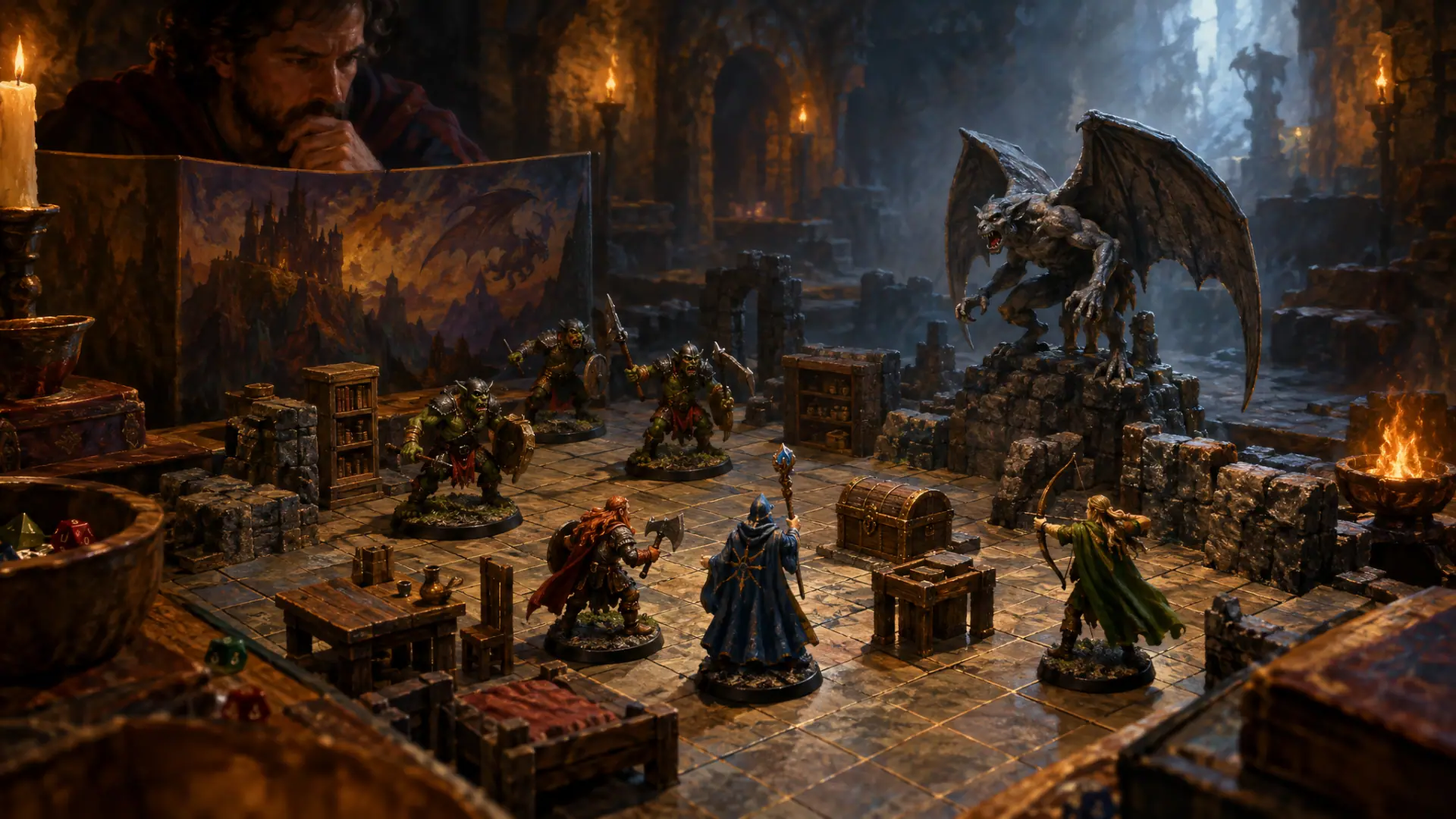
That fifth player is the key to what HeroQuest is. It is still a board game — there is a fixed board, a rulebook, dice and a winner — but it borrows the central idea of the roleplaying game: a game master who knows the secrets of the adventure and plays against, and for, everyone else. For countless children it was a first step from Monopoly toward Dungeons & Dragons.
Origins
Baker had worked at Games Workshop before moving to Milton Bradley, the American toy and game giant. There he convinced Roger Ford, Milton Bradley's head of development, to let him develop a fantasy game. Baker then went back to Games Workshop for miniatures and fantasy know-how. The result was a partnership that mixed Milton Bradley's mass-market production and distribution with Games Workshop's design sensibility and sculpting: the box's monsters — Orcs, Goblins, Fimir and Chaos Warriors among them — came straight from the world of Warhammer.
The collaboration worked well enough that the two companies followed it in 1990 with Space Crusade, also designed by Baker, which did for Games Workshop's science-fiction universe what HeroQuest had done for its fantasy one.
How it plays
The board shows the floor plan of a generic dungeon of rooms and corridors, but at the start of a quest it is almost empty. The evil wizard player holds the Quest Book, whose fourteen maps describe the adventures of the base game. As the heroes move, the evil wizard places doors, monsters, traps and furniture — tables, bookcases, tombs, a throne — according to what the heroes can see, so the dungeon unfolds room by room like a scene described by a Dungeon Master.
On their turns, heroes roll two six-sided dice to move up to that many squares and take one action: attack, cast a spell, search for traps or secret doors, or search for treasure. Combat uses special dice marked with skulls and shields — three skull faces, two hero-shield faces and one monster-shield face. The attacker rolls to score skulls, the defender rolls to block them with shields, and each unblocked skull removes a point of the target's health. The Barbarian is the strongest fighter; the Dwarf is tough and can disarm traps; the Elf both fights and casts spells; the Wizard is physically weak but commands three sets of spells. Spells come in four elemental sets — Air, Fire, Water and Earth — shared out between the Elf and the Wizard.
Searching is where tension lives. It can uncover gold and equipment, but it can also draw a card that springs a wandering monster or another misfortune. Heroes who survive a quest keep their gold and buy better weapons and armor between adventures, and the fourteen quests link into a loose campaign — a light, board-game version of a character advancing through a series of adventure modules.
Reception & impact
HeroQuest was a hit, particularly in Britain and Europe, and it sold more than 300,000 units by 1990. It won the 1992 Origins Award for Best Graphic Presentation of a Boardgame of 1991. A wave of expansions followed: Kellar's Keep and Return of the Witch Lord in 1989 (with Kellar's Keep reaching North America in 1991), Against the Ogre Horde in 1990 and Wizards of Morcar in 1991. Games Workshop also published Advanced HeroQuest (1989), a revised and much more detailed version with its own rules. Computer versions followed from Gremlin in 1991, with HeroQuest II: Legacy of Sorasil on the Amiga in 1994.
Legacy
HeroQuest is remembered as the game that put a dungeon on the family table, and its descendants are easy to see in Games Workshop's later Warhammer Quest (1995) and in the modern dungeon-crawler board game, from Descent: Journeys in the Dark to Gloomhaven. Nostalgia for it remained strong enough that, after Hasbro acquired the trademark in September 2020, its Avalon Hill division launched a crowdfunding campaign for a new edition that hit its $1 million goal within 24 hours. The remake reached retail at the end of 2021. Because the Games Workshop connection had ended, its art was redrawn, the "Chaos" name became "Dread" throughout, and the Fimir were replaced with new fish-like Abominations.
Marginalia
- Designer Stephen Baker moved from Games Workshop to Milton Bradley and persuaded its development head to let him make a fantasy game.
- The evil wizard is called Morcar in the UK edition and Zargon in the North American one.
- HeroQuest's combat dice carry three skull faces, two hero shields and one monster shield.
- The game had sold over 300,000 units by 1990.
- It won the Origins Award for Best Graphic Presentation of a Boardgame of 1991.
- Hasbro's 2020 crowdfunding campaign for a remake reached its $1 million goal within 24 hours.
Quick answers
- When was HeroQuest first released?
- HeroQuest was first released in 1989 (UK & Europe); 1990 (North America); remade 2021.
- Who created HeroQuest?
- HeroQuest was made by Stephen Baker (designer).
- Who published or developed HeroQuest?
- Milton Bradley Company, Games Workshop and Avalon Hill.
- What kind of work is HeroQuest?
- HeroQuest is a board game in the Dungeon-Crawler Board Games and Fantasy Adventure Board Games tradition, released for Board game with miniatures & 3D furniture and Home computers (Gremlin Graphics, 1991).
- Why is HeroQuest important?
- HeroQuest was many families' first taste of a game-master-led dungeon crawl, bridging mass-market board games and roleplaying, and it founded the dungeon-crawler board game as a mainstream genre.