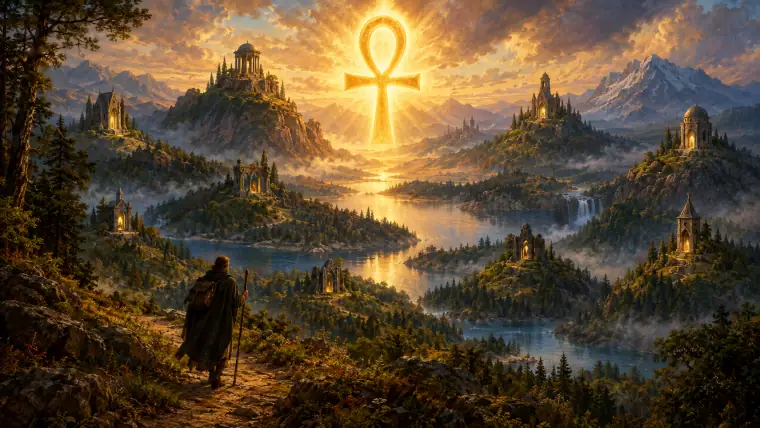
Akalabeth launched Richard Garriott's career and the Lord British persona, pioneered first-person perspective dungeons on a home computer, and is counted as 'Ultima 0', the prototype for one of the defining CRPG series.
Overview
"BEWARE FOOLISH MORTAL, YOU TRESPASS IN AKALABETH, WORLD OF DOOM!!" So warned the hand-assembled package that a Texas teenager began selling from a Houston-area computer store. Inside was an Apple II game in which the player, sent by the benevolent Lord British, descends into dungeons to slay a list of ten increasingly terrible monsters, drawn in "perfect perspective" through "infinite dungeon levels." Akalabeth: World of Doom, written by Richard Garriott in 1979 and published nationally by California Pacific Computer Company in 1980, is one of the earliest home-computer role-playing games and the seed of the Ultima series.
Origins
Garriott grew up in Nassau Bay, Texas, near NASA's Johnson Space Center, the son of astronaut Owen Garriott. Friends nicknamed him "British" because he had been born in Cambridge, England. At Clear Creek High School he talked his way into a self-directed programming course and wrote fantasy games on a teletype terminal connected to a DEC PDP-11, estimating that he produced 28 of them; he ran weekly Dungeons & Dragons sessions at his parents' house and read Tolkien. One of those programs, under the working title DND, kept evolving over two years, with his gaming friends as playtesters.
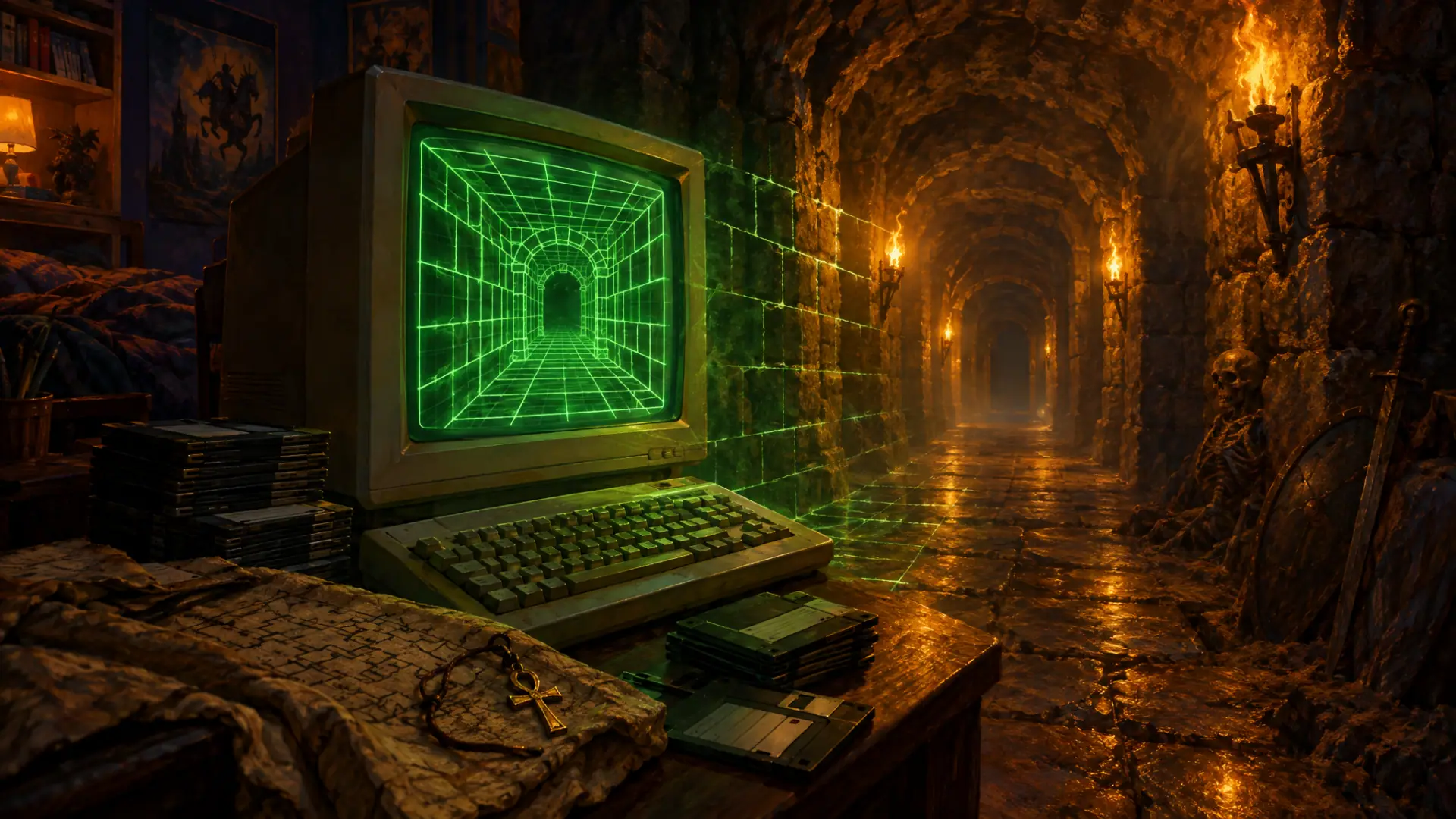
In the summer of 1979 he took a job at a ComputerLand store in the Houston area and discovered the Apple II. He moved the game to an Apple his father bought him, first using ASCII characters for an overhead map. After playing Escape, an early Apple maze game, he switched the dungeons to a wireframe first-person view, making Akalabeth the first computer role-playing game with such graphics. When the program reached revision DND28B, now renamed Akalabeth, his boss, John Mayer, suggested selling it in the store. Garriott spent $200 on Ziploc bags, photocopied instructions and a cover sheet drawn by his mother, and sold the game for $20; he later said only a handful sold at the store. One copy reached California Pacific in California, which signed him to a deal paying $5 a copy, redid the cover with art by Denis Loubet, raised the price to $35, and suggested crediting the author as "Lord British." A Softalk reader contest invited players to guess who he was.
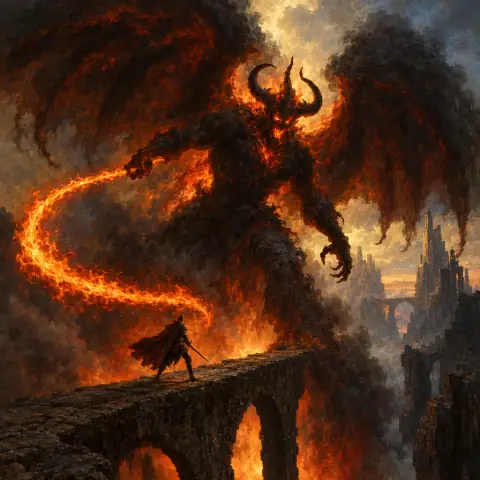
The name comes from the "Akallabêth," the account of Númenor's downfall in The Silmarillion (1977), though the game has nothing to do with Tolkien's story. The final monster on Lord British's list is a Balrog.
How it plays
The player chooses a class (fighter or mage), receives randomly generated statistics, and buys food, weapons, a shield and a magic amulet at the Adventure Shop. A simple overhead world map leads to towns, Lord British's castle and dungeon entrances. Below ground the view switches to wireframe first-person corridors, where monsters from skeletons to the Balrog wait. Lord British assigns one monster at a time; slay it and return for the next. Food runs down as you move, and running out is fatal.
At the start, the game asks for a "lucky number," which seeds the procedural generation of the dungeons and statistics; entering the same number recreates the same world. Because it was written in Applesoft BASIC, players could list and alter the code, and some did, for instance editing the unpredictable magic amulet, which could turn a character into a mighty Lizard Man or a feeble toad, to produce the Lizard Man every time.
Reception & impact
Steve Jackson, reviewing it in The Space Gamer No. 36, called the graphics better than any similar game he had seen and recommended it "highly." Dragon magazine's reviewer in 1982 found it "a poor cousin" to Wizardry, and Computer Gaming World's Scorpia, an Ultima devotee, later wrote bluntly that "it wasn't all that terrific," while crediting it as the first game with 3D perspective dungeons.
Sales are disputed. Garriott has long said the game sold about 30,000 copies, earning him $150,000, three times his father's astronaut salary, and called it the best return on investment of his career. The historian Jimmy Maher notes that it appeared only twice near the bottom of Softalk's monthly top 30 Apple II list, and that surviving copies are rare; he suggests closer to 10,000 copies might have produced the same royalties. The dating is also debated: Garriott and Origin place its first sales in 1979, Maher in the summer of 1980.
Legacy
Concepts that would define Ultima appear here first: first-person dungeons, a top-down overworld, the need for food, single-key commands and faux-Elizabethan English. Large parts of its code became the dungeon engine of Ultima (1981), and Lord British became the most famous developer persona in games. In 1998 Electronic Arts included a DOS version, programmed for free by fan Corey Roth, in the Ultima Collection, where it officially picked up the nickname "Ultima 0"; it was the game's first official port to any system besides the Apple II.
Marginalia
- It evolved over two years under the working title DND; the version Garriott showed his boss was revision DND28B.
- Garriott spent $200 on bags, photocopied instructions and a cover drawn by his mother, selling copies for $20.
- The name comes from the Akallabêth in Tolkien's The Silmarillion, though the game has nothing to do with Tolkien's story.
- The last monster on Lord British's list is a Balrog; later Ultima games call the creature a Balron.
- A 'lucky number' seeds the procedural generation of the whole world, so the same number always recreates the same map.
- Garriott says it sold 30,000 copies and earned him $150,000; historian Jimmy Maher believes the true figure was lower.
- Steve Jackson reviewed it in The Space Gamer No. 36 and recommended it 'highly'.
Quick answers
- When was Akalabeth: World of Doom first released?
- Akalabeth: World of Doom was first released in 1979–80 (Apple II).
- Who created Akalabeth: World of Doom?
- Akalabeth: World of Doom was made by Richard Garriott (designer & programmer).
- What kind of work is Akalabeth: World of Doom?
- Akalabeth: World of Doom is a computer RPG in the Western Computer RPGs (CRPG) and First-Person Dungeon Crawlers ('Blobbers') tradition, released for Apple II and MS-DOS (1998, Ultima Collection).
- Why is Akalabeth: World of Doom important?
- Akalabeth launched Richard Garriott's career and the Lord British persona, pioneered first-person perspective dungeons on a home computer, and is counted as 'Ultima 0', the prototype for one of the defining CRPG series.